Closed Caption Creator – Scaling Closed Caption QC: How Automation Reduces Operational Overhead in Multi-Platform Delivery
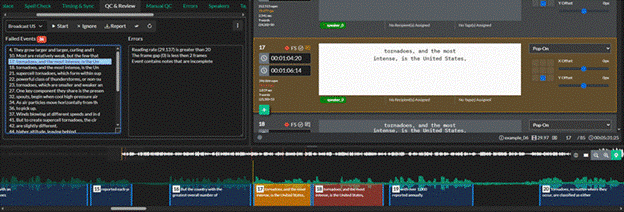
Closed Caption Creator screenshot showing the QC & Review panel and Event Errors for each Subtitle Block.
The broadcast landscape has fundamentally changed. Where broadcasters once managed content for a handful of distribution channels, today’s operations span dozens of platforms, each with unique technical requirements and format specifications. This expansion brings a particularly complex challenge: closed caption quality control.
Modern broadcasters manage exponentially more content across diverse platforms—from traditional broadcast to Netflix, Amazon Prime, YouTube, and emerging FAST channels. Each platform demands specific caption formats (SRT, VTT, TTML, SCC, EBU-STL, PAC), character limits, reading speeds, and timing synchronization rules. When you factor in multilingual content delivery, the complexity multiplies dramatically. A single piece of content might require caption variants for broadcast TV (32 characters per line, 2-line maximum), Netflix (42 characters per line), and YouTube (platform-optimized formatting)—each requiring individual quality control.
The traditional approach of manual QC scaling linearly with content volume and platform count is becoming operationally unsustainable. The work required to QC caption files scales directly as you acquire more content or deliver to more platforms.
Current Approaches and Their Trade-offs
Most broadcasters today employ one of three QC strategies, each with limitations.
The first approach involves basic spot checks on original caption files, trusting they’ll meet requirements across all delivery platforms. While this minimizes upfront QC investment and enables faster delivery, it results in higher failure rates at platform endpoints. Platform rejections delay content availability and often incur redelivery fees.
The second approach requires manual QC for each platform delivery. This ensures higher accuracy and catches platform-specific issues before submission. However, it creates a linear scaling problem where QC work increases with platform count. For a broadcaster delivering to 10 platforms, this means 10 times the QC work—an unsustainable operational model.
The third approach—automated QC with exception handling—breaks this linear scaling pattern by leveraging technology to handle routine quality checks while preserving human expertise for complex problem-solving.
Understanding QC by Exception
QC by Exception represents a fundamental workflow shift where automated systems handle predictable, rule-based quality checks, and human operators intervene only when automated systems detect issues or cannot resolve problems automatically.
This methodology operates on core principles that maximize efficiency: automation handles routine tasks, human expertise focuses on complex problem-solving, clear escalation triggers determine when files require manual review, and continuous improvement uses exception data to refine automated rules.
The workflow benefits are substantial. Organizations typically see 70-90% reduction in routine QC tasks, faster processing times for standard files, consistent application of quality standards, detailed reporting with audit trails, and scalability that handles volume increases.
Technical Implementation with Automated Solutions
Implementing automated caption QC requires robust technical solutions that integrate into existing broadcast workflows. Closed Caption Converter addresses this need through flexible deployment options—available as a CLI tool for on-premise workflows and as an API for cloud-native architectures.
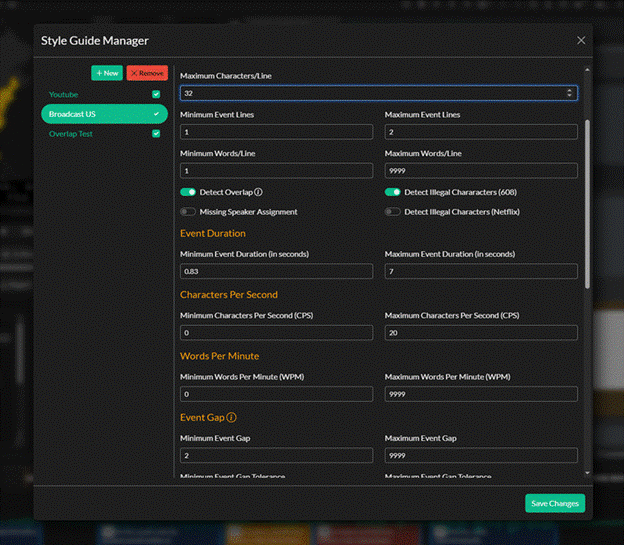
The Style Guide Manager can be used to configure custom style guides for each delivery platform.
The system’s strength lies in its custom style guide configuration options. Users can build platform-specific rule sets that automatically validate caption files against precise requirements. For example, a Netflix style guide might enforce 42 characters per line with 2-line maximums, while a broadcast TV guide ensures FCC compliance with 32-character limits and specific timing requirements. Reading speed validation can be configured for maximum 20 Characters Per Second (CPS) to ensure viewer comprehension.
When files undergo automated QC, the system generates comprehensive reports identifying issues with timestamps, severity classifications (critical, warning, informational), and automated pass/fail determinations. These reports integrate seamlessly into workflow management systems through JSON/XML output formats.
Converter also offers automated correction capabilities through process modules. The Automatic Format module intelligently inserts line breaks to meet character limits while preserving readability. The Automatic Reading Speed module adjusts caption timing to meet CPS requirements while maintaining synchronization with audio/video content.
Files that cannot be automatically corrected are flagged for manual review with clear documentation of attempted fixes and remaining issues, ensuring seamless handoff to subtitle editors.
Integration with Professional Editing Tools
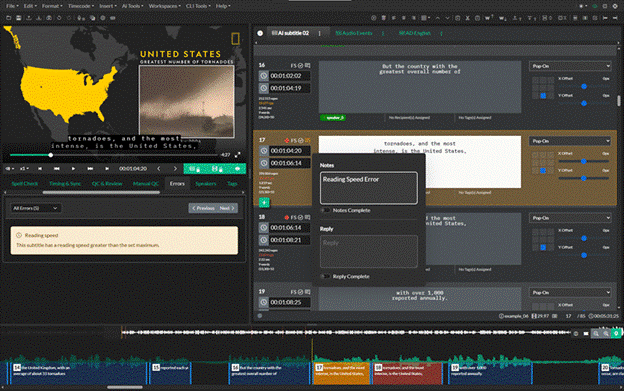
Closed Caption Creator screenshot showing a project currently in Review.
For files requiring manual intervention, integration with professional subtitle editing tools becomes critical. Closed Caption Creator offers multiple integration options designed for modern broadcast workflows.
For organizations requiring programmatic task management, the Work Order API enables automated assignment of correction tasks, integration with work management systems, and automated progress tracking with completion notifications.
Desktop versions remain available for high-volume correction workflows, offering full-featured editing capabilities with advanced timing and formatting tools suitable for complex corrections.
Moving Forward
The broadcast industry’s content complexity will only continue growing. Organizations that implement automated caption QC workflows today position themselves to handle tomorrow’s scale requirements without proportional increases in operational overhead. By embracing QC by Exception methodologies, broadcasters can maintain quality standards while achieving the efficiency necessary to compete in an increasingly complex distribution landscape.
The question isn’t whether to automate caption QC, but how quickly your organization can implement these workflows to stay competitive in the evolving broadcast ecosystem.
Reference Links
www.closedcaptioncreator.com

Nathaniel Deshpande, CEO/Founder Closed Caption Creator