IABM Hosts Industry Initiative Dynamic Software Licensing
Transforming Broadcast Software Licensing and Management

Stan Moote CTO – IABM

Noor Hassan, Worldwide M&E Partner Solutions Architect at AWS
The CFO’s within our industry got all excited about the switch from CapEx to OpEx with the expectation in our everchanging industry of minimizing the risk related to over or under funding CapEx investments, hence providing flexibility. The theory being moving toward software-defined workflows, budgeting for projects on a pay-as-you-go basis would provide improved business flexibility, and implementation of best-of-breed multi-vendor solutions.
The broadcast industry’s adoption of cloud-based and hybrid workflows has highlighted fundamental challenges between traditional licensing models and modern operational requirements. With the transition to software-based and cloud-based technologies, traditional approaches that correlate licenses with hardware create operational friction for system integrators, vendors, and customers.
Customers, system integrators (SIs), and Independent Software Vendors (ISVs) are voicing these challenges and the impact when migrating broadcast and live production workflows to software-based, cloud or hybrid ones.
“Today’s broadcast industry requires flexible, transparent licensing models that empower media companies to experiment, scale, and innovate without friction. This collaborative initiative addresses a critical industry challenge by providing best practices for how broadcast applications are licensed and managed, enabling broadcasters to respond faster to opportunities while focusing on what matters most – creating compelling content for their audiences.” – Steph Lone, Global Leader Solution Architecture for Media, Entertainment, Games & Sports, AWS
Current Industry Pain Points
Broadcasters and media companies face numerous challenges with traditional licensing approaches. The operational complexity of managing hundreds of proprietary licensing systems across multiple vendors creates significant administrative overhead and potential points of failure.
Cost uncertainty presents another major challenge, as organizations face significant difficulties in forecasting and optimizing licensing costs across their operations. Technical barriers further complicate matters, with many licenses being tied to hardware identifiers like MAC addresses or hostnames, manual license setups; all create bottlenecks in accelerating software-based deployments. Security is a top concern that must also be considered especially with distributed, hybrid systems.
Back in the day, we all designed around having redundant systems, or at least some type of planned disaster recovery. With software licenses, a continuous audit is required to ensure the license doesn’t expire at an in-opportune time – not really practical! Not unlike in the total hardware days, the SI’s and the hardware suppliers ultimately come under fire when operations cease to work. It is issues like this that the industry is still in build and license for peak mode, rather than taking advantage of shared resources.
The Dynamic Software Licensing Initiative
Reviewing IABM members in the vendor community showed there is no common approach to licensing within the industry, so the Dynamic Software Licensing (DSL) initiative began. This initiative is a collaborative approach aimed at developing a framework of best practices for broadcast software licensing in cloud and hybrid workflows. AWS, System Integrators, vendors, and customers are working together to address current licensing challenges and propose practical recommendations to streamline software application licensing and management.
Core Principles
1. API-First Approach
The initiative implements common APIs for comprehensive license operations across platforms. These APIs provide robust support for automation and programmatic management of licensing workflows. The architecture ensures seamless integration with infrastructure as code tools, enabling modern DevOps practices.
2. Security by Design
Security needs to be built upon a zero-trust architecture framework, addressing various layers of the workflow, from access control and minimum permissions, to license key encryptions
- Flexible Consumption ModelsThe system supports dimension-based licensing, where dimensions are parameters defined by vendors for their respective applications, including time-based, feature-based, and usage-based models. The architecture is designed to fully support hybrid deployments, allowing seamless operation across on-premises and cloud environments.
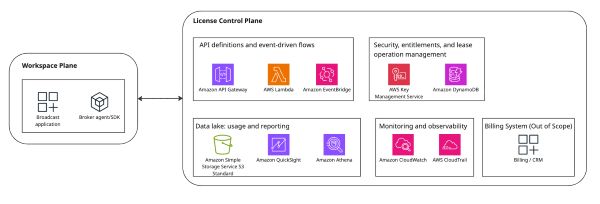
Proposed Technical Architecture
License Control Plane
The license control plane provides centralized management of entitlements and policies, ensuring consistent license governance. It includes comprehensive usage metering and analytics capabilities for monitoring and optimization. Security and authentication services are integrated at the core level. A common API gateway facilitates uniform access across all licensing operations.
Workspace Plane
Within the workspace plane, local license validation ensures continued operation even during network interruptions. The system supports robust offline operation capability for environments with limited connectivity. Comprehensive usage tracking provides detailed insights into license utilization. License renewal is handled through automated processes, reducing manual intervention.
Benefits to the Ecosystem
For Broadcasters and Media Companies
Broadcasters benefit from predictable operational costs through flexible and efficient licensing models and management. The system enables faster deployment capabilities, reducing time to air. Disaster recovery is enhanced through flexible license mobility. Security controls are improved through modern authentication and authorization mechanisms. Usage visibility provides clear insights into license utilization. The system offers comprehensive support for hybrid workflows, enabling flexible operations.
For Software Vendors
Vendors can implement flexible licensing models adapting to various customer needs. With automated operations and API-first approach, vendors reduce operations overhead and provide improved time-to-value for their customers.
For System Integrators
For system integrators, the complexities of licensing processes are reduced through common interfaces and APIs. This provides a more streamlined experience for their end customers, especially for multi-vendor deployments. Additionally, systems become more easily scalable and repeatable across different customers and scenarios as involved vendors use common best practices.
Looking Forward
The Dynamic Software Licensing (DSL) initiative represents a shift in how broadcast software is licensed and managed. As the industry continues its digital transformation, DSL provides the foundation for more flexible, secure, and efficient licensing operations.
Conclusion
Dynamic Software Licensing addresses a critical industry need at a crucial time in the broadcast industry’s evolution. By providing a common, secure, and flexible approach to software licensing, it enables broadcasters and vendors to embrace the benefits of cloud and hybrid workflows while maintaining operational and financial efficiencies.
Tom de Brouwer, Principal Architect, from Merapar summed this up: “We want to change the conversation from ‘what do we own?’ to ‘what can we achieve?’ This cloud-native licensing proposal is the mechanism that enables that shift, turning a static asset into a dynamic service that can respond to an opportunity in minutes, not in months.”
“Cloud-native licensing is not just a technical shift – it’s a strategic enabler for the media industry’s digital transformation. By aligning business models with modern cloud architectures, we open the door to scalable innovation and lasting partnerships.”
— Thomas Pister, VP Solutions, LOGIC media solutions GmbH
IABM members are driving this initiative, and its success will depend on continued industry collaboration and commitment to developing and accepting a common best practice towards licensing.