Limecraft – Smooth Operations – Environmental Sustainability thrives on Operational Excellence
Maarten Verwaest, Limecraft
Across Europe, the conversation about environmental sustainability in the media industry is no longer superficial. It is grounded in measurable data, and in an urgent need to address the footprint of the content we create. BAFTA Albert reports (https://wearealbert.org/wp-content/uploads/2025/11/ACCELERATE-2025-BAFTA-albert-report.pdf) that one hour of UK-produced television generates an average of 16.6 tCO₂e, with scripted drama rising to 48.7 tCO₂e per hour—the highest of all genres. These numbers serve as a reliable benchmark for understanding the wider European landscape.
According to the European Audiovisual Observatory, around 1,800 European producers deliver 16,000 hours of scripted fiction each year. Applying the drama benchmark of 48.7 tCO₂e per hour, Europe’s scripted sector alone is responsible for approximately 800,000 tonnes of CO₂ annually. Fiction, although a relatively small part of the total volume, carries a disproportionate share of the environmental load.
To understand the full picture, we need to look beyond scripted content. Europe produces an estimated 200,000 hours of television across all genres each year. When we apply the multi-genre average of 16.6 tCO₂e per hour, the combined footprint for European TV production is over 3 million tonnes of CO₂ per year, with scripted accounting for almost one-third of the total impact.
These figures highlight two important realities. First, production itself remains the dominant source of emissions, led by travel, location work, and energy-intensive studio operations. Second, while post-production contributes a smaller share of 15%-30% depending on the genre, the Limecraft sustainability analysis shows that unnecessary file movement, repeated transcoding, and fragmented toolchains add a significant amount of avoidable energy use.
If the industry wants to reduce its environmental footprint at scale, the opportunity is clear: simplify the supply chain and eliminate needless digital inefficiencies, minimize file transfers and use cold storage as much as possible, and use AI responsibly. Even modest operational improvements become significant when multiplied by nearly two hundred thousand hours of content each year.
Building a More Sustainable and Reliable Production Workflow
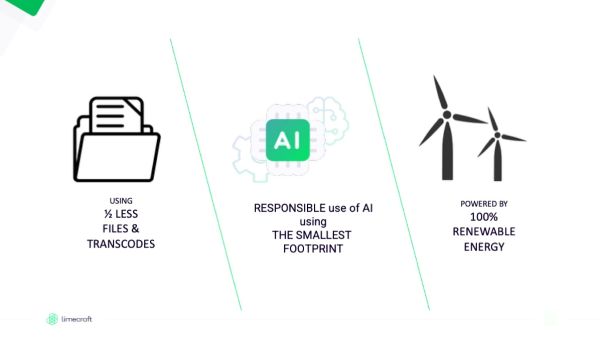
To reduce the industry’s environmental footprint at scale, producers need to be mindful about each step that can simplify operations and eliminate waste. Much of the inefficiency during production and post-production stems from unnecessary complexity: too many tools, too many copies, and too many file movements. By adopting a cleaner and more unified approach to workflow design, producers can cut emissions while improving reliability, turnaround times, and operational stability. The following best practices provide a starting point.
Simplify the Supply Chain and Eliminate Digital Inefficiencies
Many productions rightfully adopt the “3-2-1” strategy—three copies, two technologies, one offsite. While the principle is sound, the way it is implemented often leads to sprawling workflows with overlapping tools and duplicate processes. This becomes especially problematic when multiple companies collaborate on the same production.
Instead of shipping high-resolution media between parties, producers should use a proxy-based workflow as the default. As shown across several Limecraft case studies, proxies maintain creative visibility without the hassle and the cost incurred by moving hundreds of terabytes across facilities or the cloud. A simplified, shared supply chain cuts file transfers and turn around time, it reduces human error, and makes collaboration far more efficient.
Minimize Copies, Transcodes, and File Transfers
Every extra tool in the tech stack introduces another conversion, another export, and another transfer. Internal review, external review, editing, subtitling, and delivery are often handled by separate systems even though they rely on the same underlying media. An integrated collaboration platform removes these unnecessary layers.
When review, logging, transcription, subtitling, and post-production all happen in a single environment, the result is fewer ancillary copies and a considerable improvement of the security perimeter. Reducing these hops not only saves energy—it avoids waiting time and improves overall reliability.
Use Cold Storage as a Primary Tier
Rather than manifesting high-resolution files on SSD or spinning disks—or transferring entire repositories into cloud storage—post-production supervisors should consider cold storage as the primary tier.
Cold storage offers the lowest environmental impact, it is quasi impossible to hack, and it is surprisingly effective when disclosed via a proxy-based workflows. Producers can access and work with material as easily as online storage, while keeping the high-resolution originals offline until absolutely needed. Case studies like Onze Natuur (https://www.limecraft.com/cases/hotel-hungaria-onze-natuur/) show that this approach cuts cost, reduces risk, and avoids the energy waste of keeping large volumes of media permanently “warm.”
Use AI Responsibly
AI now consumes a meaningful and increasing share of the operational budget, yet many productions use it for tasks that could be solved more efficiently by using existing upstream metadata.
Instead of applying heavy AI models to “interpret” images, producers should leverage planning documents, production reports, script notes, and casting data already generated during filming. This improves accuracy, reduces processing load, structurally avoids privacy breaches, and minimizes emissions associated with compute-intensive AI pipelines.
Summary
By designing a tech stack that is as simple as possible – but not one bit simpler – producers gain both sustainability and reliability. A reduced number of tools means fewer failure points. A proxy-based workflow minimizes storage and transfer needs. Using existing metadata instead of AI improves accuracy and increases the chances of long-term reuse. Small changes compound across the nearly 200,000 hours of television produced each year in Europe—and they represent one of the fastest, most achievable paths toward a more sustainable media industry.