Wohler Technologies – The Monitoring Plane

Wohler Technologies have been creating products and technologies for monitoring of broadcast signals for 40+ years now. We listen to our customers and innovate on their behalf to help solve their problems. In our recent conversations with customers, they guided us to provide them with “monitoring solutions” rather than singular monitoring products. Based on our research we propose the notion of a “The Monitoring Plane”.
With the evolution of infrastructure, broadcast facilities are now starting to resemble a mix between traditional broadcast and IT infrastructure. The advent of IP technologies like ST 2110 and AoIP like AES67, Dante and Ravenna, coupled with software centric signal processing both on-premise as well as in the Cloud is accelerating this trend.
The “Data Plane”:
Broadcast facilities started with Analog Audio and Composite Video technologies, that were complemented over time with digital baseband signals like 3G SDI for high-definition video and 16 channels of PCM audio, coupled with formats like MADI and AES3. That evolution has now entered the packetized transport-over-IP era, with the introduction of ST2110, ST2022-6/7 and AoIP technologies. While there is a transition towards use of the newer IP technologies, baseband continues to coexist. From a high-level perspective, the fabric through which signals flow could be identified as a “heterogeneous Data Plane”,
The “Control Plane”:
This complex fabric of “data” (signal) transport across broadcast facilities has at its core, switchers, peripherals, encoders and decoders that process signals pre or post switching. This core is now also evolving with IP technologies, enabling the use of tools that achieve routing and control in software hosted locally or in the Cloud.
Software applications hosted in the Cloud require signals to be uplinked into the Cloud for processing and potentially downlinked back to on-premise locations prior to distribution. Orchestration, switching and processing functions across these workflows, with data flows across the Data Plane could broadly be viewed as the “Control Plane”.
This perspective suggests the need to define a “Monitoring Plane”.
What is “The Monitoring Plane”?
In order to get a better understanding, it would be useful to view the data fabric and various points across that fabric that need to be monitored as “the monitoring plane”.
The Monitoring Plane perspective helps us realize a well-defined and structured approach that is valuable in designing a system that caters to the needs of operators, managers and executives in the broadcast industry, enabling them to meet KPA’s and related predetermined standards for QOS and QOE.
What are attributes of The Monitoring Plane?
“The Monitoring Plane” on the lines of “Control” and “Data” planes, needs a set of attributes to be effective. We separate monitoring into the two broad areas: “signals to monitor”, and “unified operator interfaces for monitoring”. The following attributes help define The Monitoring Plane:
- Signal Agnostic: Visual representation of monitored signals should be consistent and independent of signal type, baseband or IP, compressed or uncompressed.
- Location Agnostic: Data flow can span local facilities, remote trucks (OBV’s), Cloud infrastructure and also on-premise equipment. Ideally The Monitoring Plane should be able to provide monitoring independent of signal or operator location.
- Consistent Media Analysis: View video and listen to audio signals being monitored across a heterogenous fabric in a predictable way, focusing attention on the signal being monitored rather than specific monitoring tools and mapping signals across those tools to obtain a consistent view.
- Audio Loudness: Monitor parameters like audio loudness across signal types. Provide a visual representation of audio loudness to diagnose audio level problems signals across varying underlying data fabrics, and potentially across broadcasters and service providers, as they link signals with each other as the occasion may demand.
- Signal Metadata: Visual representation of signal metadata. This might mean video and audio format, CC information in the VANC section of an SDI signal, or IP packet losses and delays for a ST2110 signal.
- Automated Alerting: Move in the direction of “monitoring-by-exception”, drawing operator attention towards monitoring only when there is an exception that demands their attention.
- Vendor Agnostic: Use open industry standards to monitor signals, without having to resort to vendor specific applications, avoiding vendor lock-in.
- Open Standards: The Monitoring Plane is not something that any single industry vendor can hope to solve single handedly. It is therefore important to collaborate across vendors and solution providers, with a shared goal of solving customer problems.
Wohler’s Approach:
Having done some groundwork researching the problem, we implemented the generalized set of attributes described above, as a starting point.
MAVRIC: Advanced Cloud-based Remote Monitoring
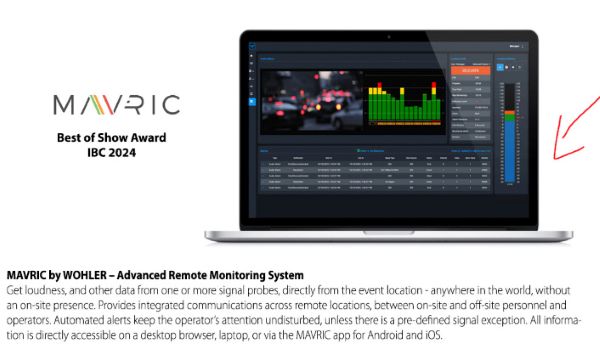
Wohler recently launched “MAVRIC”, which is an abbreviation for “Multichannel, Audio and Video Remote Indication and Control”. MAVRIC was awarded the “Best of Show” at IBC 2024, as a recognition of the fact that it breaks new ground in the area of broadcast signal monitoring.
MAVRIC provides for three core function, Remote Monitoring, Automated Alerting and Integrated Conferencing. MAVRIC uses a simple architecture, where our in-rack gear supplemented by openGear monitor-on-a-card hardware are used to realize “probes”. These “probes” connect into our Cloud-based remote monitoring application that is accessed using a standard web browser. Probes stream encoded audio and video into the Cloud, enabling operators to see live video and listen to audio from the probes from anywhere in the world. Probes can also be configured to trigger alerts upon occurrence of predetermined error conditions in the monitored signals. Media streaming infrastructure for MAVRIC can be deployed on-premise, should the customer require media signals to remain in-network.
An Android/iOS mobile app supplements MAVRIC. Alerts for preconfigured conditions are paged to the mobile app, helping customers realize a true “monitoring-by-exception” paradigm. The mobile app also includes a built in “conferencing” function so operator groups can connect “in-context” to resolve problems as they occur. The system is secure, configurable and horizontally scalable to grow as per customer requirements.
NEW. MPEG SRT Monitoring.
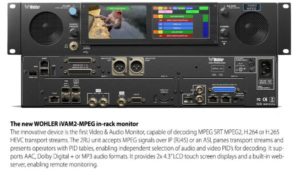
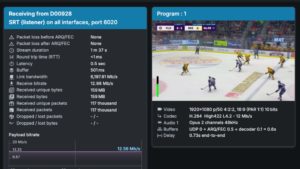
Complementing our baseband and IP products is the new iVAM2-MPEG hardware monitor launching at IBC2025, providing MPEG SRT, H.264, HEVC (H.265) with AAC, Dolby Digital+ and MP3 audio monitoring.