TAG Video Systems – Efficiency Meets Sustainability in Broadcast Workflows

Paul Schiller, Product Marketing Manager, TAG Video Systems
As broadcast and media operations scale to meet growing demand across live, playout, and OTT workflows, the pressure to do more with less has never been greater. Not just from a business perspective, but from a sustainability one. With regulations like the Corporate Sustainability Reporting Directive (CSRD) expanding in scope, energy use, emissions, and even supply chain accountability are becoming operational concerns, not just compliance checkboxes.
The good news is that many of the same strategies that drive efficiency also drive sustainability. When workflows are built around resource optimization, energy savings follow. The challenge is applying this thinking across complex and often fragmented operational environments.
Staying Ahead of Change
Efficiency often begins by reducing operational complexity and the technical debt associated with dedicated, single-purpose hardware. In an era of rapid technological change, specialized broadcast equipment can quickly become obsolete, leading to hardware sprawl and wasted resources. By adopting software-defined monitoring and visualization on agile, COTS/Cloud-based infrastructure, broadcasters can replace rigid hardware with more adaptable, scalable alternatives. In practice, this involves centralized monitoring across multiple locations, with reduced reliance on siloed, fixed-function equipment that often sits idle.

This shift to multi-purpose infrastructure also creates a greater potential for long-term resource reduction. The pace of innovation for COTS hardware—like servers, GPUs, and network cards—is driven by massive R&D investments from the broader IT industry, far exceeding what is typical in the relatively niche broadcast market. As a result, media companies can leverage this rapid innovation cycle, regularly upgrading their hardware to benefit from new generations of chips and components that offer significantly more processing power and efficiency for less cost. This allows them to achieve more with a smaller physical and energy footprint over time, directly translating technical advancements into tangible sustainability gains.
Cloud Efficiency Driving Sustainability
Remote and cloud-based production, fast-tracked by the pandemic and now maturing, have brought these practices into sharper focus. By decoupling personnel from physical equipment, broadcasters reduce travel, on-site energy use, and the need for permanent control rooms at every venue. Workflows that once required OB trucks and redundant infrastructure can now be spun up in the cloud. Some industry benchmarks show that this trend has cut technical infrastructure requirements by up to 70%, delivering meaningful savings in both cost and carbon footprints.
Even modest reductions in physical presence, such as avoiding a truck roll for minor configuration changes, can add up across hundreds of live events annually. That translates to measurable reductions in emissions and fuel costs, while enabling a faster response time from geographically dispersed teams.
Hybrid cloud models further support this migration, allowing permanent control to stay on-prem while using the cloud for overflow capacity. By spinning up resources only when needed, broadcasters align OPEX to demand while also reducing always-on energy demands. This flexibility also helps with emission tracking across broader categories, like employee travel, office utilities, or cloud compute cycles, aligning with CSRD requirements for supply chain visibility.
Smarter Monitoring, Lower Footprint
However, sustainability isn’t solely related to the location of primary operations or workloads. It’s about how they’re monitored, visualized, and managed.
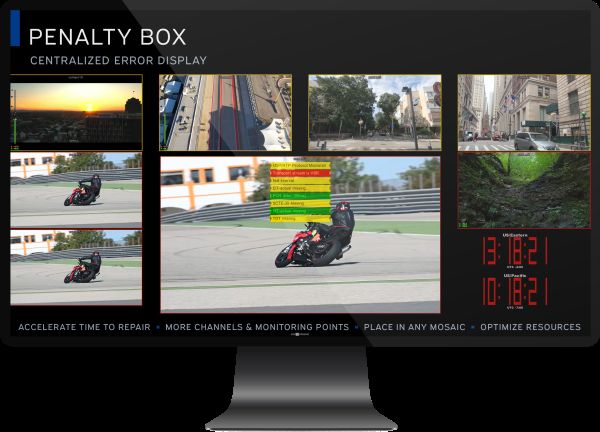
Traditional monitoring typically relies on large multiviewer walls consuming power, whether or not issues arise. More innovative platforms flip this model with features like ‘monitoring by exception,’ refocusing operators from watching everything to alerting them, or their engineering counterparts, only when something needs attention. Features like the TAG Penalty Box and Adaptive Monitoring (Decoding at greater intervals) display only the streams that trigger defined notification thresholds, allowing hundreds or thousands of channels to be monitored with smaller multiviewer display walls, less compute, and reduced energy use.
In environments like master control rooms (MCRs) or network operations centers (NOCs), this approach keeps the number of required displays and processing resources to a minimum, even as stream counts grow. This helps broadcasters avoid scaling “eyes on glass” in proportion to their content volume, supporting both operational efficiency and energy-conscious practices.
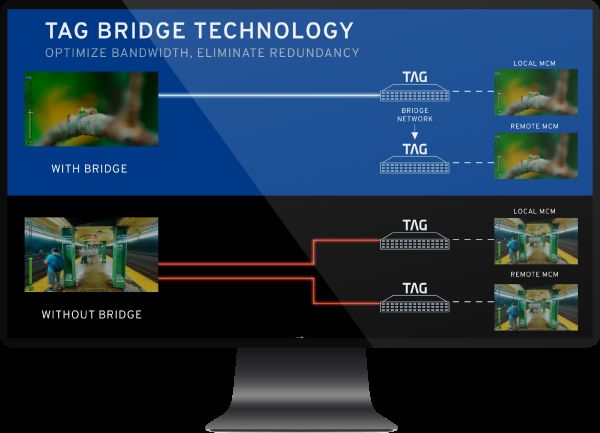
Reducing unnecessary use of bandwidth and compute resources is another practical step toward greater efficiency. Monitoring platforms that support single-ingest workflows, receiving a signal once, including video, audio, and metadata, allow operators to route that signal across multiple locations and teams without additional decoding. This avoids duplicate processing, minimizes resource usage, and supports scalable monitoring without increasing power usage or hardware requirements.
Instead of decoding the same feed at every site or for every team, signals are received once and adapted to the needs of each location. This is especially beneficial in distributed environments where engineering and production teams are located across time zones, regions, or cloud zones. Signal routing becomes streamlined, while infrastructure duplication is avoided.
Software Licensing Models That Adapt
Flexible licensing also plays a role. OPEX-aligned models help teams avoid overprovisioning by allowing resources to scale up or down on demand. This minimizes idle capacity, reduces hardware sprawl, and makes it easier to share resources across departments or remote teams.
In global operations, this adaptability reduces the need to deploy fixed infrastructure in every market. Teams working in one region can spin up the necessary resources temporarily, then hand off to colleagues in another location without duplicating compute or monitoring systems. Less hardware means less power and fewer capital-intensive decisions.
When combined with orchestration, this dynamic licensing facilitates real-time scaling while maintaining low operational overhead. More importantly, it allows technology teams to concentrate on delivering high-quality service without increasing their energy footprint.
Conclusion
In combination, these approaches reflect a shift toward smarter, more intentional workflow designs. Efficiency and sustainability should no longer be viewed as separate initiatives; instead, they should be considered as aligned outcomes of the same operational choices. By adopting software-based, cloud-enabled, and resource-aware practices, broadcasters can meet today’s performance requirements while actively reducing their environmental impact.
As regulatory pressure increases and energy demands continue to rise, the opportunity lies in building workflows that adapt, not just in speed and scale, but in responsibility. Efficiency enables sustainability. Sustainability supports resilience. And both are achievable now.