Accedo – ECOFLOW Phase 2

François Polarczyk, Sustainability Director, Accedo
Some readers may remember the ECOFLOW project (Energy-Conserving Optimization for Future-ready, Low-impact Online Workflows) that featured in the IABM Journal last November. The project, part of the IBC2024 Accelerator Programme, co-led by Accedo and Humans Not Robots, in partnership with BBC, ITV, Bitmovin, RTL Netherland, Quanteec, Cognizant, the IET, Fraunhofer Fokus, Greening of Streaming, DIMPACT and the EBU, set out to understand energy use of key components in the streaming value chain and see how they react under different conditions. It delivered groundbreaking findings around the energy usage of end-user devices and demonstrated proof-of-concept optimizations.
It was also invaluable in highlighting the state of play, and acted as a reminder of how much we still don’t know. The second phase of the project, ECOFLOW II, is now underway as part of the IBC Accelerator Programme. It builds on the success of last year’s project, with a sharper focus on data visibility and real-world engagement.
Building on a Solid Foundation
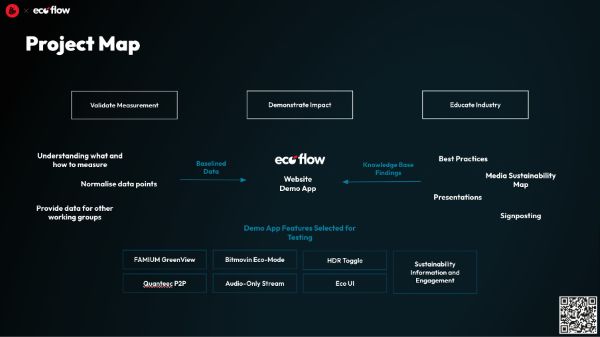
A key finding from the first phase of the ECOFLOW project was that to achieve a comprehensive understanding of environmental impact, there needs to be active participation across the entire value chain. However, unsurprisingly, getting this involvement and obtaining the required data from suppliers proved to be a real challenge. Additionally, the project highlighted that, despite increased pressure to operate more sustainably, teams are still not acting because all too often they lack the tools, insight, or right incentives. ECOFLOW II aims to develop data-driven models, tools and strategies to help businesses make more informed decisions that align with both sustainability and wider business goals.
While last year’s project focused on measuring energy consumption of end-user devices under different conditions, this phase focuses on how distribution networks impact overall energy use. It homes in on data transparency and real-world application, with ITV, Channel 4, HNR, and the IET each taking the lead on workstreams that will attempt to bridge the gap between abstract sustainability targets and operational decisions made every day by product teams. To achieve this, the project will create a digital twin that models streaming pipelines, enabling scenario-based testing even when real data is scarce. ECOFLOW II aims to build a foundation for decision-making rooted in evidence, not guesswork. Greening of Streaming and Quanteec have provided some fresh P2P client data measured during a dedicated hackathon.
Shining a Light
The streaming value chain is complex, stretching across multiple vendors, suppliers and platforms. All too often energy measurement is inconsistent or even non-existent. As a result, one of the biggest hurdles is understanding where the energy goes. Viewers click play, data moves across networks, servers spin up, encoders jump into action, and all the while, there’s very little understanding or agreement on how much energy is being used at each point in the chain.

What ECOFLOW is attempting is ambitious, aiming to provide some clear answers where there is a distinct absence of real-world data. The team learnt a number of lessons from phase 1 regarding availability and qualification of data. This has been taken into phase 2, where the main need is to secure any forms of data, but to qualify whether that data is of low, medium or high confidence. By creating a digital twin of the streaming workflow, the project hopes to simulate energy use across different parts of the chain, from origin servers to consumer devices. The intention is that by creating a controlled, real-world data-informed model, the industry will gain insights even in the absence of complete real-world data. We are also seeing this as a continuous programme of work where data quality improvements continue the evolution of the model and digital twins, towards better and more accurate representations of reality.
This approach isn’t without its challenges. Many vendors remain reluctant to disclose data, possibly because it could reveal inefficiencies or competitive disadvantages. While ECOFLOW II doesn’t have the power to force companies to provide the required data, it does hope to nudge the industry in the right direction.
Another significant aspect of this phase involves exploring mechanisms that foster participation and openness, including tools, templates, and shared frameworks that facilitate easier measurement and comparison. There are plans to introduce AI-powered visualizations to make energy use more comprehensible, especially for teams not immersed in technical detail. The idea is to give everyone, from engineers to executives, a clearer sense of the impact of their decisions.
A Business Case for Sustainability
It’s easy to position sustainability as a moral imperative, but that isn’t always effective. One of ECOFLOW II’s core goals is to reframe the conversation to not just be about reducing emissions, but rather also strategic alignment and creating business opportunities.
This is why the project is working directly with product and platform teams. By embedding sustainability considerations into day-to-day development choices, it becomes less of an external demand and more built-in. We aim to create a set of business cases backed by real data, as in: here’s how much energy this feature or decision saves; how it impacts cost; and how it aligns with the company’s wider goals.
Flipping the conversation round in this way turns sustainability from an abstract concept into something tangible and achievable that aligns with business objectives. A reduction in data transfer might mean lower CDN bills, smarter caching could ease infrastructure strain, and intelligent encoding could reduce storage and delivery costs. Companies are already making these types of decisions, often with limited insight into the full picture. ECOFLOW will help supply the missing data and evolve the data and model moving forward as and when better data is obtained. This is all focused on allowing better decisions to be made in the sustainability design of all media workflows and services.
When we started the ECOFLOW project last year, we wanted to help the industry understand and reduce the impact that streaming has on the environment. That’s not something that can be completed in a matter of months, but rather takes time, and we’re now seeing some real momentum, getting us a step closer to that goal.