Regional Research: North America
April 2020
Introduction
IABM Business Intelligence (BI) Regional Reports provide IABM members with insight into the latest broadcast and media industry developments for a specific region. Over the course of each year, these reports build into a full overview of all the major regional markets around the world.
Report Contents and Structure
The analysis is undertaken by our Head of Insight and Analysis, Lorenzo Zanni and Principal Analyst, Riikka Koponen. The report includes the latest news and research findings across a variety of topics, including:
- Business Environment
- Broadcast and Media Technology Industry
- Media Technology Demand Drivers
This edition of the BI Regional Report will include a focus on North America.
The current, global outbreak of the new coronavirus (COVID-19) is causing exceptionally high uncertainty in the global economy, resulting in unpredictable fluctuations in stock markets worldwide as well as high volatility in global energy prices. At the same time, many industries are suffering from delays in production and component supplies, particularly from China. Hence, the figures and statistics presented in this report are subject to significant changes due to the rapidly changing conditions in different countries hit by the new coronavirus.
Business Environment
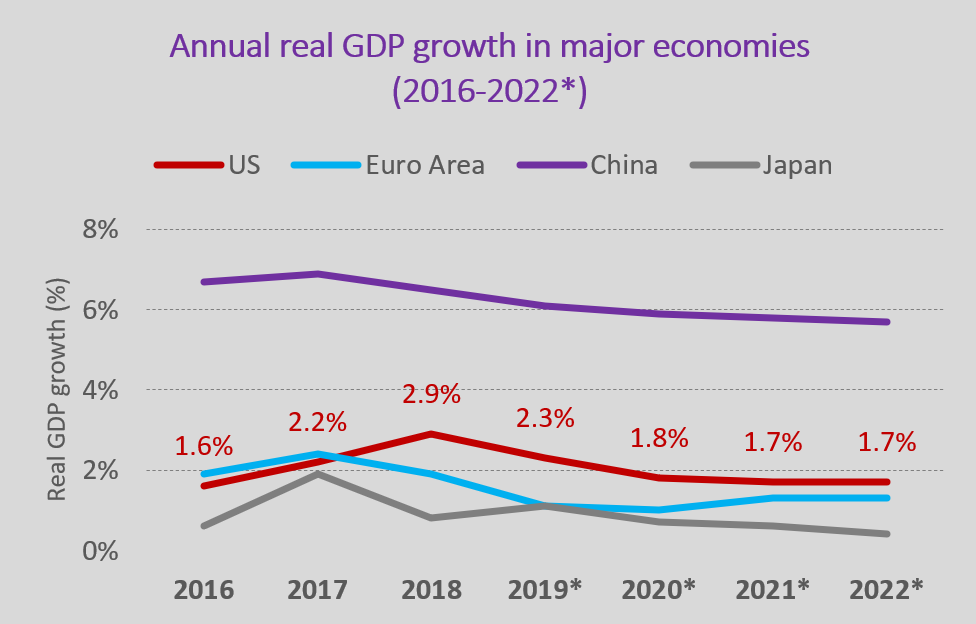
- Economic growth in the US was 2.3% in 2019, down from 2.9% in 2018, reflecting uncertainty among U.S businesses and consumers created by the trade dispute with China, according to the World Bank
- Conversely, the Dow Jones Index reached record highs in 2019 and the unemployment rate fell to a 50-year low (3.5%) in 2019. Hence, the labor market is expected to remain robust bolstering consumption in 2020
- During 2018 and 2019, the US administration raised tariffs worth over US$300 billion, affecting imports, mostly from China
- In January 2020, China and the US signed a preliminary deal (i.e. “Phase one”), but as the negotiations concerning the most contentious issues are on-going, the possibility of an escalating trade war remains elevated. The World Bank has estimated that even the easing of trade tensions between the two countries is unlikely to lead to any rapid improvement in the global economy
- In 2019, the price of Brent crude oil – the international benchmark – averaged US$64 per barrel (bbl), being US$7 bbl lower than in 2018. This was mainly due to increases in the US’ petroleum production, which put downward pressure on crude oil prices
- In October 2019, the Fed cut interest rates for the third time in the course of the year, reversing nearly all of 2018’s rate increases. Such a stimulus reflects significant uncertainty prevailing in the US economy
- The US dollar index remained stable – and high – in 2019; in December, on the last trading day of the year, the index recorded its smallest-ever annual move, being up by only 0.24% for the year
Broadcast and Media Industry
- With 121 million TV households in the US, North America constitutes one of the largest markets for broadcast and media technology products and services
- The broadcast industry in North America has now stepped into an “OTT 2.0” era, where media companies are reshaping their business models toward direct-to-consumer (DTC)
- The until-now solid business model of cable and satellite networks is being increasingly disrupted by competition from OTT operators such as Netflix and Amazon – and recently-launched streaming services like Disney+ and Apple TV+
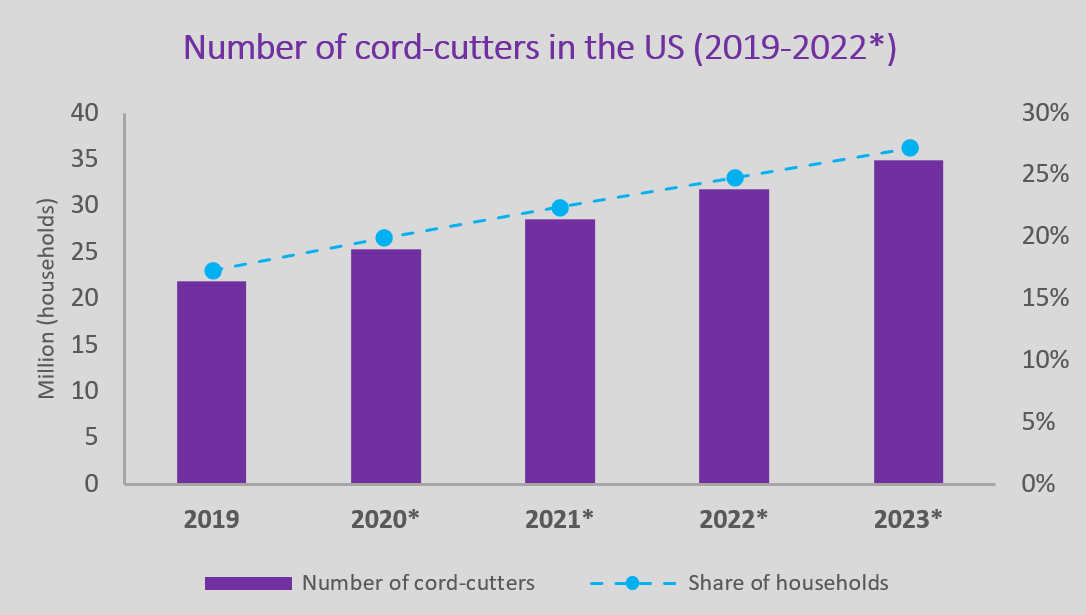
- The number of American homes without Pay-TV will increase from 21.9 million in 2019 to 34.9 million in 2023 as a result of further cord-cutting
- Pay-TV revenues are dropping in line with cord-cutting; in the US, revenues are projected to drop from US$94.4 billion in 2019 to US$84 billion by 2024
- North American companies are increasingly investing in emerging technologies such as the cloud, AI and IP to achieve greater efficiencies and agility
Media Technology Demand Drivers
- The transition to digital broadcasting has almost reached maturity and therefore does not represent a significant driver of broadcast and media technology spending
- Today, HD equipment has been adopted by 90% of TV households in the US. However, 4K/UHD TVs are rapidly replacing HDTVs
- Transition to the new ATSC 3.0 terrestrial standard system that will provide broadcasters with additional spectrum efficiency, bringing improved picture and audio quality as well as the ability for broadcasters to collect data about their viewers and use targeted ads
- Most use cases of UHD have focused on live sports broadcasting
- Competition in the OTT space continues to intensify as media companies – new and more traditional ones – race to launch their own direct-to-consumer offerings:
- Disney+ and Apple TV+ launched in Q4/2019
- AT&T will launch AT&T TV in Q1/2020
- AT&T-owned WarnerMedia will launch HBO Max in Q2/2020
- Comcast-owned NBCUniversal will launch Peacock in Q2/2020
- The OTT landscape in North America is still dominated by Netflix and Amazon, but as their growth in the domestic market has slowed down, the giants are increasingly focusing on new markets like India, Latin America and Europe
- In the US, private industry is leading 5G development and American telecoms competing against each other have been the first in the world to offer 5G services commercially
Economic growth in the US was 2.3% in 2019, down from 2.9% in 2018, reflecting uncertainty among U.S businesses and consumers created by the trade dispute with China, according to the World Bank. However, these figures contrast with the Dow Jones Index – reaching record highs in 2019 – as well as the unemployment rate, which fell to a 50-year low (3.5%) in 2019. Hence, the labor market is expected to remain robust bolstering consumption in 2020.
Source: World Bank
In contrast with the optimistic sentiment of 2017, the years of 2018 and 2019 were characterized by increased political uncertainty. At the beginning of 2018, President Trump announced that the US government would impose tariffs on imported steel (25%) and aluminum (10%). Since then, the US administration has raised tariffs on about US$360bn of goods, affecting imports mostly from China. As a response, China has imposed counter-tariffs on about US$100bn worth of US products. In January 2020, China and the US signed a preliminary deal (i.e. “Phase one”), but as the negotiations concerning the most contentious issues are still on-going, the possibility of an escalating trade war remains elevated. Under the first phase deal signed in January, China has pledged to increase its imports of US products by $200bn above 2017 levels and promised to strengthen intellectual property rights. In turn, the US agreed to halve some of the latest tariffs it imposed on China in 2019. However, in January 2020, the World Bank estimated that even the easing of trade tensions between the two countries is unlikely to lead to any rapid improvement in the global economy.
In the US, the prevailing uncertainty will likely have a negative impact on companies’ investment activity; the country’s real GDP growth is expected to decline to 1.8% in 2020 and to an average of 1.7% in 2021-22. Moreover, the World Bank expects China’s growth rate to fall below 6% this year for the first time since 1990 because of trade disputes with the US – and the recent outbreak of a new coronavirus.
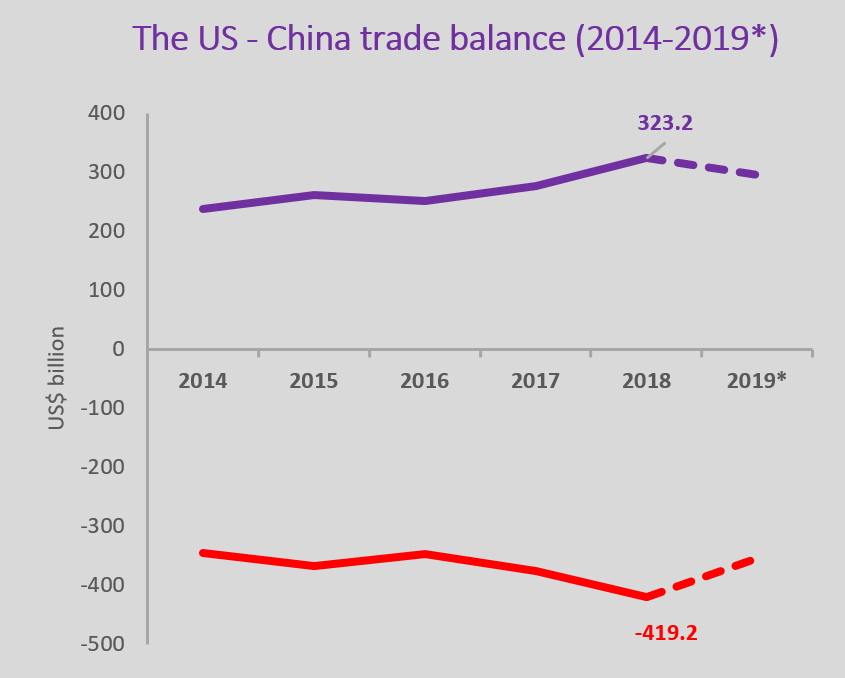
Initially, the trade dispute between the two countries broke out due to Trump Administration’s dissatisfaction with the US’ trade deficit with China, which had grown from US$315 billion in 2012 to US$419 billion in 2018. As of October 2019, the US’ trade deficit with China was down by approximately 15% compared to the previous year as a result of the new tariffs imposed by the US in 2019.
As of January 2020, the biggest categories of US imports from China were computers and accessories, cell phones, apparel and footwear, according to the US Census Bureau. Therefore, the trade war is particularly harmful for those US manufacturers who send raw materials to China for low-cost assembly, because once these items are shipped back to the US, they are generally considered imports – being subject to tariffs imposed by the US.
Source: US Census Bureau, China Customs
In 2019, the price of Brent crude oil – the international benchmark – averaged US$64 per barrel (bbl), being US$7 bbl lower than in 2018. This was mainly due to increases in the US’ petroleum production, which put downward pressure on global crude oil prices. According to several industry experts, the US’ production increases likely limited the effect on oil prices of the attack on key energy installations in Saudi Arabia in September 2019, production cut announcements from the OPEC and the US’ sanctions on Venezuela and Iran (limiting crude oil exports from these countries). Accordingly, throughout 2019, global crude oil prices traded within a relatively narrow price range compared with recent years. In 2020, the US Energy Information Administration (EIA) expects Brent spot prices to average US$61 per barrel – slightly down from the US$64 per barrel in 2019 – due to rising global oil inventories, which continue to accumulate as a result of strong oil production in the US, Canada and Brazil, lower demand for oil globally and weak compliance by some OPEC+ countries (e.g. Russia). Even though crude oil prices temporarily increased in January 2020 following the US military operations in Iraq and Iran, industry experts project global oversupply to keep the benchmark price at a lower level until 2021.
Heightened trade tensions and weakened demand from China had a negative impact on other commodities; nearly all major commodity price indexes fell at the end of 2019. According to the World Bank, metals’ prices fell by 5% in 2019, reflecting a slowdown in global manufacturing activity and supply concerns for some metals due to prolonged trade negotiations between China and the US. In contrast to other commodities, prices of precious metals (e.g. gold) rose by 8% in 2019, following the Federal Reserve’s easing of monetary policy and strong physical demand for precious metals in the context of heightened global uncertainty. Price forecasts for most major agricultural commodities have been revised modestly downwards amid the trade tensions between the US and China.
According to the U.S. Bureau of Labor Statistics, the unemployment rate fell to a 50-year low 3.5% in September 2019. This was clearly down from the annual average of 3.9% in 2018. In December 2019 alone, total employment rose by 145,000 people driven by the retail trade and health care sectors.

Source: U.S. Bureau of Labor Statistics
Marking the new era of tighter monetary policy following a decade of stimulus after the financial crisis in 2008, the Fed stopped its Quantitative Easting (QE) program – a mixture of low interest rates and expansionary stimulus program – and raised interest rates four times in 2018. In general, the hike in interest rates reflects the confidence in increased growth for the US economy. However, by the end of October 2019, the Fed had already cut interest rates three times in the course of past year, reversing nearly all of 2018’s rate increases. These cuts aim at lowering mortgage rates and other consumer borrowing costs, which should translate into an increase in domestic demand. The stimulus measures in 2019 by the Fed highlight significant uncertainty prevailing in the US economy, which is expected to continue in 2020 due to on-going trade negotiations with China as well as slowing global growth. President Trump – preparing for the 2020 election – has criticized the Fed for insufficient stimulus and has said that the Fed should cut rates to zero or below to bolster stock prices and the general economic climate.
The US dollar index remained stable – and high – in 2019; in December, on the last trading day of the year, the index recorded its smallest-ever annual move, being up by only 0.24% for the year. In 2018, the index was up by 4.4%. The US dollar value has been climbing since the Trump Administration began imposing tariffs on Chinese imports in 2018, and in September 2019, the US dollar index reached nearly 15-year highs. A strong currency has made US exports harder to sell, when US products cost most foreign buyers significantly more than they did before the trade dispute. The stronger dollar may also have a negative impact on large American manufacturers based in the US, because it makes products from overseas cheaper and US goods more expensive in international markets. This is particularly a concern for giant technology hardware companies like Apple, which rely on international markets.

Source: Board of Governors of the US Federal Reserve System
However, the stability of the US dollar index in 2019 signals that the tariffs had little direct effect on currency markets. Instead, the outperformance of the US economy and relatively high interest rates – despite the Fed’s three rate cuts in 2019 – attracted investors, who shifted funds into the US. Theoretically, the Fed’s interest rate cuts should have lowered the value of the dollar, because these cuts are generally considered to signal the central bank’s pessimism over the outlook for the US economy. However, this time, the Fed announced that its moves are based on “economic weakness in other nations that could spill over into the US”. As a result, investors sold other currencies and bought more dollars, which kept the dollar strong against the currencies of the US’ major trading partners such as the EU, Canada and Mexico. Hence, the Fed’s measures – taken due to the global economic uncertainty – seemed to have had an inverse effect on the US currency. According to UCLA Anderson Forecast, tariffs coupled with the strong US dollar increased US imports from Thailand, Vietnam and Cambodia, which actually helped Chinese businesses in 2019, because products from these countries contain lots of parts originally imported from China.
In 2020, economists expect the dollar to decline as global growth concerns should ease after the US and China signed an initial trade agreement in January. Moreover, the Fed’s potential further interest rate cuts this year should weaken the dollar, as the rewards for holding the currency will significantly diminish if interest rates in the US fall. Particularly, the US dollar is expected to weaken against the euro.
When it comes to recent developments in the US-North Korea relations, the atmosphere between the two countries has deteriorated in recent months despite the 2019 summit in Vietnam and a short, symbolic meeting between the president Trump and the North Korean leader Kim at the demilitarized zone separating North and South Korea. Since then, discussions have stalled as the US refuses to remove sanctions until North Korea has completely abandoned its nuclear program. Late in 2019, North Korea conducted several weapon tests and announced that the country will soon introduce “a new strategic weapon”.
In Canada, economic growth slowed down from 1.9% in 2018 to 1.5% in 2019, according to the IMF. However, the unemployment rate of 5.5% in 2019 was a multi-decade low, and on a year-on-year basis, employment grew by 456,000 people (equaling 2.4%). Canada’s economy is export based, and its exports account for 45% of its total GDP. As the world’s seventh largest oil producing country and a net exporter of crude oil (accounting for 10% of total Canadian exports), Canada’s economic growth is influenced by global oil prices. In 2019, the Bank of Canada (BoC) estimated that lower oil prices would detract 0.5% from real GDP growth in 2019. While the Canadian economy depends on expanding oil production, the country is increasingly suffering from a lack of pipeline capacity – threatening the future expansion of production in western Canada. Late in 2019, the Bank of Canada released a scenario in which the Canadian economy would shrink by 4.5% by 2021 if a global slowdown became more pronounced. However, the bank still kept its 2020 GDP growth forecast at 1.8% owing to the new US-Mexico-Canada Agreement (USMCA) replacing the former NAFTA.
Since the financial crisis in 2008, economic growth in Canada has been mainly fueled by consumer debt, with consumption and residential housing investment accounting for approximately 93% of real GDP growth since the crisis, according to Allianz Asset Management. However, there are concerns that the housing markets in Toronto and Vancouver are becoming overheated and hence both cities are facing new local regulations designed to cool them. Moreover, new federally mandated rules are intended to tighten mortgage credit. The mix of these developments slowed Canadian housing markets in 2018, but in 2019 the country’s largest top-tier metropolitan real estate markets – the Greater Toronto Area, Vancouver and Montreal – gained traction and benchmark prices rose notably.
The Canadian dollar benefited from de-escalation of trade tensions between China and the US and lifted to US$ 77 cents in January 2020 amid the imminent approval of the USMCA deal by the US Congress. The forecast for the Canadian dollar is bound to changes in commodity prices and the differential in short-term interest rates between Canada and the US. As there is little change to be expected in interest rates between the two countries, the currency fluctuating range will depend on the development of commodities prices in global markets, which are subject to a significant uncertainty due to the elevated trade tensions. However, the National Bank of Canada estimates the Canadian dollar will fluctuate in a range of US$ 75-77 cents in 2020.
It is worth noting that the Canadian economy is highly dependent on economic activity in the US – about two-thirds of Canada’s exports go to the US. Hence, implementation of the new USMCA agreement as well as the outcome of tariff-related disputes between the US and China will affect the course of Canada’s economic growth in 2020.
The Broadcast & Media Industry
Overview
Compared to Europe, where broadcasting mostly started as a state monopoly, and with many public service broadcasters (PSBs) still playing a major role in many European countries, North America’s broadcast and media sector has favored private offerings of radio and television services. Initially, the broadcasting industry was financed only through advertising, but it later developed into a complex ecosystem of different networks, Pay-TV operators, affiliates – and most recently over-the-top (OTT) players.
In Canada, the Canadian Broadcasting Corporation (CBC) – a public broadcaster – was the first network to be established in the country, but from the 1960s onwards the broadcasting industry started to diversify thanks to private networks entering the market, and CBC’s market share was diminished.
With 121 million TV households in the US, North America is home to a number of very large broadcast and media organizations, and hence it constitutes one of the largest markets for broadcast and media technology products and services. In 2019, the top three North American broadcast and media organizations Comcast, Disney and AT&T (video entertainment) generated revenues of US$109bn, US$70bn and US$31bn respectively. The size asymmetry between end-users and suppliers in this region has often caused pressure on broadcast and media technology product prices.
The traditional broadcast landscape in North America is structured around the relationship between media networks and distributors:
- Media networks are broadcast and cable/premium programmers that derive money from advertising and distribution fees charged to third-party distributors. Media networks can be divided into:
- Broadcast networks such as CBS and ABC carried by local stations, which are owned by or affiliated with them as well as by Pay-TV operators.
- Cable/premium networks generally carried by Pay-TV operators over cable, satellite and IPTV.
- Distributors are free-to-air terrestrial stations, station operators and Pay-TV operators carrying a mix of original content and programming from external media networks. They derive money from advertising and fees charged to subscribers.
The emergence of OTT has challenged this traditional model, and the broadcast industry in North America is now in the midst of a radical transformation. Over the past few years, it has stepped into an “OTT 2.0” era, where media companies are reshaping their business models to increasingly deliver their original content direct-to-consumer (DTC), bypassing traditional means of distribution. According to The Diffusion Group, all “major” TV networks in the US will introduce standalone DTC OTT services by 2022 driving total DTC subscriptions close to 50 million by 2022. Moreover, Akamai estimates that over 50% of publishers view DTC video services as a primary or secondary revenue source. Hence, broadcasters’ DTC initiatives are crucial, as cord-cutting continues to outpace projections.
Pay-TV penetration has declined in the US recent years, particularly due to the high costs associated with Pay-TV subscriptions. Pay-TV profit margins continue to erode as programming license fees increase far ahead of subscription rate increases. According to eMarketer, the number of American Pay-TV homes that no longer have access to a traditional Pay-TV service (i.e. cord-cutters) is expected to increase from 21.9 million in 2019 to 34.9 million in 2023. In total, there were 86.5 million Pay-TV households in the US in 2019, but this figure is likely to drop to 79.4 million by 2021, data from eMarketer shows. In the third quarter of 2019 alone, major US Pay-TV providers – representing nearly 93% of the market – lost about 1.74 million subscribers, clearly up from 0.96 million cord-cutters in Q3 of 2018, according to data from Leichtman Research Group. For example, AT&T – one of the leading Pay-TV providers in the US – accounted for 79% of the net losses in the benchmark quarter compared to 30% in Q3 2018. This significant change can be partly explained by AT&T’s struggle in acquiring new profitable subscribers, particularly on its recently rebranded AT&T TV Now (formerly DirecTV Now) platform.
Source: eMarketer
New research from GlobalData published in November 2019 showed that Pay-TV revenues are dropping in line with cord cutting; in the US, revenues are projected to drop from US$94.4 billion in 2019 to US$84 billion by 2024. These figures are consistent with the study of Leichtman Research Group, which showed that Pay-TV penetration in the US dropped from 84% in 2014 to 75% in 2019. Moreover, the same study found out that for the first time since 2010 less than half of all American TVs have been connected with a Pay-TV operator’s set top box (STB).
Canada is expected to face a somewhat similar situation as the US, but the decline of Pay-TV is much slower and nearly flat; the number of Pay-TV subscribers will decline from 11.18 million in 2017 to 11.17 million by 2023, according to Digital TV Research. Nevertheless, it is important to note that despite its continual decline, the cable and satellite Pay-TV business is still large in North America.
Pay-TV operators have responded to fierce competition by announcing smaller, cheaper “skinny bundles” of content packages and video-on-demand (VOD) services. To attract millennials, who are reluctant to pay the full cost of a cable or satellite subscription and prefer to watch video content on multi-devices, many traditional networks and cable companies are offering their viewers the option to binge-watch their favorite series and movies with the same convenience as the top streamers. For example, the legacy TV and radio network CBS launched its direct-to-consumer offering, CBS All Access, in 2014, soon followed by cable giant HBO, which launched its direct-to-consumer services, HBO Now and HBO Go. In 2015, satellite provider Dish Network also launched its own OTT platform, Sling TV, while Verizon launched go90 – a free, ad-funded mobile platform.
As the competition around original content intensifies, TV networks and broadcasters are adopting a holistic method of monetizing their inventory. Instead of working in silos, traditional media companies are increasingly combining different monetization methods such as ad-funded, subscription or transaction, which allows them to have more transparency and a better understanding of their whole inventory and how it works across different delivery systems. This also means that TV networks’ core business is converging, as they are overlapping on more fronts than ever before.
After purchasing DirecTV for US$48.5bn in 2015, at the end of 2016, AT&T launched its own direct-to-consumer skinny bundle offering, DirecTV Now. However, while the price of a monthly subscription gradually rose from US$35 in 2016 to US$50 in 2019, DirecTV Now struggled to generate enough revenue to offset fast-rising programming costs and was operating at a loss. This is in line with Deutsche Bank’s calculations that skinny bundles’ profit margins are a negative 6% versus a positive 38% for traditional Pay-TV, and thus less appealing to cable companies. In June 2019 – after several quarters with accelerating subscriber losses – DirecTV Now was rebranded to AT&T TV Now and the service’s monthly subscription rose further to US$65 covering about 45 channels (including HBO). This likely caused confusion among viewers, given that the rebranding did not include notable changes for the streaming service. In December 2019, AT&T announced that it plans to roll out a new streaming service called AT&T TV in the first quarter of 2020. According to Jeffry McElfresh, CEO at AT&T Communications, the lower capital expenditure involved in OTT distribution and technological improvements should help AT&T to revive its subscriber volumes. McElfresh said that the company’s growth agenda is on 5G, its entertainment group and on AT&T TV that will be offered nationwide. “We’ll grow in our Pay-TV business with AT&T TV, coupled with a focus on our fiber broadband footprint driving incremental penetration,” he said.
AT&T – which has owned WarnerMedia (formerly Time Warner) since 2018 – is expanding its also positioning in the OTT space through WarnerMedia’s new streaming service, HBO Max, which will launch in May 2020. The announced monthly subscription of US$14.99 will cover a wide range of shows and movies from producers under the WarnerMedia umbrella, including HBO, CNN, TNT, TBS, Crunchyroll, Turner, Warner Bros and Cartoon Network. Whereas HBO’s recent hit productions include Game of Thrones and Chernobyl, Warner Bros, in turn, produces series such as The Big Bang Theory and The Voice and movies like Crazy Rich Asians and Dunkirk. Interestingly, in January 2020 – before the new streaming service was launched – WarnerMedia picked up the most wins at the Golden Globes for any company, outrunning Disney and Netflix.
Other major media companies had a difficult year too. In the third quarter of 2019 alone, Dish Network lost 341,000 subscribers, compared to an increase of 16,000 subscribers over the same period in 2018. Industry experts anticipate that Dish Network’s total revenues will continue to decline from US$13.6 billion in 2018 to US$12.2 billion by the end of 2020. Recently, Dish Network has been locked in a carriage dispute with HBO (i.e. WarnerMedia) and another impasse with Sinclair Broadcast Group. Late in 2018, Dish Network’s customers lost access to HBO due to a licensing dispute between the premium cable channel and the TV distributor. This was the first time in HBO’s over 40-year history that it went dark. According to industry experts, the dispute likely stems from the fact that WarnerMedia – owning HBO – is demanding more money from Dish to be able to carry its channels. This viewpoint was supported by WarnerMedia’s later statement saying: “We made extremely reasonable offers and received no true level of engagement from Dish in return. To this day, we would be open to constructive talks that would lead to carriage of HBO on Dish”. However, in practice, the negotiating power of cable and satellite distributors (like Dish) over content deals will be increasingly challenged, after AT&T’s new streaming service launches in May 2020.
In September 2019, the Wall Street Journal report that AT&T was exploring spinning off its loss-making DirecTV (rebranded to AT&T TV Now in October) into a separate company and combining it with Dish Network. Charlie Ergen, Chairman at Dish, told investors later the month that merging DirecTV and Dish “always made sense”. However, he noted that it was not sure if such a marriage “would pass regulatory muster”.
Verizon, which has witnessed a decline in Pay-TV subscriptions and a surge in its broadband subscriptions, is also revamping the way it sells its TV and broadband internet service. Instead of offering “bundles” that combine TV, broadband and phone service, the company recently introduced a new “Mix and Match” plan with individual broadband service combined with Pay-TV programming. This move can be interpreted as a response to cord cutting and viewers’ increasing preference for streaming services charged on a monthly basis instead of long-term (e.g. two-year) contracts typical for traditional Pay-TV operators. In the US, smaller providers have been pushing broadband over Pay-TV and since Verizon is not the only broadband provider in many of its operational territories, the new service may help the company to attract broadband subscribers from its competitors.
In November 2019, Disney launched its own subscription-based streaming service, Disney+, in the US, Canada, Australia, New Zealand and the Netherlands. By the end of March 2020, the service will also be available in the UK, Germany, France, Italy and Spain. Disney+ costs US$7 per month or US$70 per year, being clearly below the monthly subscription of Netflix (US$12.99). Originally announcing the service in 2017, the company also said that it will pull all of its content from Netflix starting from 2019.
To augment its in-house technology capabilities, Disney acquired a streaming technology provider, BAMTech, at the end of 2017. The following year, Disney launched an ESPN-branded sports streaming service. Later in 2018, Disney and 21st Century Fox shareholders approved a US$71.3bn deal, in which Disney purchased Fox assets and got control over Fox’s entertainment properties and a 39% stake in Sky, India’s Star and Hulu. The mega deal accentuated the increasing importance of scale in the US media industry. In January 2020, Disney announced that it is dropping the word Fox from the 21st Century Fox studios’ name to avoid consumers’ connotations with a politically polarized Fox News media.
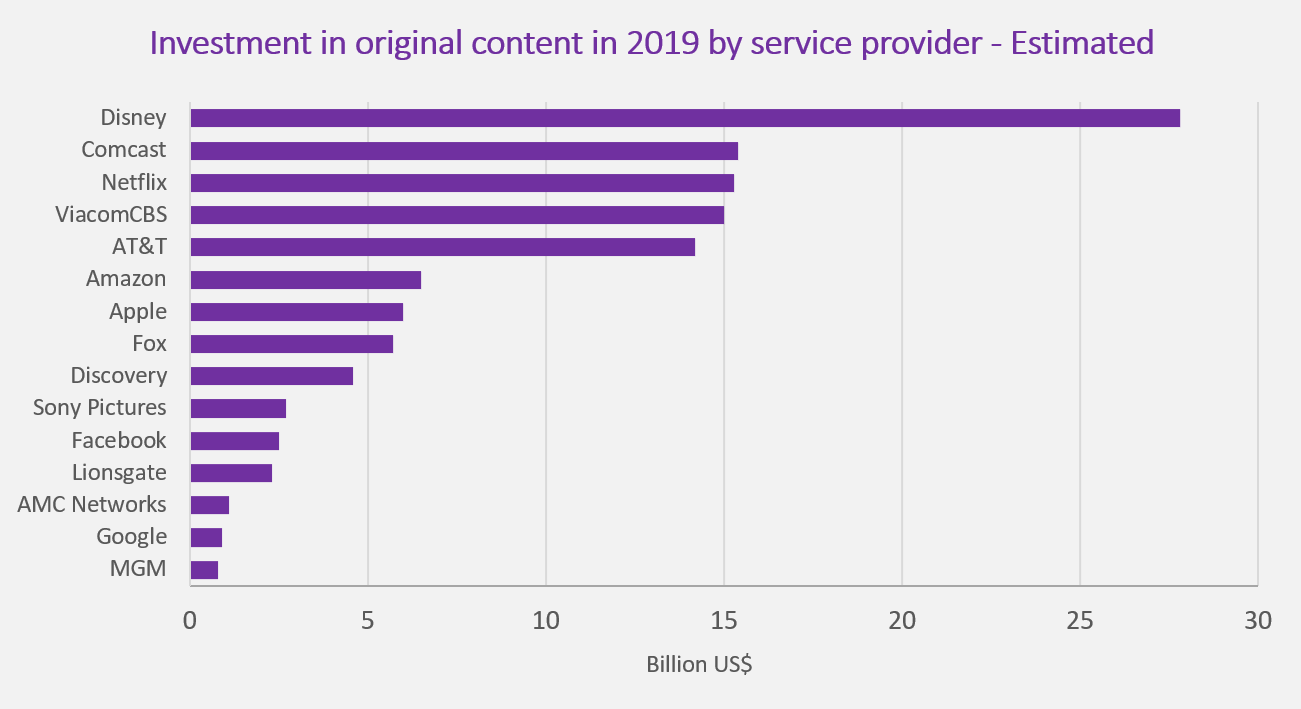
Even though its content library is smaller than that of Netflix, Disney+ provides exclusive access to a significant share of its massive content archive, including Star Wars series and content from Marvel Studios. Viewers’ interest in the new service has been huge; a few weeks after the launch, Disney+ had already surpassed 22 million mobile downloads, according to Apptopia. However, the actual figure is likely higher, because the service can be downloaded onto smart TVs, streaming devices, desktops and other platforms. As of December 2019, the number of Disney’s subscribers on its three online video services – Disney+, Hulu and ESPN+ – stood at 53 million. By 2024, the company expects Disney+ alone to have 60-90 million subscribers. This it in line with Disney’s ambitious investments in original content in 2019, which Variety Intelligence Platform estimated to have exceeded US$27 billion, being nearly double compared to Netflix (US$15bn).
In September 2018, Comcast – America’s biggest provider of cable and broadband services – won the bidding war with Disney over Sky in a deal worth US$40 billion. As Disney had just acquired 21st Century Fox, which in turn owns 39% of Sky, Comcast wanted to secure the remaining 61% for itself, attracted by Sky’s major sports rights deals and partnerships with BT Sport, Spotify and Netflix. Through Sky, Comcast also strengthened its footprint in Europe, where Sky has around 27 million subscribers and has thus been enjoying growing revenues – contrary to what many ad-funded broadcasters in Europe are experiencing. These mega deals among the largest media companies during 2018 illustrated that the battle over original content is intensifying.
Source: Variety Intelligence Platform
Comcast – which was estimated to have spent US$15.4 billion on originals in 2019 – announced in January 2020 that it is going to make “rate adjustments”, as its cable customers continue to switch their bundle cable/internet packages to streaming channels. While Comcast continued to lose cable subscribers (149,000) in the fourth quarter of 2019, it managed to add 442,000 broadband subscribers. Therefore, Comcast – the owner of NBCUniversal – has decided to launch its own streaming service, Peacock, in July 2020. Peacock will be available either as a free ad-supported service or as Peacock Premium priced US$10 per month.
According to research firm MTM, the premium OTT market in the US expected to reach US$ 21 billion by 2020, significantly up from US$16.4 billion in 2017. In this spirit, traditional broadcast and media companies are seeking scale through consolidation, while heavily investing in original content to compete effectively with new media players like Facebook, Amazon, Apple, Netflix and Google (i.e. the FAANGs). These new media players, in turn, are increasingly entering the field of sports – the crown jewels of linear TV. According to a recent report from ReThink TV, streaming revenues from sports media rights are expected to reach US$85 billion by 2024.
In 2019, Netflix was estimated to have invested about US$15 billion in original content, up by 25% from previous year. According to BMO Capital Markets, Netflix’s content spending will reach US$17.3bn in 2020. Facing serious competition from Disney+, Apple TV+ as well as WarnerMedia and Comcast/NBCUniversal starting later this year, Netflix announced in the last quarter of 2019 that it will raise US$2 billion in debt to fund new investments in content. Already before the announcement, Netflix was known to have about US$14.6 billion of long-term debt. Earlier, it had already raised prices of streaming plans in the US and in some Latin American countries to compensate its massive content spending. In addition to its financial strains, Netflix’ stock went down in January 2020 after the Q4 2019 earnings call, where the company reported increased revenues (US$5.47bn), but a lower number of domestic subscriber additions (550,000) than analysts expected. Nevertheless, in the US, Netflix continues to be the top pick among consumers; according to a December 2019 survey by Cowen, Netflix remains the most popular platform to view content with 25% of respondents saying so, followed by basic cable (18%), broadcast (17%) and YouTube (13%).
Even though Amazon has not spent as much on original content as Netflix, its market cap is six times bigger than that of its main rival. According to internal documents obtained by Reuters, Amazon Prime had over 100 million subscribers worldwide, of which about half were in the US. Hence, in terms of subscriber base, Amazon is still far behind Netflix, but it has the advantage of having in place a platform ecosystem of partners and a digital platform that invites third parties to make money on the Amazon platform, which Netflix still has yet to build. Recently, Amazon Prime has grown rapidly in the Indian market, where its total local investment to date equates to US$6.5 billion, according to Jeff Bezos, CEO at Amazon. During his visit in Mumbai, he said: “We have just made a decision to double down on our Prime Video investments in India”. Amazon plans to offer one Indian original per month from 2020 onwards.
Compared to Netflix’s strategy of still relying on monthly subscription-based revenue model and investments in original content, Facebook is strengthening its position as an interactive video platform provider for user generated content (UGC) and live videos. According to Forbes, over half a billion internet users globally now watch online videos daily on Facebook, while other established video platforms like YouTube, Twitch and Vimeo are losing their users to the “new” market entrant, Facebook. With the Facebook-owned Instagram Live and Facebook Live user base increasing, the popularity of live video for business has continued to grow. In 2017, the company launched the Facebook Watch platform in the US giving Facebook users a dedicated platform to find their favorite shows and video creators, and to start conversations with friends, other fans and the creators themselves. A year later, In September 2018, the Watch platform was made available globally on iOS and Android, Apple TV, Samsung Smart TV, Amazon Fire TV, Android TV, Xbox One and Oculus TV.
Apple, which already produces some original shows such as Planet of the Apps and Carpool Karaoke, launched its own streaming service, Apple TV+, in November 2019. The new service is priced US$4.99 per month, but by buying an iPhone, iPad, Mac or Apple TV viewers’ get one year’s subscription for free. According to industry experts’ estimates, Apple spent about US$6 billion on original content in 2019. The streaming service offers a range of exclusive movies and shows from film directors like Steven Spielberg. Apple has also announced that celebrities like Oprah and Prince Harry will star in a mental health documentary series to be shown on Apple TV+ in 2020. Apple has looked at investing in original content as iTunes, its music and entertainment sale and rental service, has suffered from increased competition from on-demand subscription offerings such as those provided by Netflix, Amazon and Hulu. With its OTT initiative, Apple is responding to the intensifying competition and gets new revenue sources.
Google has been investing in original content through its YouTube division in recent years, launching subscription services YouTube Red in 2015 and YouTube TV in 2017. YouTube Red is an ad-free subscription service that also includes Google’s originals, while YouTube TV is a skinny-bundle of live premium channels. Google’s investment in original content amounted to nearly US$1 billion in 2019, according to Variety Intelligence Platform. Late in 2019, the company announced that YouTube will set up a US$100 million fund to invest in original children’s content.
The next chapter will discuss the major technology trends in the North American broadcast and media technology market more in detail.
Media Technology Demand Drivers
Key Trends
We examine specific trends driving broadcast and media technology spending in North America. The trends we discuss are:
- Transition to Digital and HD Broadcasting
- Transition to ATSC 3.0
- New Viewing Experiences (UHD and VR)
- OTT and Multi-Platform Delivery
- 5G
The transitions to digital and HD broadcasting are mature trends in this region and do not represent significant spending drivers for vendors. The transitions to new viewing experiences, multi-platform delivery, ATSC 3.0 and 5G are instead now the principal spurs.
Transition to Digital and HD Broadcasting
In North America, the transition to digital broadcasting has almost reached maturity and therefore does not represent a significant driver of broadcast and media technology spending.
In the US, the Federal Communications Commission (FCC) started running tests of digital transmission in 2008. The requirement was set for full-power TV stations to shut down their analog transmissions by June 2009. Low-power TV stations were given an extended deadline of September 2015 and continued to broadcast in analog. However, the FCC suspended this deadline due to the Incentive Auction, which required the repacking of TV spectrum, and meant that some stations may have had to go off air or change channels. On completion of the auction in 2017, the FCC announced a new date of July 13, 2021 for low-power TV stations to shut off analog transmissions. According to Digital TV Research, in 2016 only 2% of North American TV households received analog TV – through analog cable.
After the competition of the spectrum auction in March 2017, the FCC issued the new channel allocation table for US broadcasters. This meant the start of the FCC-mandated 39-month timeframe for repacking the spectrum, during which broadcasters must move their transmission frequency to a new position on the spectrum. Each transition phase has a deadline, by which stations are allowed to commence testing and operation on their post-auction channel. Each phase also has a date by which each station must stop operating on their pre-auction channels. The process of repacking the spectrum impacts nearly 1,000 TV stations in the US and should be finished by July 3rd 2020, according to the FCC. The work during the repack process consists of upgrading transmission infrastructure such as digital TV transmitters, broadcast antennas, RF components, and any required structural engineering work on TV transmission towers.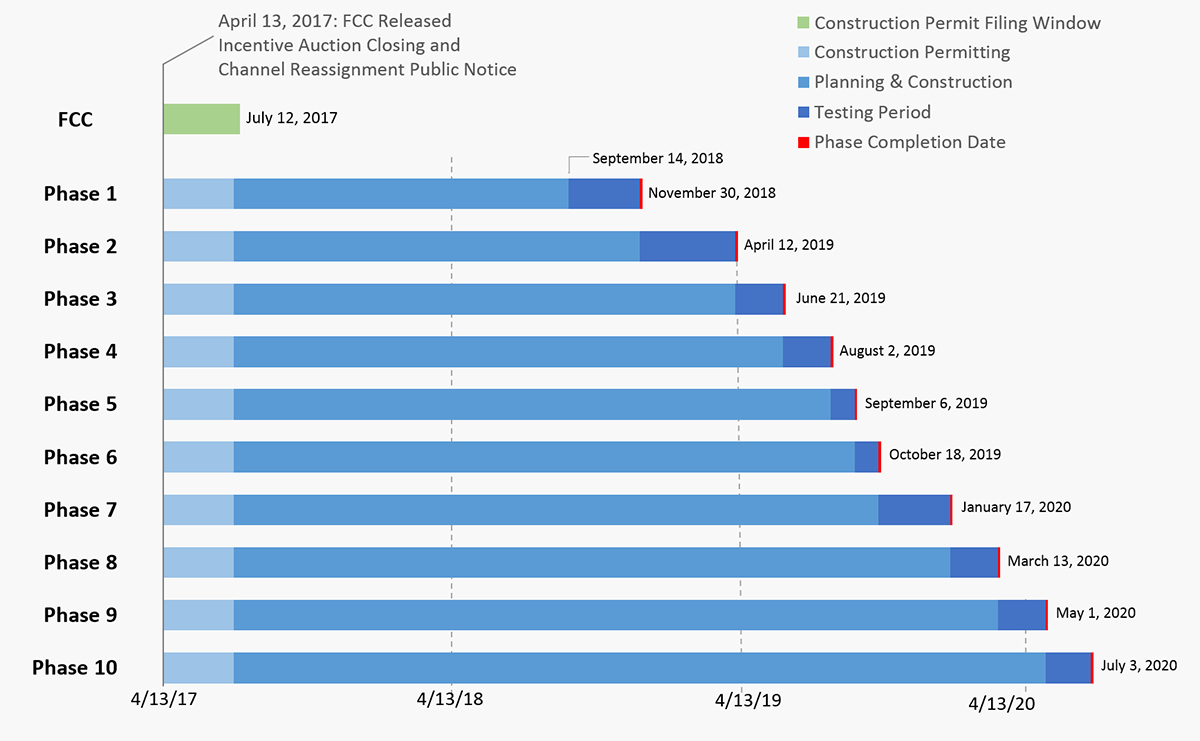
Transition schedule. Source: The FCC
At first, the US government allocated US$1.75 billion to the TV Broadcaster Relocation Fund to reimburse broadcasters and MVPDs (Multichannel Video Programming Distributors) for reasonable expenses incurred during the repack process. In 2018, the US Congress allocated an additional US$1 billion to repack expenses. The reimbursements scheme is valid until July 3rd 2023.
In Canada, the CRTC set the initial deadline for the transition of full-power TV stations to the end of August 2011. A total of 28 markets were involved with the exception of some CBC transmitters which were given a one-year extension to continue analog transmissions. A deadline is yet to be set for low-power TV stations. The remaining analog over-the-air television signals across Canada are scheduled for shutdown by 2022.
In North America, the transition to HDTV has been a major driver of broadcast and media technology spending; it drove a wave of spending on digital equipment in the 2000s, while tests of high-definition television had already been carried out in the 1990s. In the US, the number of HD channels grew significantly between 2005 and 2012, but after that spending on digital equipment waned as broadcasters started to focus on new technologies like multi-platform content delivery. Hence, HD became mainstream in the US with hundreds of channels being delivered over satellite, cable, IPTV and terrestrial. In 2015, Leichtman Research Group estimated that over 80% of American TV households had at least one HDTV set. Today, HD equipment has been adopted by 90% of TV households in the US and all major TV networks offer HD programming through about 200 HD channels. However, 4K/UHD TVs are rapidly replacing HDTVs in the US – as of December 2019, about 34% of American households already had a 4K/UHD TV set, according to IHS Markit.
Canada went through a similar experience with the transition to HDTV nearing maturity in 2012 and today HDTV sets are standard. According to the Consumer Technology Association, at the end of 2018, 26% of Canadian households had a 4K TV set, reflecting that the transition from HDTV to 4K/UHD TV is slower than in the US. As of January 2020, there were over 75 French HD and over 285 English HD channels (many of which were US channels) in Canada.
As North America’s transition to digital broadcasting and HD have reached maturity with technology spending is now focusing on multi-platform, IP, AI and cloud-based technology, while HD spending is gradually being replaced by 4K channel launches.
Transition to ATSC 3.0
ATSC 3.0 is the next-generation terrestrial standard system that will provide broadcasters with additional spectrum efficiency. It provides broadcasters increased flexibility and new market opportunities through enhanced transmission and reception functionality, delivery of 4K UHD TV, immersive audio, and interactive services using a mix of Internet and broadcast connections.
The arrival of ATSC 3.0 will allow terrestrial broadcasters to deliver a greater number of HD channels, because the new standard provides more efficient terrestrial transmission. The new standard will also help Pay-TV operators – battling with cord cutting – to increase the number of HD channels and thus attract new subscribers. Accordingly, the rollout of ATSC 3.0 by broadcasters in the US is expected to drive spending, particularly with regard to transmission-related equipment.
Work on the new DTV system began in 2010 with an initial study on what it should provide for consumers. At the end of 2017, the FCC voted to allow broadcasters to voluntarily roll out ATSC 3.0. FCC Commissioner, Mignon Clyburn, specified that no subsidies would be provided by the government to consumers for the purchase of ATSC 3.0 compliant equipment.
Today, both the US and Canada rely on the American ATSC (Advanced Television Systems Committee) standard for terrestrial broadcasting. Currently, over-the-air TV (i.e. antenna-based TV) signals use version 1.0 of the ATSC standards, introduced in 1996. In comparison to the current standard, the new IP-based ATSC 3.0 uses both over-the-air signals and the consumer’s in-home broadband to deliver nearly as high picture quality as a cable or a satellite connection. Technically, actual programming will be broadcast over the air, whereas ads are provided over the internet – enabling accurate geotargeting (which is also used for advanced emergency alerts). For viewers, this means more online-type advertising. With an IP-based standard, broadcasters can have a two-way signal and hence gather information about their viewers. Moreover, viewers can watch broadcast video on mobile devices and in cars – a notable advantage for broadcasters wanting to attract younger audiences.
In terms of picture quality, the current ATSC 1.0 standard supports 1080p at most. By comparison, ATSC 3.0 allows 4K UHD broadcast and other picture quality upgrades such as high dynamic range (HDR), wide color gamut (WCG) and high frame rate (HFR) – and extensions to 8K resolution in the future. When it comes to audio improvements, ATSC 3.0 supports object-based sound formats like Dolby Atmos and DTS:X. So, for viewers, ATSC 3.0 translates into a bigger number of channels in higher quality and improved audio quality. Viewers do not need a new TV or a larger antenna to enjoy these benefits, but they may have to buy an external converter box, if their TVs do not have an ATSC 3.0 tuner. Usually, newer TVs supporting 4K or HDR include ATSC 3.0 tuners. For those viewers who have older TVs, Madeleine Noland, President of the ATSC, announced at CES 2020 that there will be 20 models of external ATSC 3.0 tuners coming to the market in 2020. At CES 2020, major TV manufacturers like Sony, Samsung and LG also announced ATSC 3.0-compatible TVs targeted at the US market. For example, LG – a co-developer of ATSC 3.0 – is planning to launch six ATSC 3.0-compatible models in the coming years.
The timeline of implementing the ATSC 3.0 standard in the US is characterized by the fact that the switch is not mandatory; stations may choose to broadcast in the new format on a voluntary basis. However, stations that switch to ATSC 3.0 must continue to offer ATSC 1.0 signals for at least five years after the switch, according to the FCC. In the US, various TV stations have been testing ATSC 3.0-standardized broadcasts since 2014. In 2017, the National Association of Broadcasters got the first license to start broadcasting ATSC 3.0 at full scale.
In March 2017, the two largest broadcast station owners, Sinclair and Nexstar, formed an ATSC 3.0 consortium – the Pearl TV consortium – to coordinate the launch of ATSC 3.0. Later in 2017, seven broadcasters – E.W. Scripps Company, Fox Television Stations, Meredith Local Media Group, Nextstar Media Group, Tegna, Telemundo Station Group and Univision – across 10 stations in Phoenix launched a “model market” to demonstrate the viability of the next generation ATSC 3.0 ecosystem. In October 2018, the Pearl TV consortium announced the addition of seven broadcasters in the Phoenix area bringing the total participating stations to 14. In addition to technical tests, the consortium’s task is to collect data on viewers’ preferences and their interaction with ATSC 3.0. Since then, major broadcasters including NBC, Fox, Nextstar Media Group and Tegna have announced that they will switch to ATSC 3.0 in 2020.
In 2019, WRAL-TV Raleigh N.C. provided the first Winter Olympics broadcast in 4K/UHD using ATSC 3.0 – this example highlights how the deployment of ATSC 3.0 can lead to more spending on 4K/UHD. Later in 2019, one station in Chicago and another four-tower installation in the Dallas-Fort Worth area in Texas started to broadcast the new standard. According to TV Technology, by the end of 2020, TV stations owned by Fox, NBCUniversal, Univision and SpectrumCo (i.e. Sinclair Broadcast Group and Nextstar Media Group) should switch to ATSC 3.0-broadcasting in up to 40 regional markets across the US.
Outside of the US, the new ATSC 3.0 standard was adopted by three major local broadcasters – MBC, SBS and KBS – in South Korea in May 2017, and the 2018 Olympic Games in Pyeongchang was broadcast using the new standard.
While on the broadcast side there is a major interest in deploying the new standard, there are still doubts over consumer adoption. From a demographic perspective, broadcast-only reception is more widespread among low-earners, making the switch even more unlikely for them. This is a major concern for US television executives. However, in general, interest in the new standard remains high as the rollout of ATSC 3.0 has now began in the US and it is expected to boost 4K/UHD adoption, gradually superseding HDTV in the region.
New Viewing Experiences (UHD & VR)
According to IHS Markit, about 34% of North American homes had 4K/UHD TV sets as of October 2019. This percentage is expected to reach 64% in the next four years. These figures are in line with our latest Buying Trends survey, which showed that over one third of end-users have already launched UHD offerings, followed by another third planning to do so in 1 to 3 years’ time.
In North America, the adoption of 4K/UHD is driven primarily by terrestrial broadcasters – now switching to the new ATSC 3.0 standard – and Pay-TV operators, who continue to differentiate and diversify their offerings. For example, in South Korea, the adoption of ATSC 3.0 notably facilitated 4K/UHD adoption among terrestrial broadcasters.
Somewhat surprisingly, in 2019, the trade dispute between China and the US also fueled demand for 4K/UHD TV sets in the US. According to IHS Markit, domestic shipments of 4K/UHD TVs in the US surged in 2019, because American distributors were stockpiling their inventories ahead of proposed tariff increases on TV sets manufactured in China. Globally, sales and shipments of 4K UHD TVs now exceed more than half of all TV shipments worldwide.
Over the past five years, a clear majority of UHD deployments have focused on live sports. The first 4K/UHD live broadcast in the US took place at the Masters Tournament in 2016, which was offered by DirecTV (now AT&T TV Now) on the first 4K/UHD channel in the US. Later in 2016, DirecTV offered some of the US Open golf matches in 4K/UHD. Another key milestone for UHD technology that year was the 2016 Summer Games, from where NBC broadcast over 80 hours of content in 4K/UHD and 4K HDR. In 2017, Fox Sports started producing one college football game per week in 4K, distributed through DirecTV. Later in 2017, the Canadian cable Pay-TV operator Rogers broadcast a series of major live sports events such as some NHL and NBA matches.
As these examples illustrate, 4K/UHD offerings have been mostly launched by major Pay-TV operators – often relating to the most important sporting events. Accordingly, industry experts anticipate that the 2020 Olympic Games could act as a catalyst for UHD production. Already in the 2018 Winter Games in PyeongChang, several broadcasters like NBC, Japan’s NHK and Olympic Broadcasting Services (OBS) covered selected content in 4K HDR. Recently, Olympic Broadcasting Services (OBS) – preparing for the 2020 Summer Games in Tokyo – announced that it is partnering with Alibaba Cloud to create a cloud-based sports broadcasting platform, the OBS Cloud, to support the first-ever live coverage of the Olympic Games in UHD/HDR, enriched with sports highlights packages, behind-the-scenes clips and VR effects. In December 2019, the Australian free-to-air broadcaster, Seven, announced that it had teamed up with telecom operator Optus to develop a channel to provide 4K/UHD coverage of the 2020 Summer Games in Tokyo. Exclusively available to Optus 5G Home customers via the Fetch Mighty set-top-box, the 4K/UHD package will also include 8K production. NHK, in turn, has announced that it will “mass produce” the 2020 Summer Games, for which the Japanese broadcaster has developed its own camera set up to shoot in 8K. NHK started broadcasting 4K/8K UHD in December 2018, using a specially developed satellite broadcasting service to deliver the UHD content.

Source: AVS Forum
New media players like Netflix and Amazon have also played an important part in boosting the adoption of 4K/UHD. Over the past few years, Netflix and Amazon have only accepted original content shot in 4K/UHD. This has increased demand for 4K production equipment. At the beginning of 2019, Netflix announced that it does not accept exceptions in terms of cinema cameras for its 4K original productions. Accordingly, the company banned the use of the ARRI Alexa (excluding the large-format Alexa 65) for its original programming, because the standard model used a 3.2K resolution sensor instead of the requested 4K. Soon after, ARRI released a new model with a 4.5K sensor.
In September 2018, Netflix launched the Netflix Post Technology Alliance with Sony, Adobe and MTI, who now share Netflix’s roadmap to develop tools and systems to meet 4K production requirements. Those tools that get approved by Netflix are permitted to use the “Netflix Post Technology Alliance” logo. Moreover, Netflix recently joined the Academy of Motion Picture Arts and Sciences’ Academy Software Foundation – a forum for open source software developers – to have its foot in industry standardization processes.
Most use cases of UHD technology highlight how this is being applied (in delivery) to live broadcasts, particularly live sports broadcasts. A similar consideration can be made on VR, which is mostly being used in sports where it could represent an alternative, or surrogate, to watching a game in the stadium. While broadcasters have experimented with VR for several years, the technology still presents end-users with the challenges of having the right tools to deliver VR graphics – and its high costs. This is in line with our latest Buying Trends survey data; only 14% of end-users said that they are already using VR technology, while another 14% said they are very likely to do so.
Fox strengthened its commitment to VR broadcasting in 2017, when it decided to collaborate with Livelike on a “social” VR experience for the CONCACAF Gold Cup – an international football tournament of the North and Central American and Caribbean regions held every two years. Through the Fox Sports app, viewers were able to communicate to each other – via their avatars – while watching the games. In 2018, during the 2018 FIFA World Cup in Russia, Fox Sports & LiveLike provided four matches in VR through Oculus Go and Gear VR headset.
In 2017, the partnership between NBA Digital and NextVR marked the first time VR technology was monetized in broadcasting. The two organizations delivered one NBA game per week in VR, which was charged to consumers through a subscription model (the NBA League Pass).
In 2018, NBC presented more than 50 hours of VR content from the 2018 Winter Games in South Korea. It was the first time that the Olympic programming in VR was delivered live in the US on a wide range on devices and platforms. The content was available on the NBC Sports VR app. Later in 2018, Copa90 announced a new partnership with NextVR to deliver the International Champions Cup match between AC Milan and Manchester United as a VR live broadcast.

Source: IABM
In 2020, Alibaba Cloud and Intel plan to deliver a 360-degree 8K immersive VR video experience from the 2020 Tokyo Summer Games by delivering 8K images over 5G mobile networks.
These use cases highlight how VR technology is so far making inroads only into sports broadcasting. According to recent IABM data, most end-users still do not know how to monetize it. VR technology needs to find a clear business model backing it as most deployments rely on free broadcast to viewers through apps.
OTT and Multi-Platform Delivery
As discussed in previous chapters, OTT and new media offerings continued to grow in North America in 2019, further strengthening the region’s role as the global OTT industry leader. North America’s developed broadcast market with a solid broadband infrastructure has provided an excellent seedbed for OTT services; according to eMarketer’s estimate, there were 182.5 million people in the US viewing content through subscription-based OTT services in 2019, representing over 55% of the country’s population. The US alone is estimated to account for 90% of the North American SVOD market. Fueled by the recent launches of new SVOD platforms like Disney+ and Apple TV+, the SVOD market in the region is forecast to grow at an annual rate of 9% through 2023, according to GlobalData.
When looking at all digital video consumption in the US, the figures are even higher; in 2019, about 235 million people watched digital videos, representing over 70% of the country’s population, data from eMarketer shows.
As discussed in previous chapters, cord-cutting continues to accelerate in North America, favoring OTT players. Accordingly, Pay-TV providers are focusing on more profitable internet services and offering packages that include TV, internet and phone services as well as an OTT video subscription for a single and lower price. Moreover, broadcasters and media companies are seeking to increase their operational efficiency by deploying IT-driven solutions. Large US broadcasters like Fox and ABC-owned ESPN have built new facilities based on IP rather than traditional broadcast products. Already in 2015, Disney and ABC announced during the NAB Show that they would virtualize their master control infrastructure by using technology from Imagine Communications to be able to playout from the cloud and to provide pop-up channels. In 2018, Telemundo opened its new headquarters in Miami, with its infrastructure based on advanced IP technology (ST 2110). The facility now hosts Telemundo Network, Telemundo Studios, Telemundo International, the cable network NBCUniversal as well as the company’s digital media operations.
Today, the OTT landscape in North America is dominated by Netflix, Amazon and Hulu. According to data from Digital TV Research, Netflix had 62 million subscribers in the US in 2019, translating into a market share of 34%. Amazon was estimated to have 54 million subscribers (29% market share) in its home market in 2019, followed by Hulu with 26 million subscribers (14%). Industry experts expect the recently launched Disney+ to be the biggest winner in the North American OTT market in the coming years. At the end of November 2019 – only few weeks after its launch – Disney+ had an estimated 24 million subscribers in the US, boosting cancellations among Netflix customers, according to Cowen & Co.
After having seen its subscriber growth slow down over the past 12 months, Netflix warned in a letter to its shareholders in October 2019 that the streaming wars will intensify due to the launches of Disney+ (2019), Apple TV+ (2019), HBO Max (2020) and Peacock (2020). However, the company also noted in the letter that “we are all small compared to the linear TV”, signaling that Netflix sees its major targets in those subscribers who decide to cut the cord in the coming years.
In January 2020, Netflix reported its earnings for Q4 2019, the first quarter in which it faced direct competition from Apple TV+ and Disney+. While Netflix’s quarterly revenue of US$5.47 billion met investors’ expectations, its domestic subscriber additions (550,000) fell significantly below the expected 589,000. Earlier in 2019, Netflix reported a loss of 126,000 domestic subscribers during the second quarter. In fact, North America has been its slowest-growing market in recent years; the region grew only 7% in 2019. As a result, Netflix is now seeking growth from new markets like Brazil, Mexico and India – like its key rival, Amazon. Late last year, Netflix published figures on its global subscriber growth, which showed that the Asia-Pacific region is the company’s fastest-growing market, with 14 million subscribers. This means that Netflix has managed to triple its subscriber base in the region since 2017.
Amazon Prime Video is another giant in the North American OTT market. As Netflix, Amazon doesn’t offer the same content to US and Canadian viewers. Canada for example didn’t get access to Prime Video or Prime Music at the same time as the US. Amazon Prime in Canada still falls short compared to the US when it comes to offered content. This is due to the fact that cable companies own Canadian rights and users have been opening an account in the US to get better content. However, over the past two years, this has gradually changed and Amazon is now providing a more diverse content library to Canadian viewers.
Prior to the launch of Disney+, Hulu – owned by NBCUniversal, Fox, Time Warner and Disney – had third largest market share in the US in 2019 in terms of subscriber base. Recently, industry experts estimated that Hulu with its Live TV was the biggest US virtual MVPD in terms of subscriber base. As an on-demand video service available in the US and Japan (not in Canada), Hulu focuses mostly on streaming newer TV shows and its own original content. In October 2019, Hulu added the feature to watch content offline. Like Netflix and Amazon, Hulu has recently increased its investments in original content. For example, its exclusive series include the super popular The Handmaid’s Tale. To compensate its increasing spending on originals, Hulu raised the price of its base package by US$10 to US$54.99 per month in December 2019.
Launched in 2014, Pluto TV is another interesting live TV streaming service – and a competitor of Hulu+ Live TV. Acquired by Viacom in March 2019, Pluto TV offers free content mainly curated from available online sources. As of November 2019, Pluto TV had over 20 million active users, which made it the largest free TV streaming service in the US. The service has over 170 content partners providing content through 240 channels. For Viacom, Pluto TV is a key platform to boost its advertising revenue. For example, in September 2019, Viacom reported that 3,500 brands advertised on Pluto TV.
While the biggest OTT services seek to enter new markets, a wide range of smaller OTT players focusing on a very narrow range of thematic content for well-defined audience has emerged. In the US, about 30% of OTT video subscriptions consist of “other SVOD services”, which include subscription-based linear OTT video streaming services and a wide range of smaller streaming networks, according to Ovum. While Netflix’s US market share is estimated to be over 30% (as of 2019), followed by Amazon (29%) and Hulu (14%), nearly third of OTT subscriptions consist of a heterogeneous collection of services, many of which are intentionally counter-positioning themselves against the big OTT services. The advantage of these niche networks is that their narrow focus allows them to target the most passionate users and to connect and engage with them on a more personal level – globally. As aptly noted by Kun Gao, CEO at Crunchyroll, an anime-focused niche streaming service with over two million subscribers globally, “niche OTT services offer everything for someone, rather than something for everyone.”
Niche OTTs are not an entirely new phenomenon in the streaming space. For example, Crunchyroll has been able to gradually expand its subscriber base since its launch in 2006 by focusing on distribution of exclusive, licenced content. Compared to the big OTT players, Crunchyroll has intentionally refrained from overspending on content or producing paid-for services that would be too similar to those which viewers can get for free (e.g. on YouTube). Only in 2019, Crunchyroll launched its first own original series called High Guardian Spice.
Like Crunchyroll, a great majority of niche OTT services rely on a subscription-based video on demand (SVOD) business model. An AVOD model is clearly less common among niche OTT services, because it goes against the key strategic pillar of highly specialized streaming services: the content must be exclusive to attract paid subscribers, who are after hyper-areas of content which they cannot watch anywhere else. To expand their subscriber base, some niche OTTs have moved to a hybrid pricing model, which enables them to target different sub-niches within a niche at different price points.
Relying on paid-for premium content has also worked for niche OTT services focusing on premium live sports like DAZN, WWE Network and MLB.com. This is partly due to the fact that Netflix and Amazon are not yet dominating the live sports segment, leaving room for new niche SVOD services. For services like DAZN, an SVOD model is a must, as premium sports rights are very expensive and because sports streamers need to continuously invest in augmented production like multiple cameras, immersive formats and service quality (i.e. low latency). According to DAZN, through an SVOD model, it can guarantee that it is streaming compelling content that its customers are willing to pay for. Moreover, a stable and relatively predictable revenue flow through an SVOD model enables the company to continuously monitor the ROI delivered by different sports rights and decide quickly which rights it should not renew if the ROI is below its expectations.
In the OTT space, sports is expected to be the next key growth segment globally. The increasing number of big OTT players bidding for the same sports rights as broadcasters has resulted in the prices of rights (e.g. in football) skyrocketing – bringing sports clubs higher revenues. While sports federations and OTT players launch new sports services, broadcasters are gradually losing their dominant position as sports content aggregators and will not be able to control viewers’ access to sports content as they did in the Pay-TV era.
As 5G starts to deploy globally, streaming of live sporting events will represent a large share of 5G telco-OTT bundling revenues in the coming years. According to Ovum, live sports streaming will account for over 50% of bundling revenue by 2024, which is significantly up from the 20% figure in 2019. In terms of revenue, this will mean that 5G network bundles will surge from US$6 million in 2019 to US$4.9 billion by 2024. Live sports will make up the majority of these revenues, followed by SVOD.
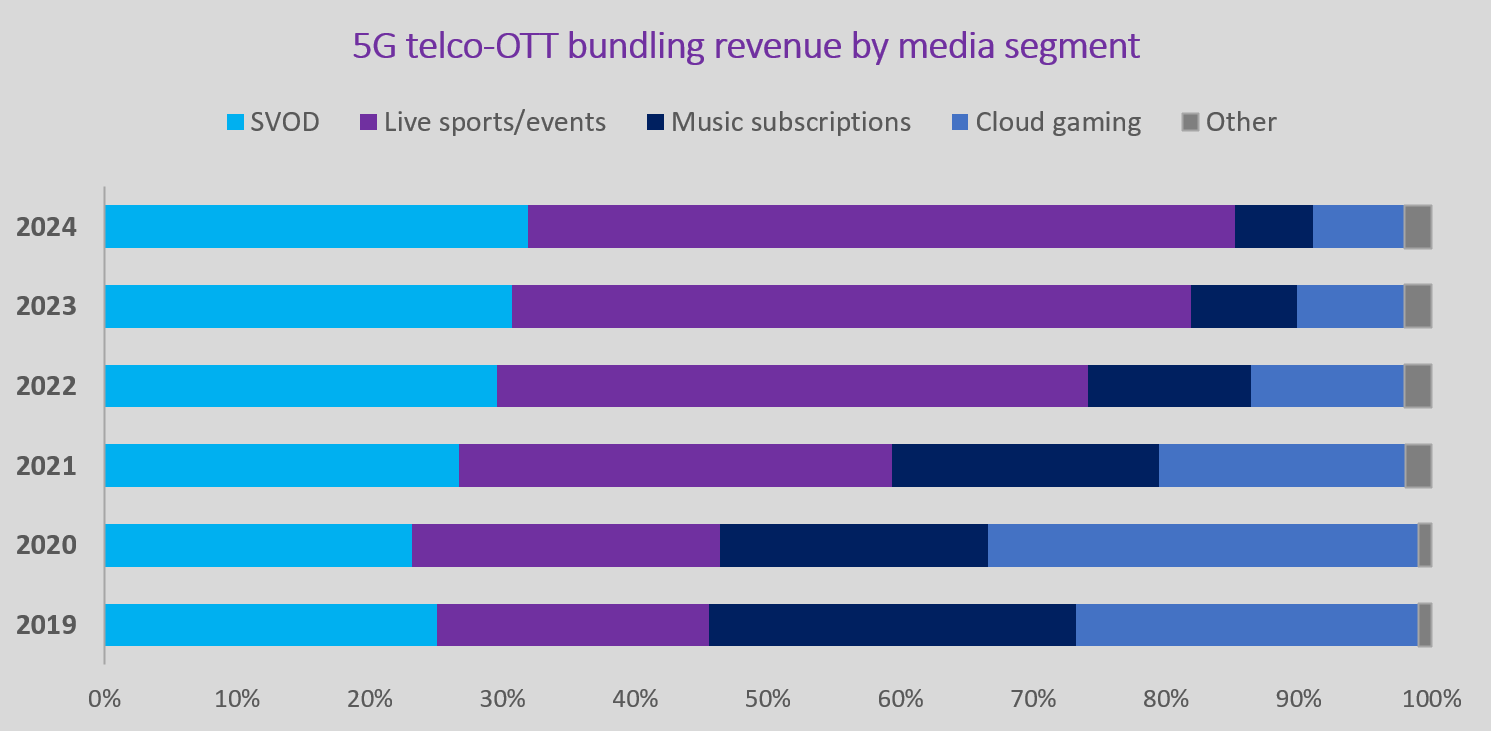
Source: Ovum
5G
In 2018, telecoms globally started to commercially deploy fifth generation (5G) networks as a response to growing demands for data from end consumers and industrial users. 5G is expected to enable telcos to expand consumer services such as video streaming and VR applications, support the increasing number of connected devices (e.g. IoT and smart homes), support new industrial uses (e.g. industrial monitoring systems), perform advanced analytics with the aid of AI applications and enable the use of new technologies (e.g. autonomous vehicles).
5G is expected to yield significant economic benefits; it could create up to 3 million new jobs and add US$500bn to the US’ GDP, according to the US Congressional Research Service (CRS). Globally, 5G technologies could create US$12.3 trillion in sales activity across multiple industries and support 22 million jobs by 2035.
In the US, private industry is leading 5G development and American telcos competing against each other have been the first in the world to offer 5G services commercially. So far, the US government has supported the private sector with its 5G deployments by making spectrum available for 5G use and streamlining processes related to the siting of 5G equipment such as small cells. By comparison, in China the central government is the key promoter of 5G infrastructure.
In the US, private telcos started 5G deployment in 2018. For example, Verizon launched fixed 5G services in four cities in October 2018. As of December 2019, Verizon’s 5G network was already available in 30 cities. Earlier in 2019, Hans Vestberg, CEO at Verizon, had said that the company was planning to offer 5G service across 50% of US in 2020. However, according to industry experts, such a dramatic expansion would only be possible through dynamic spectrum sharing.
In December 2018, AT&T launched mobile 5G services using a 5G hot spot in 12 cities. Since then, the company has expanded its mobile 5G network to seven more cities. At the end of 2019, AT&T said that it had made 5G access available in 30 states in the US. The company also announced that it will deploy a standards-based nationwide mobile 5G network in early 2020. In this process, the company would be deploying 5G through three key 5G pillars: mobile 5G, fixed 5G and edge computing.

Source: Northwest News Network
Like Verizon, AT&T’s 5G network relies on high-band spectrum, making the network more suitable for a limited area with relatively small coverage like urban areas or individual sites (e.g. sports stadiums). For the rollout process, this means that the selected area must have many small wireless cells relatively close to each other, because high-band signals do not travel as far as those of low-band spectrum. However, 5G speeds in such network can be 100 times faster than on LTE.
In December 2019, T-Mobile announced the launch of its nationwide 5G network, which made it the first US carrier to offer 5G service across the US. T-Mobile’s 5G network relies on low-band wireless spectrum, which means that T-Mobile has built its network broadly covering as many people as possible, but at the cost of speed. This is a different strategy from T-Mobile’s competitors Verizon and AT&T, which are deploying 5G in much smaller areas allowing higher speeds. In practice, T-Mobile upgraded its existing 4G equipment with 5G technology allowing it to build its nationwide 5G network more quickly with less equipment and at lower cost. This was due to the fact that low-spectrum enables signals to travel further without the need for increased numbers of cell towers and radios. As a result, T-Mobile’s 5G network is estimated to increase download speeds compared to 4G LTE by 20%, according to T-Mobile. To keep up with the competition, T-Mobile recently announced that it is also deploying high-band spectrum 5G in several big cities like New York, Los Angeles and Las Vegas. Interestingly, in December 2019, AT&T – vice versa – announced that it had started to deploy low-band spectrum 5G in five cities in the US, because access to the high-band spectrum network was so fragmented.
As of January 2020, T-Mobile’s acquisition of Sprint was pending due to legal hurdles. According to several industry experts, Sprint could help T-Mobile to increase its nationwide 5G network speed and data processing capacity, because Sprint holds large amounts of mid-band spectrum.
Overall, the US’ 5G deployment is estimated to be affected by the lengthy spectrum allocation process, resistance from local governments to federal small cell siting rules and limitation on trade that can affect availability of equipment, according to Congressional Research Service (CRS). Moreover, a purely market-based approach to deployment in the US may not ensure that all areas and all industries will have access to 5G – at least in the coming few years.


