IABM Business Intelligence (BI) Regional Reports provide IABM members with insight into the latest broadcast and media industry developments for a specific region. Over the course of each year, these reports build into a full overview of all the major regional markets around the world.
The analysis is undertaken by our Head of Insight & Analysis, Lorenzo Zanni and Principal Analyst, Riikka Koponen. The report includes the latest news and research findings across a variety of topics, including:
- Business Environment
- Broadcast and Media Technology Industry
- Media Technology Demand Drivers
This edition of the BI Regional Report will include a focus on Latin America.
Market Overview
Business Environment
- In 2019, the IMF set Latin America’s GDP growth forecast at 0.6% – the lowest rate since 2016. This year, economic activity in Latin America (LATAM) is expected to rise to 2.3%
- Particularly weak economic growth in the region in 2019 stemmed from heightened trade tensions between China and the US, the slowdown of the global economy as well as elevated domestic policy uncertainties in the largest Latin American economies
- Brazil, Colombia and Mexico combined account for 60% of Latin America’s GDP and thus economic development in these countries largely determines the pace of economic expansion in the whole region
- In 2019, the IMF’s growth estimate for Brazil stood at 0.8% due to international headwinds and the fact that the country’s recovery from a severe recession is still on-going
- In 2019, the IMF revised Mexico’s economic growth forecast down to 0.9% as a result of elevated political and policy uncertainty delaying investments and tightening credit conditions. This year, these conditions are expected to normalize accelerating the country’s economic growth to 1.9%
- Argentina is gradually recovering from recession and the country’s GDP growth in 2019 was estimated to be -1.3% by the IMF
- In Venezuela, the economic crisis continued to worsen in 2019; the country’s real GDP is estimated to have fallen by 35% over the past 12 months, according to data from the IMF. This means that the Venezuelan economy has cumulatively declined by over 60% since 2013
Broadcast and Media Industry
- Many countries in LATAM lack the infrastructure and resources required to develop their broadcast and media industry
- AT&T DirectTV Latin America and América Móvil have become the top players in LATAM and have been focused on the premium segment
- Growth in the number of Pay-TV subscribers in this market is expected to re-start in 2020
- For big countries like Brazil, the satellite sector is still relevant, and future prospects look bright for satellite operators thanks to the introduction of new technologies like Ka-band services and LEO
- According to Business Bureau S.A., Netflix’s market share in the region accounts for 18%, followed by Claro Video with 4% and HBO Go with 3%
Media Technology Demand Drivers
- The transition from analog to digital has been appealing for many governments in LATAM, and recently more countries have joined the list
- When it comes to HD penetration, an estimated 54% of Latin American homes with a television had an HD screen in 2016, and this share is forecast to reach 76% by 2022
- Brazil and Mexico have the largest number of HD channels in the region, followed by Argentina, Colombia, Chile, Peru and Venezuela
- The transition to UHD remains at an early stage with only a few initiatives as the focus for broadcasters is on upgrading infrastructure to HD
- Major broadcasters like Globo and Televisa have woken up to the growing threat of OTT offerings and have launched their own streaming apps for connected TVs and devices

Business Environment
Latin America generally refers to all the territory that is south of the United States, including Mexico, Central and South America, and the Caribbean islands, where the Portuguese and Spanish languages are predominant.
Historically, the largest driver of GDP growth in Latin America has been the expansion of the labor force, resulting from a demographic boom and women’s increased participation in working life. However, over the past decade, the region has struggled with a slowdown of economic growth, caused by weak macroeconomic policies, political uncertainty and a volatile business environment. In 2019, the IMF set the region’s GDP growth forecast at 0.6% – the lowest rate since 2016. This year, economic activity in Latin America is expected to rise to 2.3%, according to the IMF. Particularly weak economic growth in the region in 2019 stemmed from heightened trade tensions between China and the US, the slowdown of the global economy as well as elevated domestic policy uncertainties in the largest Latin American economies. Given the fact that only three economies – Brazil, Colombia and Mexico – combined account for 60% of Latin America’s GDP, economic development in these countries largely determines the pace of economic expansion in the whole region.
According to McKinsey, there are two main reasons for Latin America’s sluggish growth over the past decade: the lack of midsize companies and the lack of a solid middle class. The former refers to a persistent polarization among Latin American firms; a few very large companies and a wide range of small, largely unproductive firms form the region’s corporate landscape. The missing middle tier of companies has translated into a lack of dynamism and investment in new technologies, which are crucial for productivity growth. The middle class is largely ‘missing’, because with low productivity, the rapid economic expansion of the workforce has held back wage growth squeezing the middle class. According to data from McKinsey, Latin America’s bottom 90% of income distribution accounts for only 64% of domestic consumption – the lowest share in the world, akin to Sub-Saharan Africa.
In order to remove these region-wide economic hindrances, Latin American countries have started to work towards the establishment of a more competitive business environment that reduces cost of entry and improves access to finance, particularly for middle-sized firms. Today, much of the region’s labor force is employed by a multitude of small companies, many of which operate outside the formal economy. These unproductive, informal firms are mainly concentrated on the retail, construction and agricultural sectors.
In terms of individual countries, Brazil is the largest economy in Latin America and its population of nearly 215 million forms the biggest consumer market in the region. According to the World Bank, Brazil experienced a period of significant economic and social progress between 2003 and 2014; over 29 million people were lifted up from poverty and the Gini coefficient (reflecting the distribution of wealth in a society) dropped nearly 7% during that period. However, since 2015, Brazil has suffered from highly depressed economic activity, which has stagnated the pace of poverty and inequality reduction. In 2019, the IMF’s growth estimate for Brazil stood at 0.8% due to international headwinds and the fact that the country’s recovery from a severe recession is still on-going. According to the Brazilian Economy Institute, the country’s unemployment rate is still very high (11.6%), while consumer confidence is very low. Brazil’s newly-elected president Jair Bolsonaro, who took office in January 2019, has pledged to increase international trade and economic growth through signing new bilateral trade agreements. For example, Brazil and China have recently strengthened their economic ties and Brazilian exports to China – currently equating to about 28% – are increasing rapidly. In November 2019, China raised the number of Brazilian meat plants that are allowed to export to China, while Brazil allowed two Chinese state-owned oil companies – being the only foreign bidders – to attend an oil auction in Brazil. In December 2019, Brazil’s currency, the real, weakened significantly against the US dollar partly due to declining interest rates. Surprisingly, the US president Donald Trump accused Brazil of devaluing its currency on purpose and slapped tariffs on Brazilian steel and aluminum imports.
In 2019, the IMF revised Mexico’s economic growth forecast down to 0.9% as the result of elevated political and policy uncertainty delaying investments and tightening credit conditions. This year, these conditions are expected to normalize accelerating the country’s economic growth to 1.9%. Mexico – which is the second largest economy in Latin America – is highly dependent on its largest trading partner, the US, which accounts for 80% of Mexican exports. In October 2019, the IMF expressed its concerns over Mexico’s optimistic budget targets in the context of lower growth prospects. Moreover, the country should also advance in its productivity-enhancing structural reforms to accelerate growth.
Other major economies in the region include Argentina, Chile, Colombia and Peru. Argentina is gradually recovering from recession and the country’s GDP growth in 2019 was estimated to be -1.3% by the IMF. Economic growth in Chile has remained robust: the IMF forecast for 2019 was 3.2% and in 2020 the fund anticipates growth to accelerate to 3.4%. However, in October 2019, a wave of demonstrations and political unrest flared up in several areas of Chile reflecting Chilean citizens’ long-standing frustrations related to economic inequality, rising living costs and poor quality of healthcare and education. According to an OECD report, Chile has the highest rate of income inequality among a group of 35 of the world’s wealthiest nations.
In Venezuela, the economic crisis continued to worsen in 2019; the country’s real GDP is estimated to have fallen by 35% over the past 12 months, according to data from the IMF. This means that the Venezuelan economy has cumulatively declined by over 60% since 2013. The prevailing hyperinflation and the humanitarian crisis have resulted in massive outward migration. According to the latest estimates, the total number of migrants from Venezuela surpassed 5 million by the end of 2019. The country’s situation has already had significant spillovers to other countries in the region.
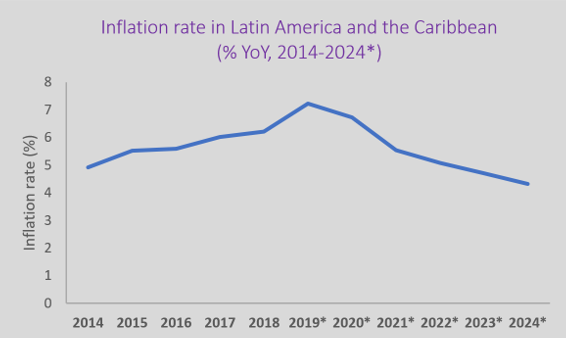
In 2019, the inflation rate in Latin America and Caribbean was estimated to stand at 7.2%, while projections see a reduction in 2020 until 2024.
Source: Statista
Latin American exports are largely dominated by natural resources such as petroleum, copper and iron ore. The decline in oil prices over recent years has impacted nations such as Brazil, Mexico and Venezuela – the largest oil exporters in Latin America. According to BP’s Statistical Review of World Energy report, Latin America produced 8.6 million barrels of oil per day (bpd), which accounts for nearly 9% of the world’s total oil output. While Venezuela and Mexico have traditionally been Latin America’s major oil producers, Brazil has recently overtaken them and is expanding its output. As of July 2019, Brazil’s oil production output – with nearly all of it coming from offshore fields – grew to a record-high 2.78 million bpd, according to BP’s data. According to industry experts, the country’s oil production is expected to reach 3.7 million bpd by 2025.
Simultaneously, Mexico – the region’s second largest oil producer – has witnessed a decline in its oil production output over the past decade, and in 2018 its production dropped to just 1.8 million bpd, being the lowest figure since 1980. This steady decline is mainly stemming from the continued decline of the Cantarell oilfield, which used to be one of the world’s largest. The Mexican government has said that its target is to produce one million bpd more than today by 2024 through investment in a new refinery in the state of Tabasco.
Argentina has witnessed a steep decline in conventional oil production over the past decade and thus the country is increasingly relying on shale fields (e.g. the Vaca Muerta shale fields). In 2019, Argentina’s total production stood at about 500,000 bpd, data from BP shows. The country has signaled that it aims at reaching an output of over 800,000 bpd in the early 2030s by investing in hydraulic fracturing like the US.
It is important to note that Venezuela is estimated to have the world’s largest oil reserves of 302.3 billion barrels, but the economic and humanitarian crisis in the country has dried up its total production output to about 700,000 bpd, according to BP’s estimate. Increasing production would require a significant amount of capital, which seems unlikely in the context of political turmoil.
In November 2018, during the G20 Summit in Argentina, the US, Canada and Mexico signed a pact that replaced the NAFTA agreement with the USMCA (US-Mexico-Canada Agreement). As of December 2019, the new deal was still pending final approval by legislatures in the three countries before it can move forward. In addition to the USMCA, Latin America has two other major free trade agreements in place: Mercosur and the Pacific Alliance. The former refers to the four-country common market made up of Brazil, Argentina, Paraguay and Uruguay launched in 1991. In June 2019, the EU and Mercosur countries drafted an initial free trade agreement – after 20 years of on-and-off negotiations. The latter, the Pacific Alliance, was established in 2011 and comprises Chile, Colombia, Mexico and Peru.
A Chile-based NGO, Latinobarometro, which has analyzed public opinion in the Latin American region for several decades recently found that most Latin Americans saw their economic future more negatively than at any other time over the past 23 years. The respondents cited concerns about problems of inequality, political control and corruption. In 2020, the economic and investment climate in the region are expected to remain subdued. According to the IMF, tariff disputes combined with an increase in debt and the inability to carry out macroeconomic reforms have deteriorated the economic prospects of Brazil and Mexico – the largest economies in Latin America.
The Broadcast and Media Industry
Overview
Latin America is an emerging broadcast and media technology market, with big economies such as Brazil, Mexico, Colombia and Argentina leading the development. Many countries in this region lack the infrastructure and resources required to develop the broadcast and media industry, and further challenges are presented by the unattractive business and political environment.
The largest TV networks worldwide are seeking to invest in new solutions in Latin America that can be integrated into existing production systems and improve the efficiency of their operations. In 2018, the top drivers of investment were the FIFA Soccer World Cup, the presidential elections in several countries of the region, the development of Digital Terrestrial Television (DTT) and the analog switch-off (ASO). Most broadcasters in the region are already generating content in 4K and they are increasingly deploying technologies that enable better interaction with viewers. Recently, competition in the Latin American OTT market has increased with several operators launching SVOD services. Local content has been under the spotlight for OTT providers to attract viewers, as integrated media companies like AT&T Direct TV and América Móvil have a huge presence in the region with extensive libraries of original local content.
Latin America is known for telenovelas and thanks to the power of Netflix these melodramatic TV serials have been transmitted around the world. Accordingly, there has been a growing interest in partnerships and co-produced content with other nations in recent years. AT&T DirectTV Latin America and América Móvil have become the top players in Latin America and have been focused on the premium segment. Moreover, social media like Facebook have started to become part of the list of stakeholders as many more operators are streaming content through the platform.
Mexico is still the only country that has completed the transition to digital broadcasting, while several countries in the region are showing gradual progress in the national analog switch-off (ASO) plan. Further improvements have been made by companies and governments to fight online piracy, but the problem is still huge in the region. Despite the economic and political issues and the online piracy, the broadcast and media market in Latin America is changing and many investors and broadcasters are investing in the region as they see it to have market potential in the future.
Pay-TV penetration
Economic issues in Latin America have recently increased and the Pay-TV sector remains flat. This is due to low purchasing power, a high level of income inequality, relatively poor fixed-broadband infrastructure and easy access to illegal or free high-quality alternatives. According to Business Bureau S.A., a local media consultancy and market research firm, in 2018, there were about 90.3 million Pay-TV subscribers in Latin America, of which over half resided in Brazil (25 million) and Mexico (22.4 million). Pay-TV penetration in the region stood at 51% of all TV households in Latin America in 2018, with Argentina and Venezuela ranking first and second at 74% and 71%, respectively.

Source: Business Bureau S.A.
All three major Pay-TV markets in the region have recently lost lots of Pay-TV subscribers. Brazil lost about two million subscribers between 2014 and 2018, data from Digital TV Research shows. In 2018, the two major operators dominating the Latin American Pay-TV market – DirecTV/Sky (21.3 million subscribers) and América Móvil/Claro (13.7 million) – have both lost a significant number of subscribers over the past few years. For example, América Móvil/Claro alone has lost 890,000 subscribers since 2016. Mexico, on the other hand, recorded subscriber growth in 2016 and a loss in 2017, with losses continuing through 2019. The number of Pay-TV subscribers in this market is expected to start rising again in 2020. Overall, after several flat years, Latin America registered a temporary increase in Pay-TV subscriptions in 2018 thanks to the FIFA World Cup.
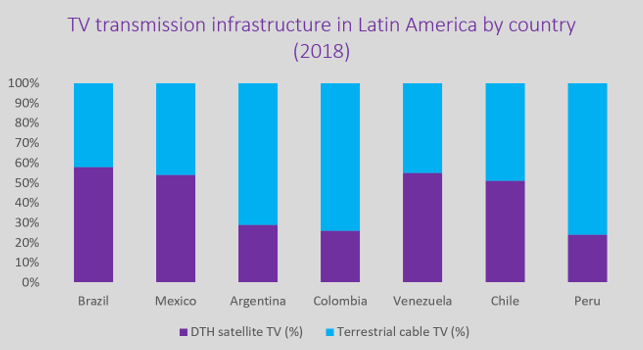
In terms of transmission infrastructure, in 2018, cable TV connections accounted for 54% of all TV subscribers, followed by direct-to-home (DTH) satellite connections (46%), according to Business Bureau S.A. Content delivery in Latin America is subject to several challenges: dispersed populations living in remote areas are difficult to reach via terrestrial TV services like cable and DTT connections, while TV operators also need to be able to minimize their service downtime in areas that frequently face extreme climate conditions, which can disturb terrestrial infrastructure. Hence, nearly half of the region’s TV households rely on DTH satellite TV delivery and its expansion continues in the region. For example, in June 2018, Latin America’s largest television programming distributor, PCTV, signed a multi-year agreement with SES to increase its viewership in Central and South America by distributing its TV channels to cable networks via SES’s recently-launched hybrid satellite SES-14 with Ku-band and C-band wide beams as well as Ku-band high throughput spot beams. Prior to the launch of its new SES-14 satellite, SES conducted an antenna programme, which led to the installation of satellite antennas at Pay-TV distribution hubs throughout Latin America. As a result, SES had already reached 25 million local TV homes as of 2019, according to the company.
Source: Business Bureau S.A.
Despite the expansion of satellite in the region, data from Digital TV Research suggests that Pay-TV revenues will decrease by 2% between 2017 and 2024, achieving $17.8 billion. Brazil is expected to remain the largest market for Pay-TV revenues in Latin America with US$5.6 billion by 2024, followed by Mexico (US$3 bn) and Argentina (US$3 bn), according to Digital TV Research.
Recent events in Latin America have brought an economic slowdown that has generally affected the market, but it has not influenced the satellite operators’ long-term plans. High competition and decrease in capacity prices have brought down the cost of satellite capacity, while customers cancelling their TV services in favor of online streaming has reduced the number of subscriptions. For large countries like Brazil, the satellite sector is key and the future prospects of the industry with the introduction of new technologies like Ka-band services and LEO are making operators optimistic. Project LEO (Low Earth Orbit) will bring a constellation of low orbit satellites that is designed to lower prices and consequently increase connectivity and demand across the markets. Over the past few years satellite broadband in Latin America has shown to have high growth potential thanks to higher available capacity. Moreover, governments in Brazil, Mexico, Argentina, Colombia and Peru have provided significant support for the market operators and thus the satellite broadband connectivity cost is decreasing in these countries.
Today, the key market players are competing with low-cost VSAT terminals with the Ku- and Ka-band capacities that focus on Internet and OTT video streaming services. According to Satellite Markets & Research, these are all brought about by High Throughput Satellites (HTS), which have entered the market over the past three years. The Ka-band for satellite services was brought into Latin America for the first time by a private player, Hispasat, with the launch of Amazonas 3. The service has gained popularity in the region, providing more concentrated coverage and internet access to more than half million people in Central and South America. Hispasat is now offering Amazonas 5, which includes HTS (High Throughput Satellite) technology. The usage of HTS is due to the higher bandwidth and the possibility of reusing frequencies.
Currently, internet service providers and mobile network operators employ satellites to provide broadband services. This makes the satellites the “middle-mile” solution, whereas in some regions, they also provide the full solution for the broadband connection. The main satellite operators and service providers of broadband via satellite in the region include: ABS, Eutelsat, Hughes, Hispasat, Intelsat, SES, Telesat and Viasat, according to Satellite Markets & Research. A more detailed description of the key satellite operators and service providers by country is provided below:
- Brazil: The state-owned Telebras provides capacity and services in Ka-band, while the privately-owned Star One (of Claro Brasil) provides capacity in Ka-band, Ku-band and C-band in the country.
- Mexico: The Mexican government (i.e. Ministry of Communications and Transportation) operates a network – the Mexican Satellite System (Mexsat) – which consists of three satellites. Mexsat-1 and Mexsat-2 are used for mobile communication devices and these twin satellites operate in the L-band and Ku-band. Mexsat-3 operates in the extended C- and Ku-bands. In general, Mexsat provides services to most government organizations as well as connectivity to remote areas, where no other service is available.
- Argentina: Government Agency, ARSAT, provides capacity and services in Ku-band with two satellites that primarily serve remote areas and government organizations.
When it comes to major private operators in the market, Hughes has been offering satellite services in Brazil for several decades. In 2016, it launched Hughes 65 West (Ka-band payload on the Eutelsat 65 West satellite) and started offering HughesNet, satellite internet service for consumers and small businesses. In 2018, it launched Hughes 63 West (Ka-band payload aboard the Telstar 19 VANTAGE satellite) to bring more capacity over Brazil. In 2019, Hughes announced a joint venture with Yahsat to combine Hughes do Brazil with Yahsat’s consumer broadband company in Brazil, because the company aims at addressing the growing market demand for a wide range of broadband services (e.g. consumer internet access, enterprise networks, cellular backhaul, Wi-Fi hotspots). This is the direction which other major, private satellite service providers such as SES, ABS, Embratel Star One, Telesat and Viasat are also exploring.
Online Piracy
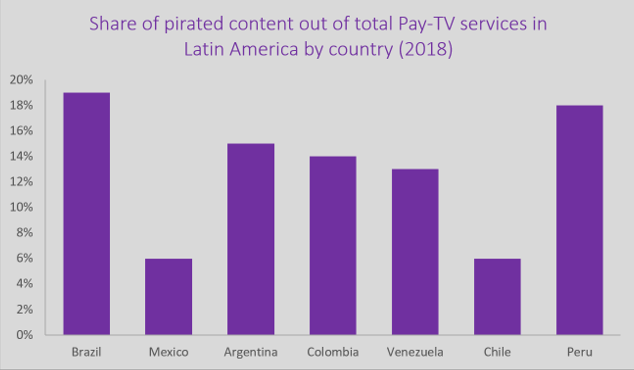
Online piracy is a problem that is frequently discussed in Latin America. The countries with the highest piracy percentage are Brazil, Peru, Argentina, Colombia and Venezuela. According to a YouGov survey, conducted in January 2017, the age bracket of consumers who admitted watching the most pirated video content is 18-24, while consumers aged 55+ watched the least. In general, content piracy is getting worse, and nowadays it is much harder to measure its impact than before, because lots of it originates from IPTV or OTT-based boxes.a
Source: Business Bureau S.A.
Content with high value is the most subjected to theft in Latin America and one of the most pirated types is sports events. Users mainly pirate it through websites, Apps and IPTV. 10,800 illegal videos were identified during 2017-2018 and more than 40% were viewed on social media, with total illegal viewing numbers equating to 1,250,000. According to Irdeto, more than 10% of all illegal streams of the FIFA World Cup 2018 was for matches involving Brazil; the three games that Brazil played registered 582 out of 5,088 illegal streams.
Fox Network Group Latin America has been fighting against piracy for more than a decade. The Group has an antipiracy department in its organization with the aim of supporting and contributing to ending piracy of Pay-TV in Latin America. More targeted education, stricter laws and a revised legal framework adapted to new technologies have been put in place. This has created a range of legal alternatives to pirated platforms.
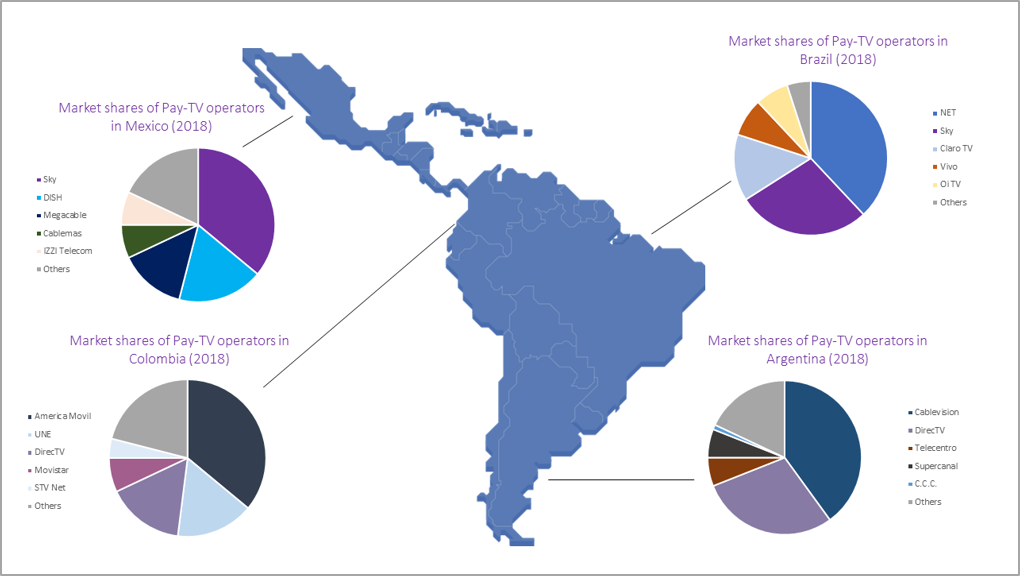
When it comes to the key stakeholders in the Latin American Pay-TV market, Sky dominates the market in Mexico, followed by DISH. In Brazil, NET has the leading position, closely followed by Sky. In Argentina, Cablevision and DirecTV lead the market, whereas America Movil, Movistar and DirecTV are particularly strong in Peru, Chile and Venezuela.
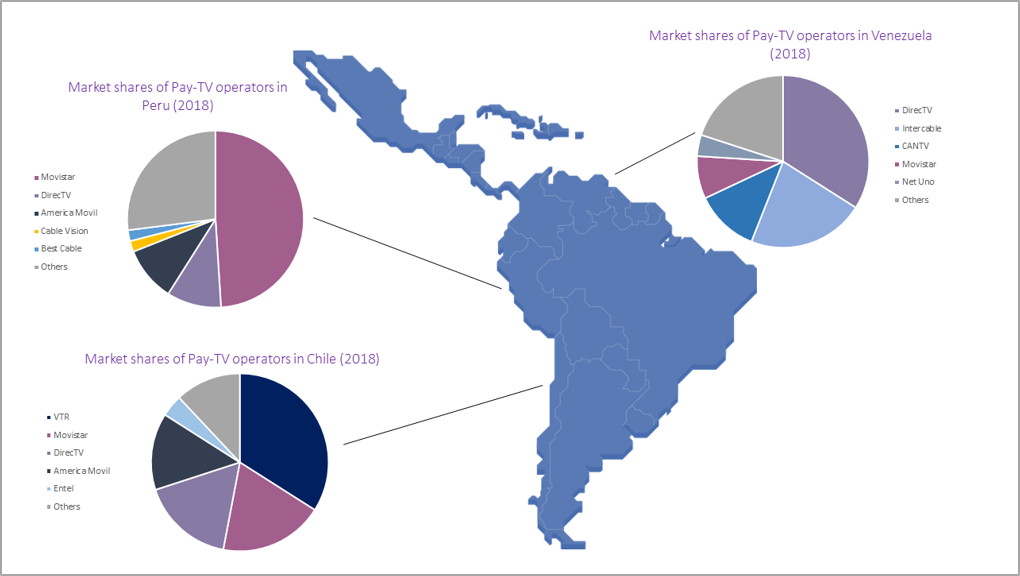
Source: Business Bureau S.A., IABM
OTT
Pay-TV providers in Latin America have focused their investments on basic Pay-TV functionalities like IP-connectivity and PVR and in addition to these they have invested in OTT services. The growth of the digital video market in the region is driven by consumer demand for content delivered to multi-devices. Hence, Pay-TV operators are investing in standalone OTT services, next-generation set-top boxes and multiscreen TV everywhere solutions. Also, some of them are focusing on finding ways to address the large base of low-income consumers. Industry participants are optimistic about opportunities for standalone, OTT app-based Pay-TV services, especially because these types of services are a valid alternative to traditional Pay-TV.
According to eMarketer, there were about 290 million digital video users in Latin America by the end of 2019. By 2023, this figure is expected to rise to 318 million (accounting for nearly half of the region’s population) thanks to the rapid growth of the mobile phone market. With the rise of LTE and smartphone tools, mobile operators have become ideal partners for OTT providers. Therefore, subscription-based video on-demand (SVOD) OTT viewership is rising in Latin America, particularly in Mexico and Brazil. Data from Digital TV Research shows that SVOD subscriptions in Latin America are forecast to increase from 27 million in 2018 to 51 million in 2024. While several mobile and Pay-TV operators provide free and limited SVOD platforms to their top paying subscribers, SVOD is expected to remain Latin America’s largest OTT revenue source – generating US$6 billion – by 2024. Brazil will continue to lead the SVOD market in terms of revenues, accounting for 40% of the region’s total by 2024, followed by Mexico (24%), according to Digital TV Research.
In Latin America, there is currently no local player that offers the same vision, catalogue and presence as Netflix. Local major OTT players include Claro Video, HBO Go, Movistar Play and Blim. In general, streaming services entering the Latin American market have relatively few entry points into the home. The key device for streaming video consumption is the Pay-TV set-top-box, whereas the adoption of low-cost connection devices (e.g. Apple TV, Roku, Amazon Fire Stick) is slow.
According to Business Bureau S.A., Netflix’s market share in the whole region accounts for 18%, followed by Claro Video with 4% and HBO Go with 3%. Telecom and Pay-TV operators have had the advantage over Netflix in offering local content that attracts audiences, but the OTT giant is already expanding its investments in the region with new original series filmed entirely in Latin America. Amazon – which is also expanding its presence in the region – has recently made a deal with Viacom International Studios, in which Amazon Prime Video is the exclusive streaming provider for several local productions in Latin America.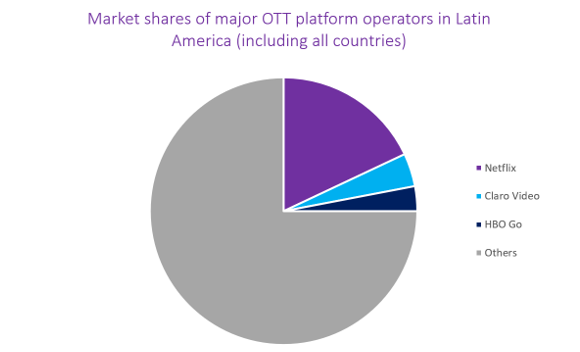
Source: Business Bureau S.A.
Netflix is continuously expanding its presence in the region with original series filmed entirely in the Latin American countries. Telefonica, the Spanish operator, signed a deal with Netflix to integrate the OTT service into its platform. The partnership covers all the countries in Latin America where Telefonica already operates, with Mexico and Brazil the most promising new markets. In practice, this meant that the Netflix app was integrated into Telefonica’s set-top-boxes and became accessible from the Movistar Play Video OTT service. Fox Sports Latin America launched its OTT service in 2019 in Mexico and Central America, offering wide coverage of local and international sports events to the users.
Claro Video entered a partnership with Opera TV and thanks to the deal, the premium video on demand service will boost its presence in the growing Latin American market, making its content available on a variety of ecosystems and devices. One more platform that is growing and providing interesting content to the Latin American region is Blim. It is the OTT service launched by Grupo Televisa in 2016 and focuses on international series in Spanish, but mainly Televisa’s original and archived content.
Facebook is clearly a key stakeholder in the region. In the second half on 2018 the social media platform signed a partnership with UEFA Champions League across Latin America. Peter Hutton, Facebook Head of Global Live Sports Programming, said that the largest online social media platform will have exclusive free-to-air rights to 32 live matches each season until 2021, including the UEFA Champions League final and the UEFA Super Cup, and that it will deliver innovative viewing experiences to the communities. The matches are available on UEFA Champions League’s Facebook Page. OTT provides opportunities to deliver programming to viewers particularly in the field of sports such as the Copa America tournament, which included live streaming from DirecTV sports and Telemundo Deportes En Vivo. Telemundo also belonged to the official Spanish-language broadcasters for the Women’s World Cup in 2019.
DAZN entered the Brazilian market with the transmission of one Serie A match on Facebook and YouTube and in 2019 the company launched its own OTT service. Also, Facebook won the rights from Conmebol for the Copa Libertadores, South American club soccer’s premier competition. The deal will run from 2019 to 2022 and will enable streaming through the social media platform in all Conmebol’s member nations.
Original content and engagement are a major selling point for consumers and more broadcasters are looking to stream content direct to consumers. Broadcasters were very busy during the summer of 2018 because of the FIFA World Cup in Russia. Latin American broadcasters like DirecTV, Globo and Televisa were the big players involved in the football event. DirecTV delivered 4K content to Argentina, Chile, Colombia, Ecuador, Peru and Uruguay. In Mexico, Sky carried the coverage on Pay-TV, while TV Azteca and Televisa broadcasted the matches in FTA. In Brazil, the main market player was Globo, which broadcasted all the matches – some live through its FTA channels and some through the Pay-TV network SporTV. FOX Sports transmitted the event for Pay-TV subscribers and in the same year it formed a partnership with Formula 1. The deal consists of five years of exclusive broadcasting of the FIA Formula 1 World Championship on TV and digital platforms through Latin America, with the exception of Brazil. The deal includes 300 hours of live broadcasting on FOX Sports, FOX Sports 2 and FOX Premium Action channels.
Media Technology Demand Drivers
Transition to Digital Broadcasting
The transition to digital broadcasting in Latin America has not been a homogeneous process. The switchover requires coordination between different parties to ensure the smooth transition between analog switch-off and digital switch-over, whilst maintaining efficiency and minimizing issues. This can make it difficult to implement the transition effectively and achieve tight deadlines, especially when each country is dealing with its own individual economic and political challenges.
Latin America is a developing region, where income inequality remains the highest in the world. Low incomes are a significant challenge to the transition to digital broadcasting as households do not have the disposable incomes to purchase new digital equipment (STBs or digital converters). Therefore, governments often have to promote the switchover and fund the purchase of digitally compliant devices for them.
As of 2019, Mexico was still the only country that had completed the analog switch-off (ASO). The main challenges that the region has been facing are the lack of government support and the inability to manage economic and political issues. However, the transition from analog to digital broadcasting has been appealing for many governments in Latin America, and several countries are in the midst of the transition process. Argentina and Colombia had set the deadline for the analog switch-off to 2019, but as of writing this report in January 2020, there was no information available about the final completion of the transition process in these countries. Chile, Peru and Paraguay expect to complete their digital transitions by the end of 2020.
- Mexico: The country started the analog switch-off in 2004 and was the first country to complete it in the region. The Mexican government chose the digital terrestrial television (DTT) technology standard used in the US, because the US completed the transition a few years before and being on the border, Mexico facilitated users to start to use set-up boxes or television sets with ATSC standards. Another incentive for this choice was exports; Mexico is a big producer of television sets and using the same standard as the US has helped the production and export of sets to the US. Many families in Latin America cannot afford new digital television devices and thus the Mexican government has subsidized 14 million high-definition (HD) television sets to the low-income families to speed up the transition.
- Brazil: The country’s transition has been quite slow. The analog switch-off started back in 1999, and the west of Paraná and the south of Rio Grande do Sul were the first cities to complete the transition. In inland parts of the country, the process should have been finalized by the end of December 2018, together with Rio de Janeiro and São Paulo. However, as of November 2018, the share of population reaching digital signal in these cities stood at 87% and 89% respectively, which meant that the switch-off – requiring that minimum of 90% of population can reach digital signal – had to be postponed. The new deadline is set to 2023. Brazil chose the Integrated Service Digital Broadcasting, the terrestrial standard (ISDB-T) originally developed in Japan, but now deployed with a different compression system and renamed the Brazilian Digital Television System (Sistema Brasileiro de Televisão Digital, SBTVD). This system has subsequently been adopted by other countries in Latin America and only Colombia, Panama, Suriname and Guyana adopted terrestrial Digital Video Broadcasting (DVB-T), used by most European countries. Brazil has been providing a low interest loan from the Bank of Brazil for BRL 1400 (USD 600) to low-income households to accelerate the transition.
- Argentina: In March 2019, the government in Argentina postponed the analog switch-off by two years from August 31st 2019 to August 31st 2021. According to the National Telecommunications Agency (Enacom), the deadline was postponed because the government could not guarantee that all the households would continue to have access to the existing services after the analog switch-off. Argentina established its own standard – the Argentine Digital Terrestrial Television System (SATVD-T) – which will be adopted when the digital broadcasting infrastructure is fully in place.
- Colombia: Colombia started its process in 2009 and adopted the European DVB-T standard. The original plan was to provide the entire population with the digital signal by 2015, but the deadline has continuously changed. As of March 2018, 85% of Colombian households were already covered with DTT connection. The latest, revised deadline was scheduled for December 31st 2019.
For the rest of Latin American countries, the deadlines are quite difficult to predict. Chile has announced that it is unlikely to meet the April 2020 deadline for its analog switch-off, even though the country has made significant progress in working with TV channels to accelerate the transition process. Paraguay’s analog switch-off will start in 2021, according to the country’s telecommunications regulator, Conatel.
Governments have a massive impact on the transition to digital broadcasting in Latin America and not all the countries have enough resources to provide loans or offer television sets to households, which continues to affect the speed of the transition process in some countries.
Transition to HDTV and UHD
HD
The transition to digital broadcasting has been a major growth driver of high definition television (HDTV) in Latin America. Compared to Europe and North America, the transition to HD is still far from reaching maturity in the region. Today, HD remains a differentiator primarily offered by Pay-TV operators to maintain a competitive advantage over other market players, and hence most HD channels are still offered by them. In recent years, the increase in number of digital TV subscribers as well as the development of satellite broadcasting have boosted the growth of HD channels in Latin America, where satellite providers have entered to compensate for low growth in maturing markets such as North America and Europe. In Latin America, satellite DTH has been and will remain the dominant platform for several more years, as fixed-broadband penetration is still low (about 12.3% in 2017). Households in Latin America are using mobile broadband systems to access the internet, and these systems are not ideal for IPTV or OTT Pay-TV at the moment, largely due to high bandwidth charges. Thus, it is more profitable to deliver linear television by satellite than by 4G wireless systems. Due to this, DTH and other satellite services are growing at a modest pace, and the poor overall development of telecom/broadband infrastructure in the largest markets like Brazil helps in giving stability to business in the satellite sector.

Source: Dataxis
Given the growth in the number of satellites delivering signals to DTH households in Latin America in the coming years, major satellite Pay-TV operators such as Claro, DirecTV Latin America, Dish Latino and TuVes Digital are preparing for the intensifying competition by coming up with new business models. For example, TuVes Digital, which targets emerging markets in Latin America, uses capacity on Telesat’s Telstar 12 Vantage satellite, through a prepaid model. Beyond the prepaid solution, TuVes has a wholesale business where it approaches larger and smaller operators, cable companies, mobile operators, telcos and cable associations so that they can launch their DTH satellite service based on TuVes’ satellite and software platform. TuVes is thus growing through both the wholesale model and by selling direct to customers. Its offer is based on having a low average revenue per user (ARPU), but having a high-quality service based on satellite. As HD channels are currently offered mainly by Pay-TV operators, the expected growth in the Latin American Pay-TV market indicates a healthy growth of HD channels, particularly in Mexico and Brazil.
When it comes to HD penetration, an estimated 54% of Latin American homes with a television had an HD screen in 2016, and the share is forecast to reach 76% by 2022, according to Dataxis. HD penetration rate by country, measured as the share of households with an HDTV set out of total Pay-TV households, grew from 73.4% in 2016 to 99.9% in 2017 in Brazil. This means that nearly all households subscribing to a Pay-TV service in Brazil had installed a high-definition television screen (HDTV). Interestingly, the second largest Pay-TV market by subscriber base, Mexico, is still far behind the other key Pay-TV markets with its relatively low HD penetration rate of 42.9% in 2017. This is partly explained by the fact that Mexican households can enjoy free FTA TV in digital and HD throughout the country, and households can access up to 30 HD channels currently for free. With the analog switch-off in Mexico, the signal quality has improved enormously and there is much more high-quality content available on FTA channels. Nevertheless, as shown in the chart below, HD penetration has grown significantly in all top Pay-TV markets in the region over the past few years. This indicates strengthened demand and interest in HD content on the consumer side, which has translated into a rapid growth of the installed base of HDTVs.
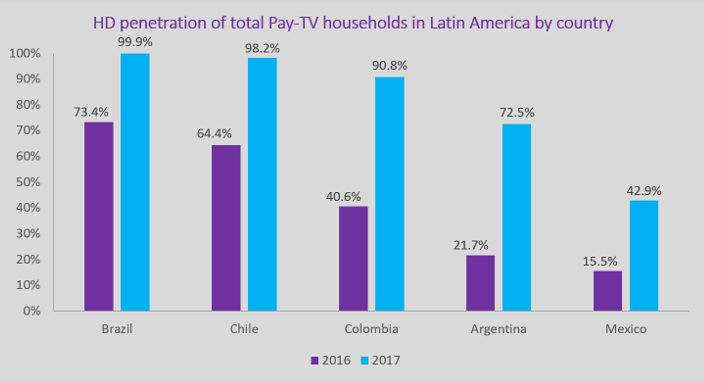
Source: Dataxis
In terms of the number of HD channels, Brazil and Mexico have the largest number of HD channels, followed by Argentina, Colombia, Chile, Peru and Venezuela. As the number of DTH households grows, many Pay-TV operators continue to add HD channels. For example, Sky Brazil added nine HD channels in 2017. Other Pay-TV operators are also adding new HD channels to their offering – Argentina’s largest Pay-TV operator, Cablevision, has brought its offering up to 70 channels during 2017 and 2018.
UHD
The transition to UHD is still at a very early stage in Latin America, as most broadcasters are focusing on upgrading their infrastructures to HD. Even though the Rio de Janeiro 2016 Summer Games accelerated the adoption and increased the number of UHD-related initiatives by broadcasters, the transition to UHD as a whole remains slow and market growth relatively modest in Latin America. The recent economic crisis in the region, decline in consumers’ disposable income and social instability in certain countries such as Mexico and Brazil have further delayed UHD/4K initiatives.
In Latin America the largest operators are driving the transition to UHD, as they see it as a real differentiator in the future. According to Embratel Star One, one of the largest satellite operators in the region, there is a move to combine DTH and IP, while the demand for UHD is not strong yet. Nevertheless, the satellite operator estimates that within two years the advent of the new H265 format (HEVC-High Efficiency Video Coding) will bring a much more efficient compression scheme that will help the deployment of UHD in satellites.
Compared to global markets, the distribution of households with UHD/4K TVs in Latin America (10%) is still far behind North America (30%) and Western Europe (20%). According to Strategy Analytics’ estimate, about 25% of households in Latin America will have UHD TVs by 2020, which is slightly above the global average of 23%.
Even though the number of households with 4K UHD TVs is increasing, consumers need to be prepared for the fact that they may not necessarily have access to 4K content, but rather content with upscaled Full HD. This is largely due to the fact that many home networks will not be ready to stream or download huge amounts of data. Customers might also be unwilling to purchase an expensive subscription, which will only offer a small selection of content. In the past, most of the Full HD devices were sold long before there was a large selection of corresponding content in that format. This could possibly be also the case for 4K UHD content in Latin America.
The growing availability of 4K-enabled connected consumer hardware is reinforcing the role of OTT, which is already benefiting from traditional broadcasters’ slow pace on UHD adoption, who have to contend with 4K equipment upgrades and new workflows. As a result, some broadcasters have started to see internet streaming, rather than linear TV, as a more viable way to deliver UHD/4K content to audiences. By eliminating consumers’ need to upgrade set-top-boxes (STBs), internet streaming allows traditional broadcasters to reduce consumer prices and attract younger audiences particularly. Thus, due to the increase in internet streaming (also by broadcasters) and OTT services promoting 4K services as premium, the rate of traditional linear UHD TV channel launches slowed from 60 globally in 2017 to just 10 in the first half of 2018. In Latin America, the number of linear 4K UHD TV channels had increased from 5 in 2017 to 9 by July 2018. For example, Intelsat announced a partnership with Encompass Digital Media to deliver NASA TV UHD in Latin America, making NASA TV the first linear UHD channel available on Intelsat’s system for Latin American Pay-TV operators.
Similarly to other global markets, live sports is a key driver of UHD adoption in Latin America. For instance, Brazil’s largest media company Globo collaborated with Japan’s national broadcaster NHK during the Rio de Janeiro 2016 Summer Games and used UHD 8K for live transmission of the opening and closing ceremonies for the very first time. In April 2018, DirecTV Latin America launched a 4K UHD channel in Argentina, Chile, Colombia, Ecuador, Peru and Uruguay. In 2018, DirecTV – in association with ESPN – broadcast some matches of La Liga, Premier League and UEFA Champions League, and in June 2018 it covered the FIFA World Cup in Russia for the first time in 4K UHD. 64 matches of the FIFA World Cup were accessible in 4K UHD for over 8 million customers in Argentina, Chile, Colombia, Ecuador, Peru, Uruguay, Venezuela and the Caribbean. DirecTV’s interactive multi-camera system premiered for both teams in each match with 4K UHD and VR formats. To see content in 4K UHD, the viewer had to be a subscriber of the Pay-TV provider and have the DirecTV decoder with 4K UHD technology as well as a 4K UHD TV.
In Brazil, NET (América Móvil), the country’s largest Pay-TV operator, also announced the commercial launch of a 4K service for the 2018 World Cup by offering 56 matches in 10 cities. NET’s 4K content was available to customers of its Net Top HD plan as well as on the “Now” VOD platform. After the World Cup, both DirecTV and NET have continued to show other content in 4K like movies, documentaries and TV series on these channels. Globosat, another Latin American Pay-TV giant and Brazil’s leading content provider, also delivered a 4K HDR stream to a dedicated SporTV 4K application on Samsung 4K TVs during the World Cup. Globosat’s stream was enabled by the AWS Elemental Delta video delivery platform and AWS Elemental Live encoders, which processed HDR video from Russian stadiums. The full 4K HDR content was exclusively available via the special version of the Samsung SporTV 4K app. However, except the major sporting events such as the FIFA World Cup in Russia and the Summer Olympics held in Brazil in recent years, the offer of 4K content is still very limited in Brazil.
OTT and Multi-Platform Delivery
The OTT market in Latin America is growing, even though low broadband penetration and poor broadband speeds are hindering its development. The number of fixed-line broadband subscriptions is still low, and a minority of these subscriptions provide connections faster than 4 Mbps, which is the minimum requirement to stream HD video. Hence, much of the internet access happens via mobile phone. Underdeveloped payment infrastructure is also hindering the growth of the OTT market – many Latin Americans do not have a bank account or a credit card, which is perceived to be a major barrier to premium OTT take-up.
Recent market dynamics indicate that the relative importance of OTT will grow substantially in the region, even though Pay-TV penetration is significantly higher than that of OTT. In Latin America, penetration of OTT services is driven by technological development and quality of broadband services, especially mobile broadband. Data from Digital TV Research shows that SVOD subscriptions in Latin America are forecast to increase from 27 million in 2018 to 51 million in 2024. It is estimated that nearly a third of the region’s TV households will pay for an SVOD package by 2024, significantly up from 13% by the end of 2017. Mexico is estimated to have become the largest OTT market in the region in terms of SVOD subscriber base in 2019, and by 2023 it will account for 36% of SVOD subscribers in Latin America, followed by Brazil (27%).
In terms of revenue, SVOD will remain the largest OTT revenue source, rising to US$4.4 billion by 2023. As shown in the chart below, the top five countries in Latin America will generate US$5.3 billion in revenues by 2023, which accounts for 83% of the regional total.
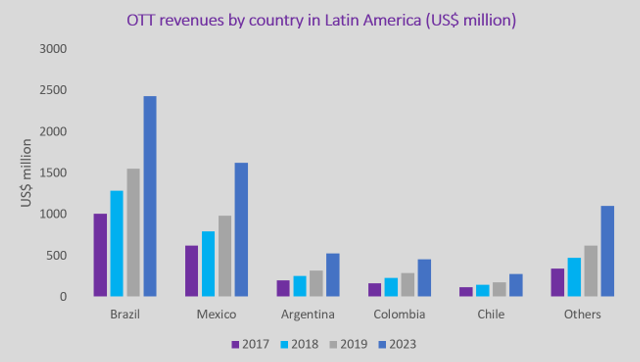
Source: Digital TV Research
OTT players in Latin America benefit from the current regulatory environment, which sets OTT service providers free of any specific regulation compared to Pay-TV, which is subject to a strong sectorial regulatory burden on concessions, licenses, content and publication, retransmissions of content, protection of user rights and delivery of information. This regulatory asymmetry creates a distortion that reduces the competitiveness of traditional services, as Pay-TV-specific levies have a direct impact on the cost of service for users. As a result, a growing number of Pay-TV operators are launching their own standalone streaming services to compete directly with new OTT players like Netflix, Amazon Prime and other OTT video companies. These virtual Pay-TV alternatives to traditional Pay-TV are more flexible and priced lower than operators’ core offerings. Local media companies are also increasingly partnering with Pay-TV operators to offer subscribers free access to their VOD libraries and streaming services. However, as substituting Pay-TV subscriptions with OTT means lower average revenue per user (ARPU), they are worth less to operators.
As discussed in earlier chapters, the key OTT players in Latin America include Netflix, Amazon Prime, Blim, Movistar Play, Claro Video and HBO Go; combined, they are estimated to account for 91% of the region’s paying SVOD subscribers by 2023. Netflix, which is currently the market leader in the Latin American OTT market, launched its service in the region in 2011 in an agreement with regional broadcasters such as Grupo Televisa and TV Azteca. Both foreign and local content is available on the platform, with Brazil and Mexico being the largest markets in the region. According to Frost and Sullivan, Brazil was Netflix’s fourth-biggest market after the US, Canada and the UK with 3.5 million subscribers in 2017. Since then, the OTT giant has continued rapid growth in the country; in September 2019, Netflix announced that it surpassed the mark of 10 million subscribers in Brazil, having a larger subscriber base than any Pay-TV operator in the country. The figure below shows the key OTT players and total OTT revenues in the top five countries in Latin America.

Source: Digital TV Research, IABM
Major broadcasters like Globo and Televisa have woken up to the growing threat of OTT offerings and have launched their own streaming apps for connected TVs and devices. For example, in 2016 Televisa launched its own OTT service, Blim, which focuses on original local content, and announced that the company will withdraw its content from Netflix, when the collaboration agreement ends between the two companies. Movistar Play, Claro Video and HBO, in turn, are attracting more subscribers, who can access these platforms for free as part of their mobile subscriptions or as part of their Pay-TV subscription. Some smaller Pay-TV operators like Oi have allowed their broadband customers to access a range of Pay-TV content on the OTT model. Such a business model combining broadband, mobile and TV has been fundamental for Oi to maintain the base of fixed services. Oi’s strategy has been to focus on hybrid boxes connected to broadband VOD content, and its VOD platform now has 30,000 pieces of content and 46 channels (of which 25 are linear) that are offered in the OTT model. Sky’s strategy to maintain its strong DTH product also combines broadband content, connected hybrid boxes and VOD, while satellite distribution is the basis of Sky’s business. In 2017, Sky invested nearly US$1.5 billion in a new giant satellite Sky B1, which has allowed company to launch over 100 channels. To compete simultaneously in the OTT market, Sky has developed Sky Media Center, an advanced box that can connect to the internet and additional points for Wi-Fi for the distribution of content inside the house. The box can record content from five channels based on the habits of the subscriber and offer them on demand.
As a response to the intensifying competition, Netflix has increased investment in local content and talent. In order to attract new audiences with local content, Netflix announced in 2017 that a new original series called Diablero would be filmed in Mexico; a second season is expected in 2020. Netflix continued to invest in content and talent from Latin America also in the field of stand-up comedy specials, with 21 new comedians from Argentina, Chile, Colombia, Mexico and Brazil hitting Netflix throughout 2017 and 2018. In May 2019, Netflix announced that it is partnering with popular YouTubers from Latin America to promote its local content and to engage with its local audiences. Lack of local content on OTT service platforms has recently become a concern in several Latin American countries. In October 2018, the Mexican Chamber of Deputies expressed its intention to establish a 30% national productions quota for streaming platforms like Netflix, Claro Video and Blim.


