Riedel – Bridging the Gap: How AV and Broadcast Boundaries Are Dissolving to Create a Unified Production Ecosystem

Joyce Bente, President and CEO at Riedel North America
In recent years, the distinction between professional AV and broadcast has begun to erode — not by chance, but through a shared evolution in technology, user expectations, and production goals. Once distinct markets with different tools, workflows, and stakeholders, AV and broadcast are converging into a unified production ecosystem.
This convergence is reshaping how content is created, managed, and delivered across a wide range of environments — from stadiums and theme parks to corporate campuses, houses of worship, and cruise ships. The result is a new production landscape where the demand for agility, quality, and scalability is universal, and where technology must meet the needs of both traditional broadcasters and modern AV users.
A Convergence Rooted in Shared Standards and Shifting Expectations
At the heart of this shift is the widespread adoption of IP-based workflows and industry standards such as SMPTE ST 2110 and AES67. Once confined to live broadcast control rooms and OB vans, these protocols are now being implemented in stadium AV systems, corporate networks, and even cruise ship infrastructures.
These standards enable interoperability, decentralization, and scalability — capabilities increasingly demanded across the board. Whether coordinating a live sports production or managing a multi-campus university’s AV setup, the expectations are the same: low latency, high reliability, remote control, and real-time communication.
As AV systems become more networked and software-defined, they start to “speak” the same language as broadcast, making it possible for solutions to serve both worlds.
New Users, Familiar Demands
The rise of hybrid workplaces, remote learning, immersive events, and large-scale live experiences has introduced AV end users to a level of production complexity that was once reserved for professional broadcasters. And with that complexity comes a rising bar.
From IT teams managing video distribution on cruise ships to entertainment staff coordinating parades in theme parks, users now expect broadcast-grade performance without the steep learning curve. They want:
- Intuitive control interfaces
- Seamless integration with existing IT systems
- Cloud-enabled and remote capabilities
- Reliable, scalable infrastructure
This isn’t just a change in technological demands; it’s a change in mindset. No longer exclusive to broadcast studios and control rooms, production is happening everywhere, and it needs to be supported accordingly.
Real-World Outcomes: A Unified Approach in Action
Take SoFi Stadium in Los Angeles, for example — a venue that functions simultaneously as a sports arena, concert venue, and content production hub. Here, a unified comms and signal transport infrastructure supports everything from NFL games to concerts and media broadcasts.
Or consider major cruise lines like Royal Caribbean, where AV and broadcast systems converge into a single network to support theater shows, ship-wide announcements, bridge communications, and guest entertainment. Technologies like fiber-based video, audio, and data distribution, along with IP-native intercoms, streamline operations across thousands of moving parts — all orchestrated with broadcast-level precision.
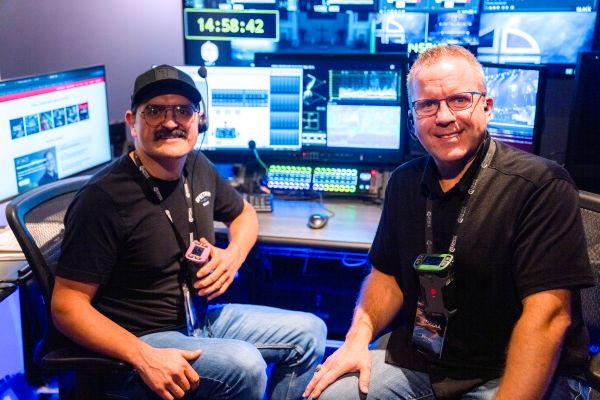
Houses of worship are also upgrading their production capabilities. For example, Prestonwood Baptist Church, one of the largest churches in the U.S., has implemented a unified solution, integrating intercom and signal distribution across its worship and media facilities to support large-scale services, live broadcasts, and special events with professional-grade reliability and quality.
These aren’t isolated cases. Similar integrations are happening in other venues, houses of worship, universities, theme parks, and government buildings. The production ecosystem is expanding and unifying.
Technology That Crosses Boundaries
Certain technologies are proving especially effective in bridging AV and broadcast:
- Intercom systems, originally built for live sports broadcasts and events, now underpin communications in venues, campuses, and hospitality spaces.
- Signal routing platforms designed for real-time, multi-format transport are being deployed in AV scenarios requiring low latency, high availability, and flexibility.
- PTZ cameras, once AV-centric, are now fully integrated into remote broadcast workflows.
- Cloud and virtual production tools, once novel in AV, are becoming crucial in broadcast for remote and distributed teams.
These solutions are not watered-down versions of broadcast tools. Instead, they are robust, resilient systems adapted to environments where reliability still matters, yet simplicity, speed, and user experience matter more.
A Shift in Strategy, Not Just Sales
For vendors crossing into both markets, this convergence is more than a revenue opportunity, as it represents a strategic shift in how products are developed, deployed, and supported.
AV projects often have faster turnaround times, tighter budgets, and different purchasing dynamics than broadcast. They prioritize ease of integration, lower total cost of ownership, and support from trusted integrators and consultants. Broadcast suppliers must adapt and rethink how they engage customers, design user interfaces, and package their offerings.
In return, working in AV sharpens a company’s approach to products:
- Simpler UX design benefits all users
- Scalable software models accelerate innovation
- Cloud-native architectures offer flexibility across verticals
Broadcast suppliers entering AV aren’t just growing their reach in a new vertical, they’re future-proofing their product portfolios.
The Future of Production: One Ecosystem, Many Use Cases
Over the next five years, production will be categorized less by labels like “broadcast” or “AV” and more by purpose and technology. Shared technologies and protocols will support a wide range of use cases.
The industry will see:
- Interoperable platforms that support everything from content creation to distribution, regardless of venue
- Hybrid teams where AV, IT, and media professionals work side by side — or may, in fact, be one person with combined talent
- Centralized control systems that manage decentralized workflows across multiple locations
- A continued push for cloud flexibility balanced with on-prem reliability
Rather than eliminating differences, convergence is ultimately about recognizing where goals and challenges align — and building systems that empower content creators, operators, and technicians across every space.
Final Thought: This Is Not a Trend — It’s the New Normal
The boundaries between AV and broadcast are dissolving — not because of technological coincidence, but because user needs and production environments demand it.
The most successful companies in this space will be those that understand both worlds and build for a future where the experience matters more than the label of broadcast or AV.
Whether it’s a concert in a stadium, a keynote on a corporate campus, a live-streamed lecture, or a live sports event, the expectations are clear: It has to work flawlessly, scale easily, and deliver professionally.
That’s not just AV. And it’s not just broadcast.
That’s the new ecosystem.