
BCNEXXT – From Rigid Rules to Adaptive Systems – Liberate Your Playout

Graham Sharp, VP of Sales and Marketing at BCNEXXT
Playout has long been weighed down by fixed, overprovisioned infrastructure designed to handle peak demands based on rules often set years ago. This model was built for reliability, but it locks broadcasters into paying for resources they rarely use. Large amounts of compute power, storage, and bandwidth sit idle for much of the day, creating operational inefficiency and inflating costs. Today, there is a smarter path forward. Static infrastructure can now be replaced with flexible, intelligent systems capable of scaling up in real time.
From Fixed Rules to Adaptive Logic
Modern playout is moving away from rigid, rules-based architectures toward adaptive logic driven by machine learning. This new approach behaves more like a system that analyses and thinks for itself. By examining the schedule and classifying each event according to its complexity, the system can automatically deploy containerized microservices and activate the required compute, storage, or graphics resources, then release them when they are no longer needed.
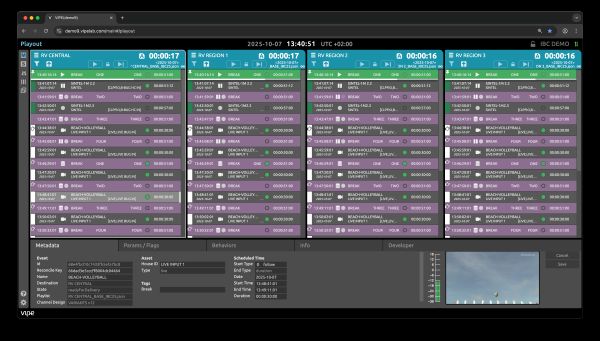
Leveraging machine learning, the system can pre-label upcoming content based on its requirements. Complex graphics or DVE effects can be routed to GPU instances, while simpler events such as static branding can be processed using CPU. This intelligent allocation ensures that every resource is used to its full potential while avoiding unnecessary overprovisioning.
This is a fundamental change in how playout is provisioned. Instead of preparing for the rare peak, capacity is assigned on demand, reducing idle time and freeing budgets from high fixed costs. For broadcasters and streaming operators, that means agility: the ability to adapt instantly to a breaking news stream, a live sports feed, or a temporary event channel without overhauling the infrastructure.
Only Pay for What You Play
At the heart of this model is a simple idea: resources should only be paid for when they are in use. This “only pay for what you play” approach severs the traditional one-to-one relationship between channels and servers, ensuring that resource usage is kept to a minimum while maintaining broadcast-grade quality.
In practical terms, high-compute tasks like rendering bumpers or promos can be centralized, processed ahead of time during regular office hours, and distributed to multiple channels. This pre-assembly of file-based content well before airtime not only reduces operational pressure but also enables smarter scheduling and staffing models. Once completed, the associated rendering resources can be powered down until needed again.
The same principle applies to live content, where extra capacity is activated only during the event itself and then released. For example, a live concert on Saturday might require an upgrade in capability for a single day. With adaptive logic, that upgrade can be switched on just for the duration of the event, using existing infrastructure more efficiently. On-premises setups benefit as well, since operators can average resources across multiple channels and time periods instead of buying servers for the absolute maximum load.
Agile, Resilient, and Future-Ready
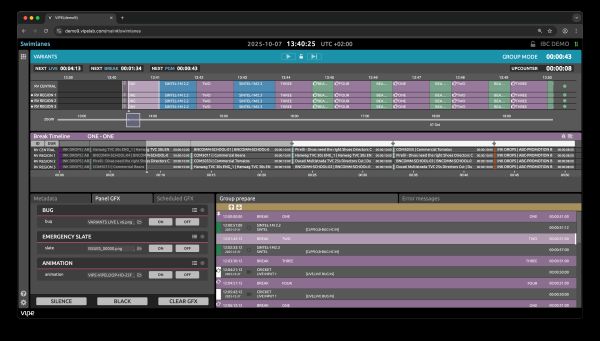
This flexibility extends beyond compute resources to the entire user experience. Even the interfaces adapt to the content type: when live events are scheduled, live monitoring and control tools appear, then disappear when the schedule returns to file-based playback.
Automation plays a critical role. Tasks that once required constant human oversight, such as ingest checks, scheduling alignment, and compliance verification, can now be automated. This frees teams from repetitive manual work and allows them to focus on high-value operational tasks. It also reduces the risk of costly on-air mistakes by ensuring that routine processes run consistently in the background.
The result is a playout ecosystem that is not only leaner and more efficient but also inherently more resilient. By using resources more intelligently, broadcasters can implement smarter redundancy strategies, reduce operational risk, and respond quickly to changes in programming.
For broadcasters, streaming platforms, and media networks, the benefits are immediate: lower infrastructure costs, better use of existing hardware, more agile workflows, and staffing models built around efficiency and adaptability. This is playout designed for the realities of today’s media landscape — flexible, intelligent, and ready for whatever comes next.


