Amagi – Engineering Resilience: How Cloud-Based Disaster Recovery Is Future-Proofing Broadcast Operations
In a digital-first broadcasting world, resilience is no longer a reactive capability – it is a strategic imperative. The modern broadcaster operates within an unforgiving landscape: a single minute of downtime can translate into millions in lost revenue, compromised reputations, and a fragmented viewer experience. For an industry that still benchmarks uptime in “five 9s,” the margin for error is vanishingly slim.
As broadcasters expand globally across linear, FAST, OTT, and hybrid delivery ecosystems, traditional disaster recovery (DR) paradigms, built on mirrored infrastructure and hardware redundancy, have begun to show their age. What the industry needs is not just continuity, but continuity with agility, scalability, and cost-efficiency. This is where cloud-native disaster recovery is redefining the blueprint for operational resilience.
Systemic inefficiencies in legacy infrastructures
Traditional DR strategies are typically rooted in physical replication, duplicating on-premise infrastructure in geographically dispersed locations. This approach is relatively expensive, complex to scale, and largely reactive. Tier-1 channels may receive dedicated backup systems, but Tier-2 and lower channels often operate without adequate protection. Moreover, DR infrastructure is usually underutilized, consuming resources while sitting idle until catastrophe strikes.
Operational limitations are further compounded by the rigidity of hardware-based systems. Maintenance is manual, scalability is difficult, and recovery is sluggish, often taking hours to resume playout during an outage. Testing cycles, if they exist at all, are sporadic and labor-intensive. The demands of continuous, cross-platform broadcasting are beginning to outstrip the capabilities of traditional continuity models.
Cloud as the catalyst
Cloud technology introduces a paradigm shift by embedding resilience into the very fabric of broadcast workflows. Rather than treating DR as a bolt-on fail-safe, cloud-based disaster recovery transforms it into an agile, integrated system – one that supports proactive planning, seamless failover, and cost optimization.
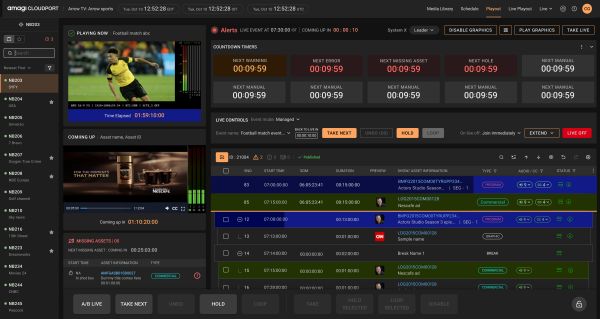
Solutions like Amagi CLOUDPORT exemplify this evolution. Operating as a cloud-native platform for automation and playout, CLOUDPORT enables broadcasters to virtualize every link in the content chain, from ingestion and scheduling to live and VOD delivery while building DR capabilities directly into the core architecture.
Learn how Sinclair recovered quickly after a KTXS tower collapse using Amagi’s cloud-based DR – https://www.tvtechnology.com/news/cloud-based-workflows-speeds-ktxss-recovery-from-downed-tower
The DR Spectrum: Configurations that scale with need
One of the key advantages of cloud DR is the ability to tailor configurations based on channel criticality and budget. Amagi categorizes its DR models into four tiers:
- Hot DR: Offers real-time synchronization and dual-site playout for near-zero downtime failover. Ideal for Tier-1 channels where even seconds of disruption are unacceptable.
- Warm DR: Maintains live automation with on-demand playout spin-up, balancing fast recovery with lower operating costs.
- Cold DR: Activates automation and playout only during emergencies, minimizing cost for channels with less stringent uptime requirements.
- On-prem Survivability: For broadcasters maintaining hybrid workflows, this option allows up to 48 hours of localized playout in the event of cloud/network outages.
This graduated model empowers broadcasters to apply granular resiliency, ensuring each channel receives the right level of protection without blanket CapEx outlays.
Resilience by design: Key cloud advantages
At the heart of Amagi’s DR strategy is a Kubernetes-based self-healing architecture, enabling automated isolation and recovery of faulty components. This design not only reduces the blast radius of failures but also simplifies operations by minimizing manual intervention.
Further differentiators include:
- Automated Failover: Sub-minute recovery in Multi-AZ deployments and 10-minute recovery in Multi-Region setups.
- Global Coverage: Cloud deployments across time zones eliminate the constraints of location-bound infrastructure.
- Periodic Testing: Scheduled DR drills and test endpoints help verify readiness, adapt configurations, and maintain compliance with evolving SLAs.
These features coalesce to deliver a resilience posture that is not only robust but intelligent, adapting in real time to operational conditions.
Strategic implications for Broadcasters
The move to cloud-based DR isn’t just a technical upgrade – it’s a business transformation lever. By replacing CapEx-heavy infrastructure with scalable OpEx models, broadcasters gain the financial agility to invest in content and audience strategies rather than sunk infrastructure costs.
Beyond safeguarding operations, cloud-based disaster recovery functions as a strategic catalyst for broader cloud transformation. By virtualizing essential broadcast infrastructure in pursuit of resilience, organizations establish a foundational layer upon which full-scale migration to the cloud can be methodically built, enabling a phased, low-risk transition from legacy systems to agile, scalable architectures. Crucially, this evolution is in lockstep with the industry’s transition from SDI to IP-based workflows, positioning the cloud not merely as a failover environment, but as the core enabler of next-generation playout, distribution, and monetization strategies.
Reinventing Resilience: From Compliance to Competitiveness
DR has traditionally been seen as an insurance policy – essential, but dormant. Today, it is emerging as a competitive differentiator. In an era of climate volatility, geopolitical risk, and escalating cyber threats, broadcasters must engineer resilience not around the probability of failure, but the assumption of it.
Amagi’s cloud-first disaster recovery model exemplifies how resilience can be embedded into the core of operations, not just protecting business continuity but enabling it. It is a call to reframe DR from an obligation to an opportunity, to not just survive the storm, but to broadcast through it.