In Conversation with Tedial

In this IABM TV interview, Julián Fernández-Campón (Chief Technology Officer, Tedial) explains how Tedial customers can access their MAM from home irrespective of whether it is an on-premises, hybrid or full cloud solution in order to continue working in a ‘business as usual’ scenario.

Q1) The global COVID-19 pandemic has had a major impact how people across the industry work. Can you explain how Tedial customers can access their MAM from home irrespective of whether it is an on-premises, hybrid or full cloud solution and continue working in a ‘business as usual’ scenario?
Q2) Your HYBRID CLOUD architecture combines best of both worlds. Can you explain how it works and why this is beneficial for users?
Q3) We understand that you’ve made some enhancements to your award-winning SMARTLIVE sports and live events solution. Can you explain what these are and the benefits that they provide broadcasters?
Q4) Continuing Tedial’s participation in the IMF User Group, HYPER IMF maintains its position as the singular end-to-end IMF workflow. Can you explain how the solution’s flexible and field proven architecture can be deployed?”

In Conversation with Object Matrix

In this IABM TV interview, Jonathan Morgan (CEO, Object Matrix) discusses the most important storage considerations & what’s new with MatrixStore.

Q1) What are the most important storage considerations right now?
Q2) How important is data analysis for your customers?
Q3) How are global teams impacting media workflows?
Q4) What is new with MatrixStore?

In Conversation with Touchstream

In this IABM TV interview, Brenton Ough (CEO, Touchstream) discusses some of the challenges faced by streaming video distributors related to QoS/QoE.

Q1: What are the challenges faced by Streaming Video Distributors related QoS/QoE?
Q2: When video delivery issues are found, how do you identify and fix the problem if it is with a third party, for example a CDN?
Q3: What is the biggest issues given the current situation of people working at home?

Special Report – Monetize – making it pay

The Monetize segment of the BaM Content Chain® is about managing business processes for content rights and royalties, scheduling linear and non-linear services, subscriptions, and selling and managing advertising. In short, how broadcast and media companies make money; Arvato Systems’ Portfolio Manager, Ben Davenport, sums this up perfectly: “Put very simply, media is monetized through advertising, subscription service or, decreasingly, public funding or subsidy.”

We asked six IABM members to explain the drivers of change in this vital segment of the BaM Content Chain® and talk through the opportunities and challenges they are facing today, and what the future holds.

Drivers of change

“There has been a significant trend towards subscription services in the last years, with Netflix and Amazon dominating, now being hotly challenged by Disney and others, while some ad-driven services, such as YouTube are also now generating a significant, and growing, proportion of revenue from subscriptions,” Ben Davenport continues. “The increasing competition here
means that media companies need to offer the best and broadest catalogue of content, in turn requiring them to maximize usage of content they own or have rights too.

“For media companies relying on advertising revenue, competition in the past decade from ‘digital’ or ‘online’ has driven a lot of innovation in the ad sales space for TV. And despite ‘stable’ viewing numbers, ad revenues for TV continue to grow and there is still fierce competition between platforms and media companies which continues to drive change and innovation,” Davenport adds.

Keep adapting

David Candler, Senior Director, Customer Solutions at Veritone, also sees the squeeze on the traditional broadcast model driving innovation. “Consumption platforms are growing and content experiences on mobile devices means that the M&E industry (e.g. studios, production houses, broadcasters, distributors, etc.) can now take advantage of new revenue options as they directly access the consumer’s device.

“For those in M&E relying on more traditional commercial models, there will need to be a realization of the new content and consumption models. They will need to rapidly assess and adopt new monetization methods; and keep adapting. Digital revenue streams are more and more in focus as these traditional sources become less effective. Digital, social media and OTT platforms are the new focus, with many rights owners are now building their own OTT outlets as the technology becomes more usable, cost effective and accessible. Adopting new advertising, subscription and other transactional revenue lines across these types of platforms is happening at a rate of knots. Content personalization also means that data and analytics is crucial to enable monetization (i.e. targeted content and ad-campaigns, etc.) as once again consumer activity drives changes in technology and revenue. In summary, there will be a lot more competition in the overall marketplace in terms of who the consumer decides to spend their time and money with,” Candler asserts.

“Ad-based monetization must be balanced by maintaining a high quality of viewer experience,” says Sam Jenning, Solutions Architect, Conviva. “As viewers are increasingly sensitive to heavy ad loads, repeat ads, and irrelevant or useless ads, especially on VOD content, publishers are shifting to server-side ad insertion – dynamically inserted ads personalized to individual viewers.

“With increased choice in the market and more ad-free services, consumers that can buy their way out of viewing ads will likely do so,” Jenning continues. “To enable this, the market is transitioning as providers experiment with varied business models that give consumers options ranging from truly ad supported to fully subscription based. In the middle is the hybrid model, which has evolved to become very successful in terms of monetization. It is expected that many SVOD and AVOD services will move towards the hybrid model as they look to monetize effectively. Privacy regulation will split ad sales into TV-like direct sold ads and campaigns intermediated by large tech or media conglomerates. Advertisers do not prefer panel or proxy metrics and will move to impression-based buys in walled gardens and large publishers as the measurement and service provided by those companies matures.”

Craig Buckland, CTO at Broadcast Traffic Systems, also identifies AVOD as the direction of travel. “We are seeing a distinct move towards Advertising Video on Demand services with consumers prepared to sit through ads for free content. At the same time, advertisers are increasingly looking to book an integrated ad campaign covering all media types. This represents a great opportunity for broadcasters to maximize monetization options.”

“Media companies have to find new ways to monetize because consumers have access to a wide choice of premium content at no cost,” says Alex Wilkinson, Head of Sales and Marketing, EMEA & LATAM, Accedo. “For some services, subscription models still work, but as many consumers have started to reduce the number of paid subscriptions, some providers are undoubtedly missing out. This means that they either need to offer something compelling enough to make consumers willing to pay or look to monetize through advertising.”

Serving multiple platforms

We asked our correspondents about the challenges of delivering ads to multiple platforms and how they are helping broadcast/media companies surmount these. As Craig Buckland of Broadcast Traffic Systems says, “The very complex nature of digital ad campaigns, coupled with the growing need to enable targeted ads and the lack of integration to existing workflows, is causing a massive challenge for broadcasters.”

“One of the primary challenges is to ensure a consistent user experience across all ads and content,” says Alex Wilkinson at Accedo. “This is especially difficult when it comes to new
innovative platforms, such as Augmented Reality, or low performing devices such as legacy set-top boxes. At the same time, media companies are looking to provide targeted advertising to deliver a more personalized and relevant experience. If done correctly, this can significantly increase the value of advertising and improve consumer engagement. The Accedo One platform ensures a consistent user experience for ads as well as for content. We have integrated our solutions, including our Augmented Reality experience, with Amazon Web Services (AWS) Elemental MediaTailor to enable targeted advertising.”

Metrics matter

“The main challenges of delivering ads to multiple platforms are fragmentation and lack of trust, user tracking, ad reach, and frequency,” says Conviva’s Sam Jenning. “Ad reach and frequency are metrics which have traditionally driven brand lift for linear television, and they have become very hard to measure for digital and OTT ads due to viewer fragmentation and measurement challenges across platforms. Ad buyers have to make sense of multiple reporting streams from individual publishers, and the publishers themselves might use a mix of direct and proxy reporting. Efforts to address this reporting have forced unreasonable overhead into publishers in the form of endless measurement SDK and reporting requirements. Lack of trust also limits the scale of ad campaigns that run.

“Conviva’s SDK, which is already deployed to the largest publishers in the world, combats this issue by powering the playback data used by technical operations teams,” Jenning continues. “This means Conviva provides validated, standardized metrics based on census measurement. Conviva enables media companies to run ad campaigns without the overhead of multiple measurement vendors, without dictating which currencies or platforms can be used, and with the potential to measure and report on metrics cross-device and at the household level.

“Another one of the key challenges for our customers continues to be tracking users across social media and owned and operated platforms to understand unduplicated reach as well as ability to track migration from one platform to another. With cohesive measurement across both channels, like Conviva offers, publishers are able to understand consumption and channel/platform performance in a unified manner to help determine optimal channel/platform mix,” Jenning adds.

Getting together

“As is often the case, the technological challenges are far easier to overcome than some of the change management in terms of process and organizations,” says Arvato Systems’ Ben Davenport. “While cross-platform advertising is a hugely attractive concept for many media organizations, getting past legacy structures is often the first hurdle in that transition. One of the ways we’re helping broadcast and media companies take on these challenges is to bring them together in a non-competitive environment to discuss and learn from each other’s experience. Facilitated by Arvato Systems, but with topics and presentations driven by ad sales professionals from broadcasters and media organizations across multiple regions, the Broadcast Sellers Circle does exactly that.

“Of course, we also help our customers delivering to multiple platforms by providing a cross-platform solution that enable them to easily create and adjust cross-platform campaigns. Along with the concept of ‘budget shifting’, we ensure that advertisers achieve their reach and frequency goals by dynamically moving placements between platforms depending on audience forecasts and postings,” explains Davenport.

Monetizing content in OTT

“We work closely with our customers to determine the best monetization strategy for their services, depending on a wide range of factors including content, demographic, platform scope, and more,” says Accedo’s Alex Wilkinson. “We then offer solutions and services to support whichever strategy suits each client, including Subscription, Video on Demand, Pay-for-Play, and Advertising Video on Demand. We help our customers define a feature set that best suits their offerings, such as paywalls, trials, and mixed-revenue models.

“Developing ways of monetizing new tech is also important and potentially lucrative. AR and VR offer unique mediums to deliver content to viewers’ homes. This also translates to fresh advertising opportunities, as brands are able to virtually place their products in the homes of potential customers,” Wilkinson adds.

Craig Buckland of Broadcast Traffic Systems sees an integrated, cross-platform approach as the answer. “We recently launched an advertising module that enables integrated linear and digital ad scheduling from one platform. The Digital Ad-Sales module allows advertising executives to fully integrate digital advertising on the major platforms into their linear campaigns. Broadcasters are able to manage advertising campaigns covering all media types. The module integrates both with broadcast automation solutions as well as with any ad platform server to ensure broadcasters can deliver and monitor the entire linear and digital campaign.”

Empowering media companies

“Conviva is already supported on OTT, CTV, and STB devices, while legacy measurement companies are still largely limited to web and mobile,” says Sam Jenning, and adds that “Conviva empowers media companies in five ways:

1. Technical analysis of playback and content engagement: Conviva provides clients with real-time data for every stream on every screen for every second of playback, including ad failure events typically missed by ad servers and analytics systems. Publishers use Conviva data to maximize inventory utilization and understand the relationship between ad load, content, and audience.

2. Building trust and reducing barriers to ad spend on historically measurable endpoints: For better or worse, ad buyers depend on legacy measurement which is tied to web cookies and mobile device IDs. By making OTT, CTV, and STB genuinely measurable, Conviva presents media companies with a path forward on these platforms that are otherwise disconnected from Internet 1.0 web-and-mobile verification vendors.

3. Providing AVOD household consumption graphs and segmentation: Conviva enables publishers to better understand viewers across services in order to maximize engagement based on viewer behavior. For multi-brand publishers, the consumption graph helps insights into maximizing share of viewing across a portfolio.

4. Enabling unified visibility into content consumption across all mediums including social media: This allows advertisers to optimize their advertising mix and understand what drives viewers to their owned and operated platforms.

5. Gain insights into social branded content, and track campaign performance: Utilizing social media enables publishers to unlock monetization opportunities with branded content and leverage their social channels to optimize monetization.”

Intelligent asset management

David Candler at Veritone sees intelligent asset management as key to monetization. “Our Digital Media Hub (our white label, content management and monetization hub) – fully integrated with aiWARE (our AI operating system) – is the future federation point for content owners to monetize their media assets. Industry data points to the growing importance of this type of intelligent asset management for the future of media owners’ businesses. More stakeholders (e.g. marketing, rights, production, post-production, partners, etc.) will increasingly turn to intelligent asset management to help them centralize and streamline their media processes, monetize their content, and drive growth in their businesses.

“Companies like Veritone are investing in this future by building and integrating relevant features into their products. Due to our robust and flexible APIs, we have the ability to expose the content residing in Digital Media Hub to multiple downstream distribution end-points such as OTT platforms, social media and applications through third-party technical partners, making it easy for additional direct-to-customer revenue streams to be activated quickly and efficiently,” Candler adds.

Open APIs are also key for Accedo, says Alex Wilkinson. “The total cost of ownership is currently high for video service providers, as they need to keep up with new tools and technologies and select different parts of the workflow from different vendors. Accedo One democratizes access to a flexible and scalable platform which includes open APIs to allow integration with a wide range of partners. This enables the use of best-of-breed vendor combinations instead of being forced into a boxed solution.”

What challenges does AVOD need to overcome to really take off?

It is becoming clear that many consumers are either unwilling or unable to pay for multiple subscriptions as the number of OTT platforms continues to grow rapidly. This is leading to a rise in the number of AVOD platforms around the world, where, as noted by Broadcast Traffic Systems’ Craig Buckland earlier, consumers are increasingly prepared to accept advertising rather than pay a subscription – particularly if it is relevant to them. “The main hurdle remains managing the complexity of OTT ads and enabling targeted ads,” says Buckland. “Broadcasters need effective ways to integrate delivery of ads across all platforms into their existing workflows, making it simple to enable ads, no matter the platform, as well as ensuring these can be effectively targeted to improve engagement. “

“Essentially, the industry needs to get better at collecting and actioning data,” says Accedo’s Alex Wilkinson. “AI and data-driven design can identify how consumers engage with certain types of ads or content to enable video service providers to better target them with appropriate ads.”

“One of the biggest barriers to AVOD is establishing legitimacy in the eyes of brands,” adds Conviva’s Sam Jenning. “If someone launches a digital-only business, they don’t have a history of demographic measurement, brand lift studies, or upfront presentations that can be used to land large advertising budgets. Independent AVODs have to generate the research and integrate measurement, like Conviva, in order to tell these stories. Another path for AVODs is to partner with established media companies, gaining legitimacy via the parent company’s ad sales while they build up this history.”

Is programmatic advertising the answer – or at least part of it?

Not yet – according to Sam Jenning. “Programmatic is still incompatible with long-form video due to inability to manage frequency and separate competing brands. On top of this, buyers remain wary of Server-Side Ad Insertion (SSAI), where requests may be spoofed and legacy measurement doesn’t work. Sellers need to stop accepting low CPMs and unpredictable fill rates, both of which are a spiral that drag down revenue and user experience.

“Looking to the future, for programmatic to work properly there will need to be mechanics which create trust, like third party granular ad verification, as well as greater adoption of solutions for long-from like PG, multi-bid, and pod-based ad request/response. Media companies need to make media matter again. Programmatic treats content as incidental, and that has to change,” Jenning warns.

Arvato’s Ben Davenport also sees limitations – but sees programmatic as useful in some cases. “Even where programmatic has been embraced and is in production, it is often only used for secondary or niche channels or off-peak programming. Advertisers and agencies know their targets, and in many markets will still insist on picking specific spots. It’s unlikely this will change for peak programming on primary channels, but we’ve been able to help our customers encourage agencies to utilize programmatic advertising by including an agency portal with our solution. This solution gives the agency direct access to define audience segments and target reach and frequency, as well as the campaign results, thereby enabling them to quickly see the benefits for them and their customers and doing so in way in which they’re familiar from digital advertising.”

Craig Buckland at Broadcast Traffic Systems notes that “The main challenge comes down to the complexity of programmatic advertising. In many cases, broadcasters are not setup to handle a mix of digital and linear ads which means that it becomes a very manual and laborious process. With our recently launched ad module, we are aiming to make it simple for broadcasters to deliver and monitor an integrated ad campaign for their customers.”

Is ad blocking still a challenge to monetizing?

Of course it’s no good basing your business model on advertising revenues if those ads are just going to get blocked at the consumer’s end. Craig Buckland adds: “Ad blocking remains a challenge, however there is evidence that consumers are turning towards ad-funded services in order to get premium content without the cost. According to Digital TV Research, for example, North American revenue from ad-support streaming platforms will nearly triple in five years. At the same time, targeted advertising makes consumers much more engaged with those ads and less likely to skip or block them.”

Conviva’s Sam Jenning also acknowledges that “Ad blocking is still a challenge, especially on mobile devices, desktop web, and by extension, SFV and news publishers. On VOD content, where viewers actively initiate a video, there is a higher tolerance for ads, but even so, Conviva measures 40 -70% of ad attempts are blocked on these devices. Server-Side Ad Insertion
(SSAI) technologies can potentially get around ad blocking, and more publishers are moving towards it even though ad blockers still impact ad measurement for SSAIs. The big picture answer is to move away from a mindset of maximizing video and ad metrics at the expense of user experience.”

And what about piracy?

Even the most perfect monetization efforts are wasted if consumers can simply access pirated content instead. Alan Ogilvie at Friend MTS lays out the stark facts: “When copyrighted content is redistributed without authorization on a large-scale, content piracy impacts customers, erodes brand and strips the bottom line of media and entertainment businesses around the world. The scale and financial implications of piracy today are well illustrated by individual cases. For example, one case of a piracy operation, Omniverse One World Television, was shut down in 2019 and agreed to pay a $50 Million settlement. In 2018 SetTV paid damages of more than$90 Million.

“These pirate subscription services not only steal content from legitimate providers, they steal their subscribers. For example, a survey conducted by YouGov highlighted the detrimental effect: ‘of the 28% of consumers who purchased a TV box used to stream pirated television and video content, half stated that they had cancelled all or some of their subscription to legal Pay-TV services’,” Ogilvie says.

So what can the industry do about it? “In terms of exact piracy related numbers and patterns, Friend MTS’ clients have access to comprehensive and detailed piracy consumption reports reflecting geography and volume of the problem these companies face,” Ogilvie says. “This comprehensive data is based on millions of videos captured and analyzed every day by Friend MTS’ highly scalable automated Global Monitoring Platform for detection of illicit content distributed via websites, social media, apps, etc. including paywalled sources. With the best interest of our clients in mind, we don’t disclose the proprietary figures but our steady and growing customer base of content owners and distributors across the globe proves that we are doing something right here and our clients’ investment pays off.

Commercial piracy the biggest threat

“When most people think of piracy they tend to think about torrents and file lockers. However, these are dwarfed by large-scale, commercial piracy when it comes to inflicting financial damages on legitimate content owners and distributors,” Ogilvie continues.

“Being the biggest threat in this respect, commercial piracy is constantly evolving, becoming ever more sophisticated and better organized. Pirate services today are legitimate looking, subscription-based offerings with thought-through business models and professional sales and marketing. They offer a wide selection of channels and content pieces not restricted by any content rights agreements and sold at a much lower price. Indeed, this piracy is big business and there is every incentive there for those who profit from content theft to invest in developing and securing it.

“Thus, a significantly increased level of technical complexity and targeted anti-piracy measures is required to defeat commercial piracy. For legitimate content owners and distributors Friend MTS’ comprehensive, scalable, technology-driven anti-piracy services directly address this menace. There will always be some tech savvy individuals that will find a way to consume content without paying for it but we are talking about getting back your average paying consumers once a pirate subscription service is shut down,” Ogilvie concludes.

What role is AI/ML in improving monetization today?

“In the shorter term, at least, AI/ML stands to make a far bigger difference at the Monetization end of the content chain than in creation or production,” says Ben Davenport at Arvato Systems. “For subscription services, recommendation engines use AI to track view behavior and make better recommendations, ensuring better subscriber retention. TV remains the most effective medium for advertising, however, currently, the typical efficiency of most advertising campaigns still offers much scope to reduce waste. AI offers several opportunities to optimize reach, frequency and increase both the efficiency and effectiveness. One of the areas we’re already seeing the successful application of AI/ML is in ratings prediction (for which we won a BaM Award® in 2019).

Accurately predicting ratings is crucial as a broadcaster to maximizing the value of your inventory, so to be able to more frequently and accurately generate predictions has had a direct and positive impact on revenues.”

Best yet to come

Alex Wilkinson at Accedo sees plenty of scope to further tap AI. “Technologies such as AI and machine learning are already being used by providers to identify trends, but many are still not utilizing them to the best effect. By analyzing how OTT customers interact with services, you can better identify trends in use and, perhaps more importantly, identify risk of churn. This insight has to be turned into action as soon as possible by, for example, adapting the user experience or conducting marketing outreach to encourage those at risk of churn to remain subscribed. In the future, video providers will rely on AI and machine learning even more to keep consumers engaged and happy. These technologies will help with providing content and ads that feel relevant to each individual customer, as well as adapting the user experience depending on trends and usage.”

Craig Buckland at Broadcast Traffic Systems also sees plenty of room for development, particularly in making advertising more relevant. “Artificial Intelligence and Machine Learning are already being used to build profiles of the consumer in order to be able to target the right types of ads to the right types of people. In the future, I expect this to get even more sophisticated and make even better choices about what a particular consumer would find interesting.”

Conviva’s Sam Jenning agrees, but acknowledges there are hurdles to be overcome to fully leverage AI’s power.

“Today, AI/ML has been improving monetization by playing a key role in ad decisioning systems for both digital ads and social content by allowing publishers to understand what content resonates with their audiences. Understanding what content resonates with an audience and when it resonates most is important for publishers because it helps them to create more engaging content and improve social monetization. While the algorithms are available, viewer data privacy and general lack of data still holds back a wider adoption of ad decisioning for digital ads.”

Efficiencies + insights = better monetization

Veritone is betting heavily on the power of AI/ML in its solutions. Says David Candler: “Using AI/ML to create efficiencies in media workflows and unlock actionable insights into content ultimately enables improvements in monetization. With capabilities such as language detection, translation, transcription, object detection, face detection, identification and much more – aiWARE imitates human behavior while recognizing and analyzing patterns. It processes information faster and at higher volumes than the human brain – all to help boost revenue and efficiency. In the M&E industry, we can help to improve monetization by automating and simplifying content accessibility, searchability, distribution and analysis. This allows organizations to discover content in new ways, to drive operational efficiencies, and generate new revenue streams.

“We believe that aiWARE’s extensive integrated AI and ML capabilities will set us apart going forward,” Candler asserts. “Intelligence to analyze, manage, and monetize media assets will be increasingly important for the market. Veritone’s applications and services help the world’s leading media companies – including broadcasters, studios, networks, and sports federations – unlock hidden revenue streams trapped in their content as well as gain operational efficiencies in their daily operations. As we continue to focus on this technology, we will be a highly compelling technical partner for anyone wanting to utilize and monetize their valuable content.”

LNS – Live News & Sports Systems

The heart of creative, cost efficient, coordinated workflows, LNS is story centric, where just One Button changes everything.

There is an expanding world market for more efficient and more accurate workflows and systems, to meet the challenge of new technology. Cost of entry has been lowered, increasing competition, and stimulating demand from live news and sports audiences. But at the same time, producers and platform operators are increasingly finding they are required to do more – with less.

LNS has been built from the ground up to help operators face this challenge. We’ve pioneered new technology and have patents pending for topic centric content generation, high quality production value and automated output, to multi platforms.

We’re also working with world leading technology companies to exploit AI and VR graphics, automation and overall cost benefits. This includes being able to present live, a complete linear rundown, without the need for a traditional control room – while also publishing to other platforms, at the same time. And, no control room needed! Think how much that will save small to medium size operations.

With more than 30 years’ experience behind us, LNS has responded to the vast culture change requirements sweeping the industry. Our prototypes are up and running and proven in their success.

Like you, we are also working to keep our costs down, as well. That’s why we have systems for larger, continuous multi-platform output operators as well as smaller operators, who may only require a Software-as-a-Service solution – and no control room!

We’re ‘in the cloud’ and also have systems which are locally based. We are experienced enough to be able to adapt LNS workflows to all environments.

The Live News & Sports System runs on Windows, which makes training and maintenance easy. It sits on MOS compliant, newsroom computer systems (NRCS) which allows efficient, real time communication within the standard protocol, linking and automating video servers, audio servers, still stores, teleprompter, scripts, running orders and character generators, for live or delayed playout of news, sports or any other production requiring fast reaction to rundown changes and updates.

This results in lower running costs, quicker reaction time in live broadcast environments, and therefore the ability to improve the production values involved in communicating with a wider audience.

Part of this improvement is the automated system for quickly moving content from one main programme rundown, say for example for broadcast operations, to its social media, web and app output and ancillary smart phone and tablet requirements. Whereas previously, these processes to move content from a broadcast environment to those of the internet and web outputs were separate app operations, the LNS systems integrate the priority process into one, streamlined and automatic, process. This used to require separate teams of people engaged on each part of the multi-media outputting process. But this is no longer necessary.

Within LNS the one team, which is responsible for the Master Rundown, can also operate the output of the other platforms, without additional manpower. Or it can do the bulk of the work, which then requires only a limited amount of additional layout wrangling. This process holds true for both news and sports in broadcast, webcast and appcast situations, all within the one unitary system, whereas before, this has not been possible.

How LNS works in detail:

Acquisition & News Planning

Journalists can quickly and easily browse for video and text, with a variety of information sources at their disposal: wire agencies, rss feeds, websites, the station’s existing media archive, or any external video file. The time and number of programmes per day, week and month, and the format or outline structure with placeholders, are imbedded into LNS system. News stories on individual rundowns are assigned to journalists who can see the tasks assigned to them from their own login.

Script and Video Editing

Journalists write their story, app and web page template cues, prompter script, camera cues and character generator text using a simple to use, multilingual Windows program. As the story is changed and updated, all users are updated on developments. The journalist can record voice overs and undertake a simple edit in their workspace, using the inbuilt timeline editor. If extensive video editing, packaging and compositing is required, the timeline can be exported to an NLE, rendered and the file imported back into the LNS workspace. If only cut editing and voiceovers are required, then rendering of the timeline is processed by LNS. After checking, the assigned journalist marks the resulting video as the on-air copy, which notifies it’s completed. It is then marked as being ready for more senior editorial approval and placed in a pool of stories and content, ready to go into the programme running order with a simple drag and drop.

Pre-Production Rundown Management

Using pre-prepared templates for each deadline or programme category, the completed stories and packaged content is now in a specific rundown, which shows detailed information on the readiness of each of the stories or packaged content, signaling potential issues such as video missing, prompter script not approved, cg not approved, etc. Users who have sufficient rights can then publish the rundown, for air, app and web.

Live Broadcast. Live Webcast. Live Appcast

At that one button instruction, several things happen; the video and CG are listed as a playlist and sent to playout servers or the automation system; prompter texts are sent as a playlist to the teleprompter; the graphic, video and copy data populates templates in apps and web pages, as determined by their position in the rundown, and are published to digital devices. Rundowns which are published before they are complete can be updated at a later stage.

One Button Changes Everything

As the programme is on air, updates to the individual scrips, video, CG, data and the running order are instantly adopted and seamlessly updated to all devices, apps. And web pages.

LNS continually notifies users of the status of the playout server, that the correct playlist is loaded and whether the playout server is active. Users with the necessary rights, can modify the rundown by adding, removing, re-ordering stories and packages, as well as edit and update incomplete stories, and republish. When a rundown is published while on-air, all five lists (playout, CG, prompter, apps and web) are updated instantly and remain in sync.

For the record

John O’Loan was responsible for the launch of Sky News, and 40+ news, sport and entertainment channels since then, including SKY TG24, STAR News India and China, National Geographic Channels, Fox Entertainment Channels, NDTV 24×7 and NDTV.com, Asia’s biggest news web site. John studied Culture Change in Media at Oxford and HEC Paris. He can be contacted at
john@livesystems.io. Visit the LNS website at www.livesystems.io.

DejaSoft – from editors to editing game-changers

We spoke to Nikolai Waldman, CTO new IABM Start-Up member DejaSoft (www.DejaSoft.com), about what inspired him and fellow founder, Clas Hakeröd, to venture beyond running an established, successful post production business into setting up their own technology company, and talked about the challenges and opportunities this has opened up for these two entrepreneurs.

Give us an overview of what inspired you to set up your own company – where do you see the opportunity in the market, and why?

I think I was destined to be proficient at languages including programming lingo, from the very beginning. I was born in Amsterdam with a Dutch father and German mother and moved to Sweden in 1985 where I have lived ever since. I enjoyed an incredible year at the prestigious Full Sail film school in Florida where I developed a passion for entertainment and media technology in real-world industry environments and came away with creative problem-solving skills that have come in useful throughout my career.

DejaSoft is a collaboration between my business partner Clas Hakeröd and me. We also own a successful boutique post facility called CAN Film based in Gothenburg. We are both established editors and post-production professionals in our own right, with over 30 years of industry experience behind us. As editors ourselves, we fully understand what post-production professionals require in order to work more efficiently.

I have always written small programs from time to time that help me in my job as an editor and colourist. For example, I developed Resolve Collect, which is a Media Manager for DaVinci Resolve. Developing does come naturally to me, but I was not aware that we would end up creating DejaEdit.

DejaEdit is described as a unique collaborative editing solution for Avid Media Composer, Avid Nexis and EditShare workflows and acts as a powerful media file synchroniser for multiple remote Avid systems. The applications and advantages of DejaEdit are vast and include allowing multi-site post facilities to work as one, empowering multiple remote editors to work together, exchanges of media with VFX houses, as well as enabling editors to easily migrate between office and home or mobile-based editing installations throughout the lifecycle of an entire project.

DejaEdit’s conception began back in 2014, when we were working on a TV-series called ‘The fat and the angry’ by director Johan Renck. It was shot in Gothenburg and edited in Stockholm. This project kick-started discussions that prompted Clas and I to further explore whether there was a better way to transfer footage to the editor, other than just sending physical hard drives across. It was at that stage that I started working on designing an application that would, in essence, create a workflow, where we could send offline files directly into the editor’s Avid Media Composer. We then founded DejaSoft, and DejaEdit was born as our main product, which we started developing further while working on projects at CAN Film.

During the development process over the years that followed, we used DejaEdit on many projects where CAN Film was handling the post workflow. This way, we could also find bugs while we managed the post-pipeline and could get feedback from editors using the software. Once we were fully satisfied that the product was successful and worked well in all scenarios, we decided to formally establish DejaSoft and introduce it to the market. We worked extremely hard to achieve the status DejaEdit enjoys in our region today as a robust and reliable solution. We now feel the time is right to share DejaEdit with the rest of the world and we want editors everywhere to fully enjoy its benefits across the globe.

Award-winning post-production professionals are already using DejaEdit on notable film projects and benefitting by being able to work from practically anywhere in the world, including the most remote areas. A few examples include the likes of Oscar Award-nominated editor Yorgos Mavropsaridis, ACE of ‘The Favourite’, ‘The Lobster’ and recently ‘Suicide Tourist’. Well-known Scandinavian producer and production manager Daniel Lägersten at B.Academy noted that DejaEdit is a game-changer and he has produced popular TV series such as ‘Riverside’, ‘The Befallen‘ and ‘The Spiral’. Editor Rickard Krantz, s.f.k. used DejaEdit in the ‘The Perfect Patient’ (aka ‘Quick’) which was nominated for Sweden’s Guldbagge award for Editing (similar to a BAFTA).

Post-production producer Anna Knochenhauer used DejaEdit on many projects, and she is known for her work on ‘Euphoria’ featuring Alicia Vikander; ‘The 100-Year-Old Man Who Climbed Out the Window and Disappeared’, ‘Lilya 4-Ever’ and ‘Together’.

Other high-profile film projects that have recently involved the use of DejaEdit, include ‘The Inner Circle’ with editors Pierre Laurent & Andreas Hay Johnsson; ‘White Wall’ with editors Sami Heikkilä and Kristofer Nordin; and ‘Conspiracy of Silence’ with editor Darek Hodor, and many more.

What are the most rewarding aspects of launching a new company?

It is very satisfying to see that an idea that we had many years ago, now being promoted on an international level and embraced throughout the world.

What challenges did you face in getting started?

One of the biggest challenges we have been facing is that there are no other products out there that are like DejaEdit. Many producers are afraid of using new technology, so a lot of time has gone into convincing them that DejaEdit works and has been tried and tested on real-world projects. We found that once a new client has tried DejaEdit out, and has been able to experience the advantages first-hand, they very quickly come back for more and have evolved into some of our most loyal customers. We just need people to be aware that it exists, give it a go, and they will be hooked.

With over 1500 vendors jostling for attention at major shows and in the press, how have you set about getting noticed by potential customers?

We are using Carole Cox’s agency Radiance Communications. Radiance helps us with communication strategies, press relations, and provides advice and guidance in many areas. We also sponsor and attend key industry events and will be attending NAB as well as having a booth at IBC this year to demonstrate the wonders of DejaEdit. We are also involved in many festivals and regional events and keep abreast of trends. We are relying on our association with IABM to also hold us in good stead, make introductions and put us in the spotlight, which will be a great help when jostling for attention at major industry gatherings such as NAB.

What’s next for DejaSoft?

We are confident that DejaEdit will drive substantial future growth, lead into new regions and open up further innovative product development opportunities.

We are open to financing opportunities to speed-up our marketing and development process. We are hoping to find commercially astute technology and reseller partners who can help us navigate the market and help us strategically sell DejaEdit software worldwide.

It has already been an exciting start to the year, and we expect DejaEdit to appeal to many international editors, studios, producers and post supervisors who are looking for an affordable film tool that is both cost-effective and time-saving.

We are already working on the next version of DejaEdit (Version 3.0), which will include new features that clients have requested, due for a late spring release. DejaEdit will be presented for the first time at NAB 2020, including a sneak preview into Version 3.0 with highlights that include ‘Private’ and ‘Global’ bin sharing and many other helpful features that facilitate media file transfer across large media projects.

We have a booth secured already for IBC 2020, where we plan to showcase the DejaEdit workflow in all its glory. These shows play an important role as it provides us with valuable feedback to help us further develop and improve on every aspect of the product to benefit users.

You have used DejaEdit in many of your own client projects at CAN Film – can you give an example of how it delivered efficiency?

One of the projects we worked on at CAN Film that stands out was the TV-series ‘Conspiracy of Silence’, which was shot in Lithuania and edited in Sweden. When we looked at the time between when the scene was shot and when the editor Darek Hodor could start editing, we were quite surprised. One and a half hours after shooting, he had the synced footage and could already start editing. He was able to send the edited timeline back to the director, by just simply dropping it in the DejaEdit ‘ToSet’ folder. The director was then able to watch the edited scene on the DIT station literally minutes later. Using DejaEdit, they always knew that all the shots for the scene were secured.

Based on your experience, what key pieces of advice would you give to someone considering starting their own company in the media technology business?

I would say that you have to make sure that you have an idea that is not only beneficial and helpful, but also unique. These factors will help your product or service stand out. It is vital that you have a stable product before launching though, as you will not get a second chance.

You have taken advantage of IABM’s Start-Up membership package. Which will be the most useful services to you, and why?

There were many reasons that motivated us to apply for IABM membership. IABM’s rates are very reasonable for our DejaSoft Start-Up, and we are very impressed with the resources and support at events such as NAB and IBC tradeshows that the organisation offers its members.

We also appreciate the fact that our news releases will be circulated across all IABM channels which we hope help give us additional visibility. I also feel that being a member of IABM gives us a kind of ‘quality assurance’ for our customers.

As it is a critical time in our growth and development as we ‘go global’, we are now fully ‘investor-ready’ and ideas-rich and therefore there are immense opportunities on the horizon. We fully welcome offers and are seeking new partnerships and ideas.

We are confident that IABM, with its extensive influence and business acumen, can help us provide the industry with a better understanding of our product. We are proud to be associated with a well-respected industry body and look forward to a fruitful partnership.

To arrange a meeting with DejaSoft at NAB, email nab@dejasoft.com
Visit www.DejaSoft.com

iSize – raising quality, lowering bitrates

We spoke to Sergio Grce, CEO of iSize Technologies (www.isize.co), about the challenges the industry is facing with ever higher resolution content delivery, and his company’s innovative use of AI for pre-processing to deliver higher quality images at lower bitrates – whatever the codec.

Tell us about iSize – when and where was it founded, by whom and with what business objectives?

We are a deep-tech technology company, powered by artificial intelligence, that is solving the problem of the increasing demand for high-quality video streaming by reducing bitrates while simultaneously improving the visual quality of streaming video.

I founded iSize in 2016, starting as a company that was using AI in super resolution to upscale still images and videos to create 4K resolutions from 1080p content.

Since then, we expanded into solving much bigger problems, primarily how to reduce the data footprint – file size in practical terms – and bitrate of video content delivered over the Internet or wireless links.

Please explain how you mathematically represent key elements of human visual perception – and what led you to this seemingly breakthrough approach to handling video through pre-processing prior to encoding and optionally post-decoding in the iSize BitSave?

In the last few years, the video content quality assessment community has moved from looking at the signal waveform, e.g., using signal-to-noise ratio and similar low-level metrics for video distortion, to quantifying visual quality using higher-level visual quality metrics that have been shown to correspond much better to what people actually see in terms of video distortion during Video-on-Demand or live content playback on their devices. For example, these metrics focus a lot more on structural aspects of content, appearance of textures and motion artifacts in the displayed video, etc. Examples of such metrics are the multi-scale structural similarity or something more sophisticated like the Video Multimethod Assessment Fusion (VMAF) that was proposed by Netflix and is now widely deployed for video content quality assessment in VoD or live streaming versus the source material.

So we have seen a turning point in the quality assessment community: moving from low-level metrics quality assessment to mid- and high-level metrics. At iSize, we work on ways to mathematically represent such metrics as functions that can be minimised at the pixel level by an AI engine that pre-processes the content prior to the actual encoding. A conceptual example of what our AI engine does would be to think of it as a mechanism that enhances textures, geometric structures, foreground and background detail, human faces, and so on, while also attenuating details that the human eye will not focus on.

What this means is that we can keep the bitrate of subsequent encoding the same – or even lower – and when assessed with existing quality metrics the processed and encoded images will actually score better than the same encoding of the source material.

Two factors guide our thinking.

One is that it is widely recognised that encoding complexity and associated bitrate savings are hitting a complexity-scaling barrier. Every new standard claims to be saving 20-40 percent in terms of average bitrate for the same video quality, but in reality, the saving is much closer to 20 percent because it is extremely computationally-intensive to implement all encoding optimizations. This is true even for large companies with large amounts of live streaming content: even if they want to adopt the latest optimizations allowable by the new encoding standards, they also face this computational explosion for diminishing savings in bitrate.

Secondly, the move to higher-level perceptual metrics is, in our view, inevitable. People have already attempted to pre-process video content using focus-of-attention methods or custom-made enhancement filters and so on, but they were never satisfactory, largely because they are essentially hand-crafted methods using a variety of rules and assumptions that do not work well for diverse types of content. In short, they were not based on learnable solutions based on data.

Machine learning has now matured enough that it’s possible to scale this type of learning based on multiple loss functions and multiple mathematical representations of metrics that can be used to train automated neural networks to perform those operations for a wide variety of content.

That’s what we believe is happening in that technical space, and why it’s important.

What kind of bandwidth savings are you achieving – and does this vary by different types of content?(please explain). Also, what are the speed advantages?

We have shown on large data sets in the public domain, for example in the YouTube UGC dataset for video compression research, that when assessing quality using high-level metrics like VMAF as well as low-level metrics like structural similarity index (SSIM), the average bitrate saving for the same quality using BitSave over 1,500+ clips is 30%. This has been validated with two generations of encoding standards, the older AVC/H264 and the more recent HEVC/H.265 standard.

(Links for validation available via iSize web site)

Have you got any real-world examples of use in the commercial world yet? If so, please share.

We are currently engaged in a number of commercial and technical discussions and have also released comparison clips to illustrate bitrate savings of 30-40 percent, as well as full bitstreams, that are downloadable for independent inspection.

www.isize.co/validating-our-deep-perceptual-precoder-with-independent-viewer-preference-testing-on-amazon-mturk/

In terms of commercial examples, iSize is gaining considerable interest from industries outside broadcast and production. The fact that we are totally codec agnostic means that we can talk to pretty much anyone who wants to reduce the video bitrates without compromising quality – and therefore cut the costs without sacrificing viewers’ experience. Alternatively, we can offer improved visual quality for the usual streaming bitrates of existing standards.

Demand is increasing and a lot of new – and fairly large – streaming and VoD companies are entering the market, many of which are evaluating what we offer, including those involved in live events, gaming, and sport streaming as well as video within social media applications.

In addition, we’re currently involved in client testing for the use cases like video conferencing as well as the defence and security sectors.

How does machine/deep learning play a part in the iSize process?What is it learning from?

Basically, it’s what in mathematical terms is called ‘semi-supervised learning’. You can think of semi-supervised learning as content passing through a BitSave pipeline that is first pre-processed with iSize’s machine learning IP. Any distortion or losses that come in from any type of encoder at ingest are compared on egress and the machine learning updates the relevant models.

We learn by emulating the process of machine learning enhancement and encoding; comparing that output with the output of just the encoder and use the result to update our models during training. Once trained, our models can be deployed for live performance with no disruption in the usual video encoding and delivery pipeline.

In your contribution to the Future Trends Theater at IBC, you indicated that you had been inspired by work in the audio side of the industry. Please expand.

The evolution of audio encoding reached a similar bottleneck, i.e., not being able to compress high fidelity audio to bitrates below 1Mbps. What subsequent technologies did, e.g., starting from the MPEG Audio Layer 3 (MP3) and beyond, was to come up with psychoacoustic thresholds of audio subbands, which remove inaudible frequencies prior to the actual encoding of the audio stream. That effectively removes tonal frequencies that the human ear can’t pick up in each audio clip and thereby reduces the subsequent encoding bitrate all the way down to 64kbps with very high fidelity audio.

As we know, this enabled the web to carry voice, music, and, eventually, associated business transactions.

The video community has been talking about doing something similar for a long time, but video is much more difficult. The human visual cortex is far more complex as a biological neural network, and visual perception is still poorly understood in comparison to auditory perception in the human brain.

Every few months it seems there’s another new video coding ‘standard’ announced

The interesting thing about what we do is that as we test with newer codecs, our bitrate savings increase in comparison to older standards. So, the better the encoder, the higher the attained bitrate savings using our technology.

For example, with the current state of the on-going MPEG/ITU-T VVC standardization, we have shown that bitrate savings can be even higher than 30 percent, and we’re still improving further.

So, even though new standards come out, they take a long time to reach the market. So promises made can take a long time to emerge. But what we do delivers savings right now, and is backward compatible without breaking anything. In a sense, we’re codec agnostic.

Tell us about other products in the iSize offering. What are you planning next?

Our aim is to improve things on the server side with machine learning, pre-processing and so on, but further down the road there is no reason why we can’t also enhance the client/decoder side. We’re effectively working our way in from the two edges, the pre- and post-processing sides.

Once we’ve firmly established our commercial footprint with BitSave, we’ll move into discussions on how to improve the client side with post-decoder enhancement.

iSize has recently joined IABM. What are the most useful member benefits to your company?

Being connected to the experts in the industry; understanding their current issues with streaming; what they are focussing on for the future gives us great insights in how we can further improve our technology so it can be used to benefit everyone.

Being part of the IABM community is helping us a lot in understanding these things because we’re a deep-tech company rather than a broadcast manufacturer.

I like to think our membership also helps fellow IABM members understand what we’re doing, which means we all benefit from the cross-pollination of information and ideas.

And finally, membership gives us visibility that we would not otherwise have in a market that is very important to us, which is essential when you are introducing a new technology.

The Media Business – Q1 2020

Media Technology and Business Highlights

Audio over IP (AoIP) – Transition in progress

Like the whole broadcast and media technology market, the audio market is currently going through a transition to IP driven by the need for increased efficiency through automation and virtualization. Moreover, as skillsets change at customer organizations, audio technology suppliers are rolling out solutions designed for multi-platforms supporting next-generation audio formats (i.e. immersive audio). Over the past few years, audio over IP (AoIP) has become the top technology priority for audio technology buyers as evidenced by our latest Buying Trends survey.

According to our data, most audio technology vendors see the transition to audio over IP (AoIP) as an inevitable trend, even though so far adoption of AoIP has been relatively slow. Despite clear cost benefits and lower overheads associated with the adoption of AoIP – like moving from point-to-point cabling installations to a networked infrastructure – many end-users still hesitate to deploy the new technology due to technical, financial and cultural reasons. On the technical side, a wide range of proprietary standards has meant that end-users have become wary of adopting any single standard and instead have chosen a hybrid approach to avoid getting locked into any vendor. In terms of financial hindrances related to the adoption of AoIP, many audio technology users have been reluctant to divest legacy infrastructure. Some have also postponed the adoption due to the lack of required skills and resources.

To facilitate interoperability for AoIP – crucial for its wider adoption – the Audio Engineering Society published an open transport solution for IP networks, the AES67 standard, in 2013. While different manufacturer-driven audio networking protocols like Dante, WheatNet-IP and Liveware had been used for years, the inclusion of the AES67 standard in the SMPTE ST 2110 suite of standards started to accelerate the adoption of AoIP in the industry – because AES67 enables communication between products relying on different protocols for IP networks.

According to Don Bird, Vice President at Lawo North America, who spoke to TV Technology in 2019, AES67 is now a basic requirement in almost every customer project, including upgrades of existing facilities as well as new facilities, as most IP audio networks are AES67-compatible. Some manufacturers see the market situation differently: Telos – an early supplier of AoIP monitoring and processing solutions for the TV market – told NewsCheck Media in November 2019 that they have seen AoIP equipment being mostly adopted in small parts of TV broadcast facilities instead of any comprehensive systems. There are several broadcasters who are doing “islands of IP” and this process is primarily driven by video IP conversions, where audio over IP comes as a side product, according to John Schur, President of TV Solutions Group for audio conglomerate Telos Alliance. While audio-only IP installations are still generally rare, some end-users – reluctant to divest their legacy infrastructure – prefer to stick to HD-SDI solutions for video but want to replace their aging audio equipment with AoIP technology to experience IP networks, which has less impact on their existing infrastructure.

Due to the complexity of the IP networking market and the abundance of different standards, many end-users have chosen a hybrid approach to IP deployments. This has incentivized technology vendors to invest heavily in R&D and to launch new solutions that support different standards and improve interoperability between different protocols – even though these hybrid products are more expensive. Our data suggest that today a hybrid approach seems to be the more preferred solution for upgrades of current facilities, while in brand new “greenfield” projects a complete transition to AoIP is more likely.

At IBC 2018, Calrec launched ImPulse core, a solution designed to help end-users to bridge existing and new products – to upgrade existing consoles. According to David Letson, Vice President of Sales at Calrec, these kinds of solutions are necessary to facilitate the transition to AoIP. “We take away the old core, put in the new one and they have an IP-based system”, Letson explained.

Source: Calrec

According to Philip Myers, CTO at Lawo, the AoIP market can be divided into three clear customer segments: 1) new greenfield sites, 2) high-end sports production trucks and 3) remote production fly packs, which serve as commentary units for broadcasters’ REMI (remote integration) productions. In terms of new greenfield sites, Lawo has for example delivered its Virtual Studio Manager control software and IP audio consoles to CBC/Radio Canada’s brand new broadcast center in Montreal. Such projects are often driven by IP video conversions.

The other two customer segments relate to other key drivers of AoIP identified in IABM studies: immersive audio production and remote production. Broadcasters are increasingly deploying IP routing for high-end sports production trucks (i.e. “super trucks”), which are designed to support large-scale HD and UHD productions, requiring mono, stereo, Dolby 5.1 and Atmos audio, because the new IP audio consoles are more compact and smaller in size. Some customers might not need a physical control surface at all, when audio functions are virtualized, or production automation systems are used to control the audio.

In the US, the transition to the new ATSC 3.0 transmission standard – delivering immersive audio – should also boost the adoption of AoIP in the coming years, as consumer devices supporting the immersive and interactive features of next generation audio are projected to become available in the market in 2020.

In terms of remote production, a great benefit of IP audio networking is that an IP console can be located for example at the home studio in London, which can mix live sounds from an event in Birmingham. When IP-connected microphones and preamps are used in the field, they can be directly controlled by a console system instead of sending more staff and equipment to do the work on site. Moreover, with IP end-users can share resources in a facility with multiple buildings and studios.

In February 2019, Sweden’s SVT provided the host production coverage of the FIS Alpine World Ski Championships by deploying an IP-based Lawo audio remote production setup, including 32 Lawo A mic8 AoIP nodes for microphone contribution and a 72-fader Lawo mc296 audio production console in Stockholm (hundreds of kilometers away from the sport venue). Lawo’s Virtual Studio Manager System was used to control all audio and video, while a team of Lawo’s professionals provided consultancy for SVT’s remote production team on site. Adde Granberg, CTO at SVT said: “In our office in Stockholm, we have the same equipment as you would find in an OB truck so the goal was to figure out how to use that so that we wouldn’t need to rent trucks as we don’t have our own trucks.”

The FIS Alpine World Championships TV compound in Åre. Source: SVG Europe

In REMI (remote integration) productions like live events, traditional live consoles and distribution methods are increasingly being replaced with a wide range of remote production systems, which can significantly reduce costs and allow scaling of operations thanks to centralized mix engines and minimal operator interaction, John Schur, President of TV Solutions Group and the Telos Alliance, noted. For example, Wheatstone introduced its new WheatNet-IP audio network product, SwitchBlade at 2019 NAB Show. The new AoIP-based solution enables end-users to send and receive router commands and automation control between two locations (e.g. sports venues) and switch audio locally from network operation centers worldwide. Moreover, the solution can be used to transfer music files from a cloud-based automation system over the internet or between two facilities.

In the coming years, the adoption of AoIP will likely be driven by the upcoming Networked Media Open Specification (NMOS), which – when finalized – will make AES67 much easier to set up and use. According to industry experts, the key benefit of NMOS is its ability to make two devices automatically discover and communicate with each other across an IP network. This would make AoIP easier, when separate IP addresses will no longer have to be manually entered for every multicast audio stream, which is the current limitation of AES67.

Broadcasters’ staff cuts continue – the BBC under pressure

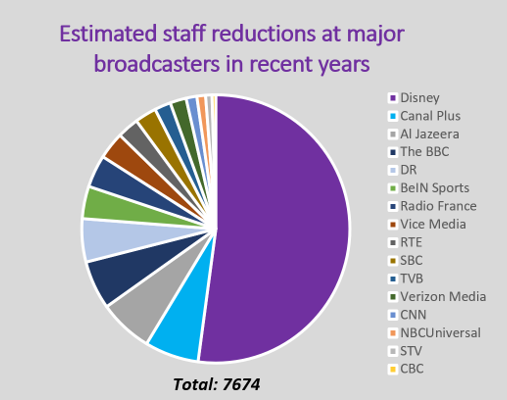
The year of 2019 was tough for an increasing number of broadcasters and media companies struggling with consumers’ changing viewing habits and competition from new media players. Significant reductions in headcount among a wide range of end-users not only reflect declining ad revenues, but also the need for new skillsets required in the new market situation favouring flexible, scalable and cost-efficient distribution strategies. One of the biggest layoff procedures in the industry for years relates to the aftermath of Disney’s acquisition of 21st Century Fox in 2018, which initiated layoffs of at last 4,000 jobs, according to industry experts’ estimates. The staff cuts affecting both Fox and Disney’s employees started with the layoff of Fox executives in 2019, soon followed by ad-sales employees at Fox Network Group and National Geographic, according to the Wrap. Later in 2019, the layoffs expanded to Fox’s TV and film divisions.

Source: Walt Disney Television Animation News

In May 2019, CNN announced that it had started corporate restructuring efforts leading to buyouts of over 100 employees. The restructuring process relates to AT&T’s – the new owner of CNN – push to manage billions in debt. According to Deadline, the buyouts were primarily targeted to employees, who were close or had already reached retirement age, and thus they were covered with a scheme providing one month of pay for every year of service.

In August 2019, Vice Media reported that it would cut 250 staff members to improve profitability. Then in September 2019, NBCUniversal laid off 70 employees as a part of its consolidation process related to its network operations. Later in October, NBC News announced that it had laid off a dozen of employees from the broadcaster’s video and tech operations.

In November and December 2019, Verizon and the Canadian Broadcasting Corporation (CBC) announced staff cuts. Whereas the CBC’s cuts were relatively modest – 35 jobs across the national news service due to “redundancy” – Verizon Media laid off 150 people to focus on creating new platforms for premium content, according to CNN. Since December 2018, when Verizon announced its long-term buyout program, there had been rumours that the company would cut 7% of its staff, affecting an estimated 800 people. By mid-2019, Verizon Media was supposed to reach cuts of about 10,400 people in its Yahoo and AOL divisions due to the poor performance of Verizon’s digital advertising business (competing with Google and Facebook).

Source: IABM

Source: The Independent

This year, the trend has continued; in January 2020, BBC News announced that it will close about 450 jobs from BBC News – BBC Two’s Newsnight, BBC Radio 5 Live and the World Service – as a part of the BBC’s cost savings target of £80 million by 2022. The annual budget of BBC News after the cost savings should equate to about £480 million. As of January 2020, BBC News employed about 6,000 people, of which 1,700 employees were working outside the UK. According to Fran Unsworth, the Head of BBC News, these cost savings should help the organization to prepare for the next decade. “We are spending too much of our resources on traditional linear broadcasting and not enough on digital”, she said. The specific job roles that will disappear will be announced early in the summer this year, the company reported. As a result, BBC staff went on a strike after the announcement, particularly criticizing the management’s way of communicating about the layoffs – many employees heard about the staff cuts from the media before receiving a notice internally.

In fact, the BBC had already announced in 2016 that it aimed at saving £800 million, of which £80 million would be from News operations. The rest should largely be achieved by adopting a “story-led” newsroom model – in which planned stories are rolled out across a bigger number of programs and outlets – to avoid duplications from numerous programs putting resources into the same news stories, according to the BBC. In practice, the centralization of the planning and commissioning of stories will likely translate into a reduction in the overall number of stories covered and films produced. Some fear that the new “story-led” model would weaken the independence of certain news programs.

Like many European public service broadcasters, the BBC has witnessed a steady decline in viewer numbers, particularly younger audiences, who are less willing to pay the licence fee, which accounts for an estimated 75% of the BBC’s revenue. According to data from the Financial Times, the BBC is facing the most severe financial constraints and political pressures in four decades, after the current government led by Prime Minister Boris Johnson took office and started questioning the BBC’s public funding model. In December 2019, Prime Minister Johnson expressed that the licence fee needs “looking at” and that the government would consider changing the existing law, which interprets the failure to pay the licence fee as a criminal offence. In February 2020, the broadcaster announced that the cost of its annual licence fee will increase by £3 from the current £154.5 to £157.5 on April 1st 2020. The fee covers the BBC’s nine national TV channels, 10 national radio channels, local radio, BBC iPlayer and the BBC Sounds app. The current public funding agreement between the broadcaster and the UK government will be valid until 2022, after which the parties must make further decisions about the licence fee level and the role of public funding.

Late in October 2019, Ofcom wrote in its second annual report on the BBC that it had already “voiced a number of concerns on behalf of audiences”, meaning that the BBC should take significant further steps to engage young people and that the broadcaster should improve the way it represents the whole of UK society. Ofcom admitted that the BBC has taken some steps to address these concerns by launching the BBC Sounds app and by making changes to the BBC iPlayer, while its spend on original content has also increased slightly. However, in the annual report, Ofcom criticized the BBC for the absence of a “clearly articulated and transparent plan” to address the issues related to the engagement of younger audiences, the need for new original UK programs and the representation of all layers of the UK society. In the annual report, Ofcom also set a timeline for the expected plan – the BBC should publish one by the end of March 2020. “If we do not see transparent signs of progress, we will step in and place additional condition on the BBC”, Ofcom concluded.

Global Business Environment – Q1 2020

Overview

The global economic outlook remained subdued over the past quarter due to an economic downturn in Europe and prolonged trade disputes between China and the US. After strong growth peaking at close to 4% in 2017 and at 3.8% in early 2018, global economic growth slowed notably to 2.4% in 2019. The current situation reflects a confluence of factors affecting major economies: economic activity in Europe remains modest as a result of weakness in trade and manufacturing, while China’s growth rate is expected to fall below 6% this year for the first time since 1990, according to the World Bank.

In January 2020, the World Bank estimated that global economic growth would amount to a modest 2.5% this year – slightly up from 2.4% in 2019 – thanks to a gradual recovery of global trade and investment. However, amid Europe’s signals of recession, advanced economies are expected to slow as a group to 1.4% in 2020 from 1.6% in 2019. In January 2020, the IMF – having a slightly more positive outlook on the world economy than the World Bank – revised its global growth estimate for 2020 to 3.3%, down by 0.1 percentage points from its October forecast. The downward revision was primarily due to lower-than-expected growth in India. As of March 2020, the COVID-19 outbreak had spread from China to nearly all other continents causing elevated uncertainty in the global economy.

Source: World Bank

In 2021, the IMF expects the world economy to grow by 3.4%, reflecting early signs of stabilization after the potential, final trade agreement between the US and China to be signed in the course of 2020.

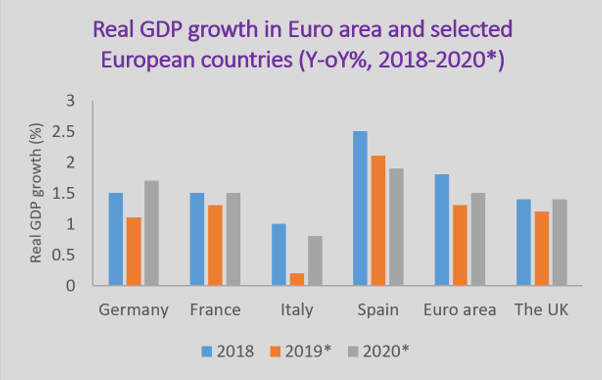
The largest economies in the Euro area are witnessing weakened growth; in Germany, car production remains particularly weak depressing other manufacturing segments, while the UK officially left the European Union on January 31st 2020. According to official statistics, the 28 countries in the EU grew only 0.1% during the last three months of 2019 compared with the previous quarter. The eurozone – including 19 EU members using the euro – recorded similar, minimal growth over the same period. As a whole, Europe’s growth declined from 2.3% in 2018 to 1.4% in 2019, according to the IMF. In 2020, the region’s growth should pick up to 1,8%, provided that the situation in the region’s largest economies – Germany, the UK, France and Italy – develops positively.

Economic growth in the US was 2.3% in 2019, down from 2.9% in 2018, reflecting uncertainty among U.S businesses and consumers created by the trade dispute with China, according to the World Bank. However, these figures contrast with the Dow Jones Index – reaching record highs in 2019 – as well as the unemployment rate, which fell to a 50-year low (3.5%) in 2019. Hence, the labor market is expected to remain robust bolstering consumption also in 2020.

Consumption – accounting for more than two-thirds of all economic activity in the US – continued to show resilience, while trade uncertainty and fears of a slowdown in manufacturing pushed private business investment down. In October 2019, the Federal Reserve (i.e. the Fed) cut the benchmark funds rate by 25 basis points to a range of 1.5% to 1.75%. The rate determines what banks charge each other for overnight lending. The cut reflected the central bank’s concerns about a further slowdown of the global economy.

At the beginning of 2018, President Trump announced that the US government would impose tariffs on imported steel (25%) and aluminum (10%). Since then, the US administration has raised tariffs on goods worth about US$360bn, affecting imports mostly from China. As a response, China has imposed counter-tariffs on about US$100bn worth of US products. In January 2020, China and the US signed a preliminary deal (i.e. “Phase one”), but as negotiations concerning the most discordant issues are still on-going, the possibility of an escalating trade war remains elevated. Under the first phase deal signed in January, China has pledged to increase its imports of US products by $200bn above 2017 levels and promised to strengthen intellectual property rights. In turn, the US agreed to halve some of the latest tariffs it imposed on China in 2019. However, in January 2020, the World Bank estimated that even the easing of trade tensions between the two countries is unlikely to lead to any rapid improvement in the global economy.

In the US, the prevailing uncertainty will likely have a negative impact on companies’ investment activity; the country’s real GDP growth is expected to decline to 1.8% in 2020 and to an average of 1.7% in 2021-22.

Source: Federal Reserve Economic Data

In 2019, the price of Brent crude oil – the international benchmark – averaged US$64 per barrel (bbl), being US$7 bbl lower than in 2018. This was mainly due to increases in the US’ petroleum production, which put downward pressure on global crude oil prices. According to several industry experts, the US’ production increases likely limited the effect on oil prices from the attack on key energy installations in Saudi Arabia in September 2019, production cut announcements from OPEC and the US’ sanctions on Venezuela and Iran (limiting crude oil exports from these countries). Accordingly, throughout 2019, global crude oil prices traded within a relatively narrow price range compared with recent years; West Texas Intermediate (WTI) crude oil was between US$49-71, while Brent crude oil was $56-80 per barrel. The US Energy Information Administration (EIA) estimates that crude oil prices will continue to decline in 2020. Brent spot prices are projected to average US$61 per barrel in 2020 – slightly down from the US$64 per barrel in 2019 – due to rising global oil inventories, which continue to accumulate as a result of strong oil production in the US, Canada and Brazil, lower demand for oil globally and weak compliance by some OPEC+ countries (e.g. Russia). WTI prices, in turn, will average US$5.50 per barrel less than Brent prices in 2020, according to data from the EIA. Even though crude oil prices temporarily increased in January 2020 following the US military operations in Iraq and Iran, industry experts project global oversupply to keep the benchmark price at a lower level until 2021. Overall, energy prices – including also natural gas and coal – are expected to decline in 2020, reflecting strong inventory injections and a decline in the US’ natural gas demand, according to the EIA’s estimates. In February 2020, representatives of OPEC and its allies (e.g. Russia) set up an urgent assembly after global crude oil prices had fallen 20% since their peak in January – hitting their lowest levels in a year. According to Bloomberg, China’s 20% drop in its daily crude oil consumption accounted for the UK and Italy’s oil need combined.  The sudden drop was estimated to be caused by the outbreak of the new coronavirus in China coupled with the extended Lunar New Year holiday, travel restrictions and prolonged shutdowns of factories, offices and shops. As a result, China – the world’s biggest importer of crude oil consuming about 14 million barrels per day – has decreased its oil purchases since the virus outbreak. Moreover, the virus has had an impact on major international airlines’ demand for jet fuel after they have suspended flights to China.

China alone accounted for one-third of global growth in 2018. However, the fact that China’s economy – which is the second largest in the world after the US – is expected to slow moderately during 2019 and 2020 will have a direct impact on the APAC region and thus the global economy. According to Chinese authorities, the country’s GDP grew 6.0% in the third quarter of 2019 – its weakest rate in almost three decades. In addition to a prolonged trade war with the US hurting Chinese exports, China is battling against continuously weakening domestic spending. The World Bank expects China’s growth rate to fall below 6% this year for the first time since 1990 because of trade disputes with the US – and the recent outbreak of the new coronavirus.

Japan is the world’s third largest economy and also a significant contributor to growth in the APAC region. According to World Bank data, real GDP growth for Japan in 2018 was 0.8% in 2018 and was expected to have remained stable at 0.8% in 2019. However, in the first quarter of 2019, Japan’s economy grew unexpectedly at an annualized rate of 2.1%, largely thanks to a positive net export balance. According to Barclays, the main question about Japan’s economy in 2019 was the impact of raising consumption tax from the current 8% to 10% in October 2019, because a similar rise from 5% to 8% in 2014 pushed the economy into a recession. Late in 2019, the IMF reduced the country’s growth forecast to 0.5% in 2020, expressing its concerns over weakened domestic demand.

According to Indian government data, India experienced real GDP growth of 7.5% in 2018, but the growth dipped to an 11-year low of 5% in 2019 due mainly due to poor performance of the manufacturing and construction sectors. However, the World Bank expects growth to pick up to 6.9% in 2020-21, and 7.2% in 2022. The new government, headed by prime minister Narendra Modi who was re-elected in May 2019, will have to continue implementation of structural and financial sector reforms with efforts to reduce public debit in order to secure the Indian economy’s growth prospects.

The Euro area has been in an economic downturn since mid-2018 and growth continued to slow substantially in the second half of 2019 due to weakness in the industrial sector as well as increased uncertainty in the global economy. Industrial production has been on a downward trend since 2018, especially in the chemical and automotive sectors. According to the European Central Bank (ECB), growth in the Euro area is set to decline from 1.8% in 2018 to 1.1% in 2019 and 1.2% in 2020. In the last quarter of 2019, GDP growth fell to 0.1% in the Euro area – down from 0.3% in July-September – as the manufacturing sector dropped further below its longer-term average level. In general, growth rates have been marked down for many economies in the region, of which Germany – the largest economy in the Euro area – continues to suffer from weak industrial production and subdued foreign demand as well as soft private consumption. In 2019, Germany’s GDP growth amounted to 0.6%, being the slowest rate since 2013. According to Eurostat, the country’s industrial output in November 2019 was down by 4% compared to the previous year. The slowdown – particularly in Germany’s auto industry – has already had a negative influence on its neighboring countries, which produce parts or finished products for German brands.

Source: Eurostat

When it comes to the British economy, the IMF has announced its baseline projection of 1.2% and 1.4% growth for the UK in 2019-2020 and most economists expect little or no change in the growth of the UK economy in 2020, even though the UK officially left the EU on January 31st 2020. As the UK’s future trading relationship with the EU remains unknown, business investment and consumer spending are forecast to remain relatively weak.

In 2019, the IMF set Latin America’s GDP growth forecast at 0.6% – the lowest rate since 2016. This year, economic activity in the region is expected to rise to 2.3%, according to the IMF. Particularly weak economic growth in the region in 2019 stemmed from heightened trade tensions between China and the US, the slowdown of the global economy as well as elevated domestic policy uncertainties in the largest Latin American economies.

When it comes to economic growth in the Middle East and North Africa (MENA), the World Bank expects growth in the region to slow to 0.6% this year compared with 1.2% in 2018 – despite the partial recovery in energy prices as well as increased infrastructure investment such as the UAE Expo 2020. Due to lower oil prices since April 2019 and a larger-than expected contraction in Iran, the World Bank revised down the growth forecast for 2019 by 0.8 percentage points in October 2019 compared to April 2019.

Exchange Rate Movements

We report the latest swings in major economies’ exchange rates and provide an outlook for their possible movements over the coming months. Exchange rates are highly unpredictable, but it still is useful to plan and attempt a forecast based on current macroeconomic trends.

The three major drivers of turbulence in foreign exchange markets have been:

  • US fiscal/ trade policy
  • Trade tensions between the US and China
  • The Brexit “effect”

Marking the new era of tighter monetary policy following a decade of stimulus after the financial crisis in 2008, the Fed stopped its Quantitative Easing (QE) program – a mixture of low interest rates and expansionary stimulus program – and raised interest rates four times in 2018. In general, the hike in interest rates reflects confidence in increased growth for the US economy. However, by the end of October 2019, the Fed had already cut interest rates three times in the course of the year, reversing nearly all of 2018’s rate increases. These cuts aim at lowering mortgage rates and other consumer borrowing costs, which should translate into an increase in domestic demand. The stimulus measures in 2019 by the Fed highlight significant uncertainty prevailing in the US economy, which is expected to continue in 2020 due to on-going trade negotiations with China as well as slowing global growth. President Trump – preparing for the 2020 election – has criticized the Fed for insufficient stimulus and has said that the Fed should cut rates to zero or below to bolster stock prices and the general economic climate.

The US dollar index remained stable – and high – in 2019; in December, on the last trading day of the year, the index recorded its smallest-ever annual move, being up by only 0.24% for the year. In 2018, the same figure was up by 4.4%. The US dollar value has been climbing since the Trump Administration began imposing tariffs on Chinese imports in 2018, and in September 2019, the US dollar index reached a nearly 15-year high. A strong currency has made US exports harder to sell, when US products cost most foreign buyers significantly more than they did before the trade dispute. The stronger dollar may also have a negative impact on large American manufacturers based in the US, because it makes products from overseas cheaper and US goods more expensive in international markets. This is particularly a concern for giant technology hardware companies like Apple, which rely on international markets.

Source: Board of Governors of the US Federal Reserve System

However, the stability of the US dollar index in 2019 signals that the tariffs had little direct effect on currency markets. Instead, the outperformance of the US economy and relatively high interest rates – despite the Fed’s three rate cuts in 2019 – attracted investors, who shifted funds into the US. Theoretically, the Fed’s interest rate cuts should have lowered the value of the dollar, because these cuts are generally considered to signal the central bank’s pessimism over the outlook for the US economy. However, this time, the Fed announced that its moves are based on “economic weakness in other nations that could spill over into the US”. As a result, investors sold other currencies and bought more dollars, which kept the dollar strong against the currencies of the US’ major trading partners such as the EU, Canada and Mexico. Hence, the Fed’s measures – taken due to the global economic uncertainty – seemed to have had an inverse effect on the US currency. According to UCLA Anderson Forecast, tariffs coupled with the strong US dollar increased US imports from Thailand, Vietnam and Cambodia, which actually helped Chinese businesses in 2019, because products from these countries contain lots of parts originally imported from China.

In 2020, economists expect the dollar to decline as global growth concerns should ease after the US and China signed an initial trade agreement in January. Moreover, the Fed’s potential further interest rate cuts this year should weaken the dollar, as the rewards for holding the currency will significantly diminish if interest rates in the US fall. Particularly, the US dollar is expected to weaken against the euro.

In January 2020, the euro – the 2nd most popular reserve currency in the world after the US dollar – rallied as the US dollar weakened to a six-month low. The strengthening of the euro also owed to the “Phase one” trade deal signed between China and the US in January, reflecting slight optimism about global growth prospects for 2020.

The British pound fell on the first trading day after the UK officially left the EU on January 31st 2020, signaling investors’ concerns over the outcome of trade negotiations with the EU. As of the beginning of February 2020, the pound was down by 1.4% against the US dollar (US$1.3011) and also dropped against the euro. In 2020, the development of the British pound will thus be bound to the progress in the trade negotiations that should be finalized by the end of this year.

Supply Trends Highlights – Q1 2020

Our latest Supply Trends Report shows that the supply side of the industry continues to be in flux, with changing business models and buyers’ purchasing behavior influencing the global sentiment and the investment climate of media technology.

The transition to new revenue models continues as software revenues surpass hardware for the very first time, while industry-wide trends like workflow automation and virtualization accelerate. The transition to IP has gradually started to mature, evidenced by the fact that the share of revenue derived from IP has increased – signaling a more established positioning of the technology in the industry.

Investment in the industry continues to be at record high levels, while the pressure from both prices and costs has eased – at least temporarily. Even though the industry is still going through a wide range of changes, the sector remains very optimistic; the IABM Confidence Ratio is rising for most industry segments. In our latest survey, the ratio stood at 12, significantly up from 8.6 in H1 2019.

From a geographical perspective, hardware suppliers and respondents from North America seem to be more confident about the future of the sector, which is relatively surprising given the big number of on-going changes in the industry. In terms of decision-makers, it is important to note that respondents like CEOs and sales and marketing staff are significantly more confident about the future of industry compared to engineering staff, who have a quite negative outlook.

In terms of the whole content chain, IABM continues to see increasing confidence – and investment – particularly in Monetize and Consume, as the focus of industry stakeholders is firmly on direct-to-consumer business models.

Source: IABM

In general, suppliers are seeing the on-going transformation of the broadcast and media industry in a relatively bright light, and several vendors seem to have found new markets in terms of geography. We report some of the suppliers’ comments below:

“The major shift to software-based production environments is a welcome environment.”

“In some markets we see strong increase, while others are static, but in general the business is more up than steady.”

“ OTT is gaining momentum month after month. The question for telcos and content publishers is not whether or not they will go OTT but when.”

When looking at the shift in revenues in more detail, the industry has continued to move away from hardware towards software and service-based revenues; our data shows that software revenues have grown significantly on the back of increased demand from buyers, while hardware revenues have been declining since H2 of 2017. This change is driven by a wide range of trends, of which most notably is the move to cloud. Service revenues have been oscillating in the range of 15-30% in the period 2016-2019. When looking at profits, the picture is quite similar with software revenues driving most of the profits – for the first time in our industry.

Revenues - Breakdown

Source: IABM

When it comes to strategic drivers of media technology demand, the move to direct-to-consumer models, workflow automation, virtualization and IP continue to be the most important. Being in line with the search for operational efficiency and the increased adoption of cloud-based technology, workflow automation and virtualization have significantly grown in importance over the past years. This is pushing media technology suppliers to move to software-based revenues, as discussed above.

The transition from SDI to IP remains very important as well, even though it has slightly lost momentum, according to our data. Moreover, our results show that there has been a significant drop in remote production in 2019 compared to 2018. This is consistent with the decline in hardware revenues evidenced earlier and signals that the transition to IP has matured. Other demand drivers have remained relatively static, except the upgrade to next-generation terrestrial standards, whose importance significantly grew in the course of 2019 – thanks to the accelerating deployment of ATSC 3.0 in the US.

Top Demand Drivers – Historical Analysis

Source: IABM

In terms of revenue and demand outlook from a content chain perspective, our data shows that Monetize and Consume continue to be the fastest growing segments for suppliers in the industry along with Manage. This is due to the fact that more investment is being made in these content chain blocks to get digital experiences and business models right, as the sector moves to direct-to-consumer models. Other segments like Create, Produce and Manage are directly benefiting from the rapid rise in content investment globally.

Overall, investment in the media technology sector continues to grow, likely driven by the move to software-based revenues. R&D and trade show investment – as a percentage of sales and marketing budget – increased in 2019. The major R&D focuses of suppliers remain cloud/virtualization and IP technology. However, most respondents predict that R&D investment will decline in 2020, followed by budgets allocated for trade shows, as suppliers continue to strive for increased operational efficiency.

IABM Members can view the full report here