Media Distillery – Content Discovery is Broken. How are Streaming Services Using Video to Fix It?

Martin Prins, Head of Product, Media Distillery
As 2025 draws to a close, the streaming industry faces a content discovery crisis. Competition for attention is fierce, content libraries run deep, and price-sensitive viewers jump between services faster than ever. At the center of this dynamic lies an enduring challenge: how to help people find something to watch quickly, intuitively, and enjoyably. In this article, I’ll discuss what’s causing these challenges, how video previews can help viewers discover content more quickly, and how they are used across the industry.
Key Trends and Research Insights
Recent reports highlight just how fragmented and competitive the video ecosystem has become:
- Viewers now juggle an average of 11 video services in North America (7 paid, 3.8 free).1 Globally, the average number of paid subscriptions has risen to 3.1 in 2025, up from 2.4 in 2023.3
- Viewers are becoming serial churners, with only 40% keeping a new subscription for more than a year.1
- Nearly three-quarters of viewers use multiple video apps in a single viewing session¹, and the average time spent browsing for something to watch has climbed to 14 minutes —up from 12.5 in 2023².
- Almost one in five consumers gives up – abandoning their quest for content altogether after browsing. For 18-24-year-olds, this number goes up to 29%.2
- Short-form consumption is on the rise. 85% of people in the Netherlands watch short-form.4 In the US, more than 30% of short-form content is consumed on the big screen.1
- SVOD pricing is up across the board, sometimes by 20%, increasingly driving cancellations³. In the Netherlands, 44% of those who cancelled a service last year did so because the service was simply too expensive⁴.
Sources: 1) Tivo Video Trend Report 2025, 2) Gracenote State of Play 2025, 3) Simon Kucher The Global Streaming Study 2025. 4) GfK’s Trends in Digitale Media 2025
Too Much Choice, Too Little Time – The Dark Side of Discovery
As consumers, we’re faced with a paradox: there is so much great content, but it takes more time than ever to find something to watch, so we frequently just give up.
To paraphrase a particular Star Wars character: overwhelming choice leads to decision fatigue; decision fatigue leads to frustration, and frustration leads to churn.
So what can be done about it?
Help Viewers Discover Video With Video
Not that long ago, discovery for TV programs was primarily driven by textual Electronic Program Guides. Now, interfaces are rich with imagery: posters, stills, backdrops, and thumbnails. But even striking visuals have their limits. The new frontier is video previews, which give viewers a deeper understanding of the content. Previews come in many forms: trailers, promos, highlights (single scenes extracted from the video), and shorts.
Shorts, or short-form video, is a trend no platform can afford to ignore, one with dual roles in consumption and discovery. YouTube Shorts viewership grew 20% in Q1 2025 to over 200 billion daily views.5 In many countries, Shorts revenue per watched hour matches core YouTube usage. But interestingly, shorts also serve as a content discovery tool themselves. Already in 2022, YouTube’s Culture & Trends report showed that 59% of Gen Z use short-form video apps to discover longer content they end up watching. I expect to see content providers increasingly focus on repurposing content for short-form consumption and content discovery.
Source: https://blog.youtube/news-and-events/neal-mohan-cannes-2025/
Surveying Streaming Services: How Video Previews Are Used
So how exactly do streaming platforms employ video previews? As a product person and streaming enthusiast, I set out to survey how global and local video services use video previews on their home pages or home screens, as this is the starting point for content discovery. Since most services use a row-based layout, I also checked whether previews were present on all rows. This overview is a snapshot, not an exhaustive study; experiences may vary depending on time, region, or device, but I think it’s illuminating.
Among the global streaming leaders, Netflix combines trailers, promos, and highlight clips in a video-first home experience for most content. They play either in the top banner or thumbnail window, with durations ranging from 50 seconds to several minutes. Among global SVODs, it represents the clearest shift toward video-led discovery. Amazon Prime Video blends promotional clips for originals with highlights for selected content, with clip lengths ranging from 15s to several minutes. HBO Max follows a similar model for originals (promos and trailers of 35-45s), but only shows static thumbnails for most assets. SkyShowtime shows promos/trailers and video previews on the front page, with lengths ranging from 65 to 145s.
As the biggest online Video Platform, YouTube plays videos inside the thumbnail window on hover/select. It plays the video from the start until about 30-45 seconds (excluding the Shorts section).
The Regional Perspective on Video Previews
When looking at some local European players, I found the following: Norwegian broadcaster VGTV uses a compilation of 1-second excerpts stitched into a 10-second clip, which they show in the top row. Other rows only show thumbnails. VTM Go in Belgium shows a single promo preview video for one of its programs —a 30-second compilation of short clips. Similarly, German / French service Arte sometimes shows a 30-second trailer for a documentary in the top row.
On the Pay TV Aggregator side, there’s one example I’ve worked on myself: Switzerland-based Sunrise, a Media Distillery customer, offers a combination of promos, trailers, and highlights in its “TV Highlights” feature, shown in the top row and a dedicated row. For their catch-up/replay content, our solution generates spoiler-free video previews from live broadcasts for 50 channels across four languages. These preview clips are 15 to 20 seconds long.
Towards Video-Led Discovery
To summarize, services vary widely in preview type, content coverage, and clip length. While the latter may be a preference, the lack of coverage stems from the limited availability of preview assets. Advances in AI now enable scalable, automated video preview creation, reducing reliance on manually produced promos and trailers. It means more services can now provide previews for large parts of their catalogs.
As we move into 2026, video-led discovery will likely become standard practice, reshaping how audiences find and connect with content, making browsing faster and engagement more meaningful. It’s sure to help viewers worldwide discover and enjoy great content in less time.

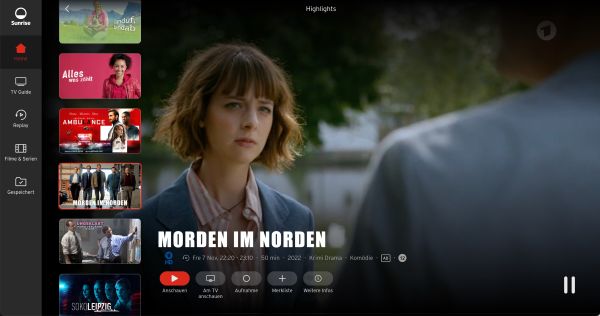
Screenshot from the Sunrise TV Highlights feature, playing autogenerated video previews