Mediagenix – The Self-Optimizing Content Flywheel: Reimagining the Content Lifecycle Around Personalization

Ivan Verbesselt, Chief Strategy & Marketing Officer, Mediagenix
Personalization has long been the silver bullet for audience engagement, and the results continue to impress. Deployments of advanced recommendation engines across major video platforms consistently show how targeted relevance can transform viewer behaviour. Recent implementations with partners such as Globo, DirecTV Latin America and Sky Brasil have delivered measurable impact: in some markets, viewer engagement has increased between 20% and 60%, while actual viewing conversion has improved by more than 35%. Clear evidence that connecting the right content to the right audience drives tangible value.
Yet these successes reflect only part of what is possible. So far, most of the industry’s progress has come from optimizing the audience-facing experience at the end of the content journey, helping people find what they want to watch. The greater opportunity lies earlier in the process. What if we could inject this kind of intelligence upstream, enriching the strategic, editorial, and operational decisions that shape what content is created, promoted, or retired?
When audience data starts to inform those upstream processes, personalization evolves beyond the user interface. It becomes a deeper operational intelligence, one that connects creativity, data, and decision-making throughout the entire content lifecycle.
The Flywheel Model
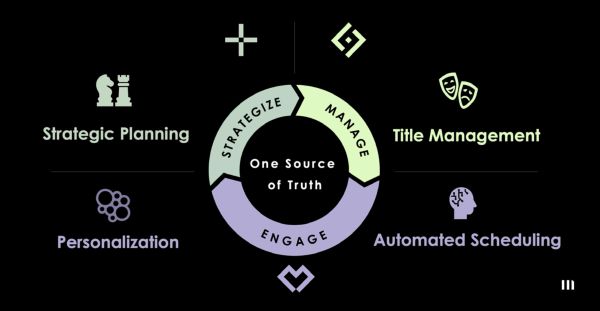
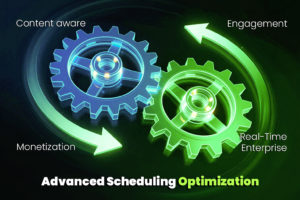
Mediagenix recently published the whitepaper Engagement & Conversion Hacking: Reimagining the Content Lifecycle Around Personalization, which explores this very concept. At its core is the Self-Optimizing Content Monetization Flywheel: a dynamic feedback loop where intelligence from engagement continuously improves upstream decisions on what to promote, reuse, or retire.
By feeding audience insights back into earlier stages of the lifecycle, this model enables a process of continuous optimization. Engagement data not only enhances recommendation systems but also informs strategy, curation, and scheduling. Each turn of the flywheel builds on the last — a self-reinforcing system where every decision creates new intelligence for the next.
The result is a content operation that doesn’t just deliver personalized experiences but learns from them, becoming more efficient, responsive, and profitable over time.
Intelligence That Powers Strategy and Curation
Connecting the right content to the right audience starts with knowing what resonates and why. By analyzing anonymized engagement patterns, media organizations can uncover how demographics connect with particular content types, themes, or formats. Feeding this intelligence into content strategy helps determine what to acquire, produce, or commission next. It also reveals new editorial lines and niche audience opportunities that may not have been visible before.
The same data-driven thinking can be applied to content curation, where vast catalogues often hide valuable assets that go unseen. Smart curation tools can surface semantically similar titles, align editorial intent with audience preferences, and improve catalog utilization. The effect is significant: effective personalization can increase the Effective Catalog Size by a factor of four, meaning more titles remain active, visible, and monetizable.
This intelligence also reduces manual effort, in some cases by as much as 50%, while expanding daily catalog exposure. It allows curators to work with precision, turning what was once an intuitive process into a measurable, strategic advantage.
However, realizing this potential often requires overcoming operational fragmentation, disparate title management systems, inconsistent metadata, and siloed rights information can still limit how effectively catalogs are surfaced and monetized. Consolidating these sources of truth is therefore an essential foundation for intelligent curation.
Scheduling That Learns
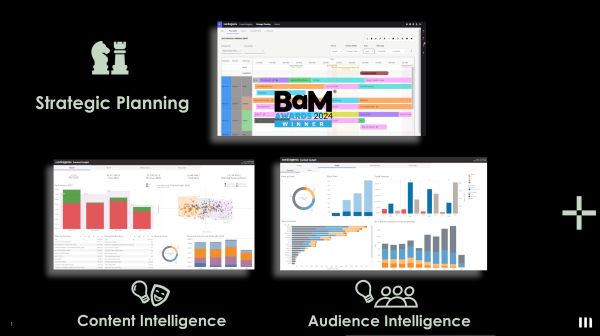
Once curated, content needs to reach audiences in the right place and at the right time. In a landscape of linear, FAST, and on-demand channels, automation has become an operational necessity, not only for efficiency but also for agility.
By using audience intelligence to inform scheduling, programming can adapt in real time. Underperforming titles can be replaced with stronger alternatives, or schedules can be dynamically reshaped to serve specific demographics at specific times. This turns scheduling into a living system that continuously evolves alongside audience behavior.
When data flows seamlessly between scheduling, curation, and strategy, every function informs the next. Engagement data improves curation, curation insights guide strategy, and strategy defines new creative directions. Over time, this creates the flywheel effect: a cycle of learning that compounds operational intelligence with every turn.
The Human Element
The Self-Optimizing Content Flywheel is not about replacing human creativity. Great content still depends on intuition, risk-taking, and originality. What intelligence can do is amplify those instincts with evidence, helping creative and strategic teams make better decisions faster.
By uniting data-driven insight with creative vision, media organizations can achieve a balance between imagination and precision. They can test ideas, measure outcomes, and build stronger connections between editorial purpose and audience response. In this way, intelligence becomes an enabler rather than a constraint on creativity.
As audiences continue to fragment and content costs rise, success will depend on how effectively organizations can harness data to learn faster and act smarter. The companies that thrive will be those that transform personalization from a consumer-facing function into an organization-wide intelligence framework, one that continuously improves engagement, retention, and monetization. The future of media is not just personalized. It is self-optimizing.