Net Insight – Protecting Live Production in the IP Era: Why Media-Specific Security Is Non-Negotiable
Paul Evans, Solution Area Expert, Net Insight

Live media production has always been a high-wire act. With tight timings, unforgiving audiences, and high-value rights on the line, live production is a world where stability is everything and any disruption quickly becomes a headline. Live production today is no longer contained within the walls of a single facility. It spans venues, OB trucks, cloud services, third-party studios, and remote teams. In this environment, the concept of a traditional network perimeter no longer applies. What replaces it must be smarter, more adaptive, and tailored to the specific needs of IP media workflows.
The security challenges of IP
The transition to IP has unlocked new levels of flexibility and efficiency for media workflows. But as the industry moves away from SDI’s predictable, point-to-point connectivity, it is trading physical isolation for increased complexity. IP media traffic moves fluidly across networks, domains, and geographies — sometimes even via unmanaged public infrastructure.
These open workflows create new points of vulnerability. Live production environments, in particular, operate on extremely tight tolerances. Stream misconfigurations, bitrate mismatches, or minor equipment errors can have major downstream effects — interrupting service, degrading signal quality, or overwhelming critical network links. In an IP-native environment, these risks can emerge not from external cyber threats, but from internal operational complexity. Media organizations are increasingly aware that even unintentional configuration errors, like routing a 4K signal where only HD was expected, or mismanaging jitter and timing parameters, can threaten service continuity. Combined with the growing use of remote contribution and hybrid cloud workflows, the security posture of a media network must now include both protection and prevention.
The Limits of traditional IT security
Today’s live production environment is fluid. Cameras in one country, switching in another. Localization such as add insertion added in the cloud. Streams are handed off between facilities, production partners, and platforms. The paths are virtual, but the risks are very real.
What happens when a misconfigured feed enters the wrong network domain? When a remote signal floods a switch mid-broadcast? These aren’t speculative threats. They’re real-world failures, many of which never make it into public view — but are all too familiar to the engineers who fight to keep broadcasts on air. When it comes to securing video over IP, generic enterprise firewalls are often the first line of defense. But while these tools are essential for safeguarding IT infrastructure, they fall short in media applications.
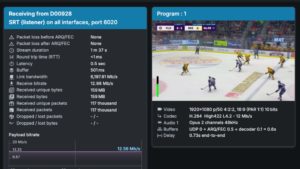
Unlike conventional IT traffic, IP media streams require high throughput, ultra-low latency, and deterministic behavior. Firewalls not designed for real-time media introduce bottlenecks, increase latency and all this at a premium cost. Worse, they often lack visibility into media-specific parameters such as jitter, video specific monitoring, or audio silence, making them ill-equipped to monitor or troubleshoot content delivery issues.
Live Production raising the stakes
In live production, the margin for error is razor-thin. Missed frames, dropped feeds, or brief blackouts can result in reputational damage and significant financial loss. The globalization of media rights with syndication agreements, international rights holders, and simultaneous multi-platform delivery, the exposure is far-reaching. A single disruption at one point in the chain can ripple across hundreds of downstream feeds.
Compounding the challenge is the need for speed and adaptability. Today’s productions often come together with minimal setup time as production companies look to minimize costs, leveraging a mix of in-house and third-party resources. OB trucks may connect to central production hubs. Remote commentators might join from home studios. Feeds traverse from dedicated fiber networks to unmanaged Internet connections.
In this context, security cannot be a static checklist—it must be embedded into the design of the network itself. Facilities need the ability to onboard new sources dynamically, validate streams in real time, and enforce rules that prevent disruptions before they occur.
The Role of standards and interoperability
The industry has begun to formalize these practices through standards like SMPTE RP 2129, which defines how media streams should be securely and predictably exchanged between networks. These guidelines provide a blueprint for building robust, interoperable media workflows that don’t sacrifice agility for security.
At the same time, innovation is accelerating. Solutions designed specifically for high-bandwidth media flows demonstrate how off-the-shelf platforms can simplify security while preserving performance. By integrating stream validation, traffic shaping, flow replication, and monitoring into a single device, these tools make it easier for media organizations to deploy protection without compromising quality or scalability.
Security as an enabler

Too often, security is seen as a hurdle to be overcome – a set of constraints that slow down progress. But in IP media, the right security model is an enabler. It allows organizations to experiment without fear and scale without fragility.
As live production grows more complex and interconnected, media companies can no longer rely on generic solutions or best-effort protections. They need purpose-built safeguards that understand the unique demands of media transport and deliver control without compromise. Media companies that lead in the IP era will be those that embed resilience into every layer of their operations, where security isn’t an afterthought, but an architectural pillar of live workflows.