wTVision – Mobile-First AR: A Strategic Frontier in the Next Media Economy

Daniel Gonçalves, Director Innovation Officer @ wTVision
Abstract:
Mobile-first AR is emerging as one of the most strategic enablers in the new media economy. By merging accessibility, interactivity, and monetization, it empowers broadcasters, media enterprises, and brands to turn passive audiences into participants. This article explores how mobile-first AR reshapes production workflows, business models, and audience engagement.
Augmented Reality (AR) has long promised to transform how audiences consume and interact with content. The latest evolution, mobile-first AR, is turning that promise into performance. In a world where content is increasingly consumed through personal devices, mobile-first AR is not just a creative format but a structural enabler of new business models across media, advertising, and live entertainment.
From Access to Engagement: A New Economics of Attention
The media economy has always been defined by how audiences access content. Linear viewing created a single revenue model based on mass attention. Digital streaming diversified it through subscriptions and targeted ads. Now, as attention migrates again, this time to mobile and interactive environments, mobile-first AR offers a hybrid model that merges participation, data, and monetization into a single ecosystem.
Unlike traditional broadcast graphics or VR experiences, AR content delivered directly through a smartphone browser (WebAR) removes friction for both producers and users. There’s no app installation, no headset barrier, and no dependency on closed platforms. The same experiences can also extend to AR glasses, unlocking a deeper level of immersion for advanced users. For media enterprises and brands, this accessibility translates into scale, a crucial factor in the new attention economy where participation equals value.
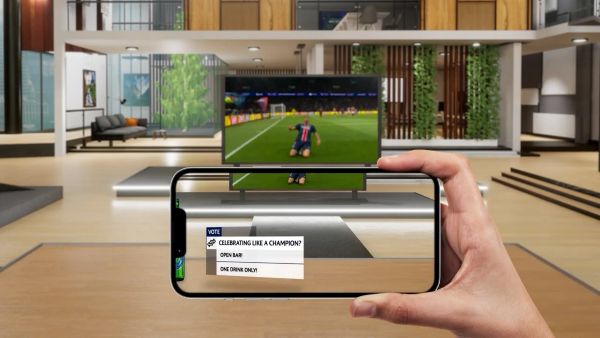
The economics of attention are shifting again: it is no longer about how long audiences watch, but how deeply they interact. Mobile-first AR converts passive viewership into measurable actions — clicks, gestures, movements, and shared moments — each of which can be monetized or tied to data-driven insights.
Democratizing Immersion
One of the most significant shifts enabled by mobile-first AR is the democratization of immersive technology. In the past, AR and VR required expensive hardware, complex integrations, and niche audiences. Today, the combination of powerful mobile devices with advanced 3D rendering capabilities and widespread 5G connectivity allows interactive AR to run smoothly on virtually any smartphone. These devices evolve at a pace rarely seen in the tech industry, continuously expanding what is possible in terms of performance and visual quality.

This accessibility reshapes the economics of production and distribution. Broadcasters and media operators no longer need to invest in heavy infrastructure to deliver AR content; they can leverage the same creative workflows used for on-air graphics or live playout. Meanwhile, brands can launch immersive campaigns without relying on app stores or proprietary platforms.
The result is a new tier of creativity that is both scalable and cost-efficient, an inflection point where innovation meets practicality.
Beyond Storytelling: Participation as Product
What sets mobile-first AR apart is its ability to redefine what “media product” means. Content is no longer just watched; it is co-experienced. Viewers become participants who explore a 3D layer of the story, engage with branded elements, or trigger data visualizations that mirror what happens live on-air.
For producers, this interactivity does not imply losing control. With AR experiences synchronized directly with live workflows, such as those managed through graphics or automation platforms, every interaction remains editorially guided. Broadcasters decide what appears, when, and how. Audiences feel empowered, while producers retain the precision of storytelling and timing that professional broadcasting demands.
This balance between participation and control makes mobile-first AR viable at scale. It brings the spontaneity of social media into the structured world of live production.
New Monetization Layers
From a business perspective, mobile-first AR introduces new monetization layers that complement existing revenue streams.
- Branded activations: Sponsors can occupy immersive spaces in natural and interactive ways, extending their presence beyond traditional ad breaks.
- Data-driven advertising: Every interaction generates insights, enabling personalized and measurable campaigns.
- Gamified experiences: Polls, challenges, and AR mini-games tied to live broadcasts create engagement and commercial value.
- Fan participation: In sports or entertainment, fans can interact with live stats, 3D replays, or augmented camera views, monetized through sponsorships or subscriptions.
AR becomes more than a storytelling tool; it evolves into a business engine that turns engagement into tangible revenue.
Convergence and Parallel Markets
The strategic potential of mobile-first AR also lies in how it bridges industries. Media technology is converging with gaming, e-commerce, and experiential marketing. Each of these sectors is built on participation — the same behavioral foundation that AR amplifies.
Broadcasters can partner with advertisers to create second-screen experiences that link live events with mobile commerce. A racing broadcast might overlay interactive 3D track maps or offer instant product tie-ins. A concert stream can turn a phone into a stage extension, offering exclusive angles or unlockable virtual rewards. Enterprises can also deliver these experiences through their own mobile apps, enabling direct engagement with users via notifications or personalized calls to action.
This convergence signals the rise of the experience economy, where consuming media and participating in it become inseparable.
A Strategic Imperative, Not an Experiment
In today’s market, innovation is not optional — it is operational. Audiences already expect interactivity as part of their everyday media experience, and mobile-first AR provides a practical and cost-effective way to deliver it.
For media enterprises, the strategic value lies in control and scalability. Mobile-first AR integrates into existing broadcast and digital workflows with minimal friction, leveraging existing teams and infrastructure. It is a democratized innovation that rewards those who evolve early rather than those who wait for maturity.
AR should no longer be viewed as an experimental add-on, but as a core layer in the evolving media stack — connecting storytelling, audience data, and monetization in a single, interactive framework.
wTVision’s Perspective
At wTVision, this evolution represents more than a technological milestone; it defines a new chapter in the relationship between real-time graphics and audience engagement. Our ongoing R&D focuses on bridging creative storytelling with operational efficiency, and mobile-first AR is a natural extension of that vision.
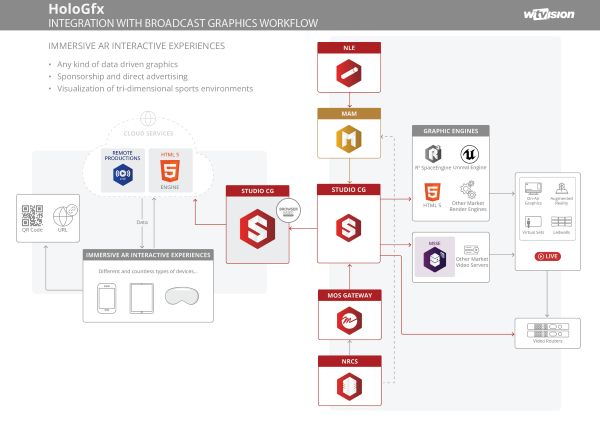
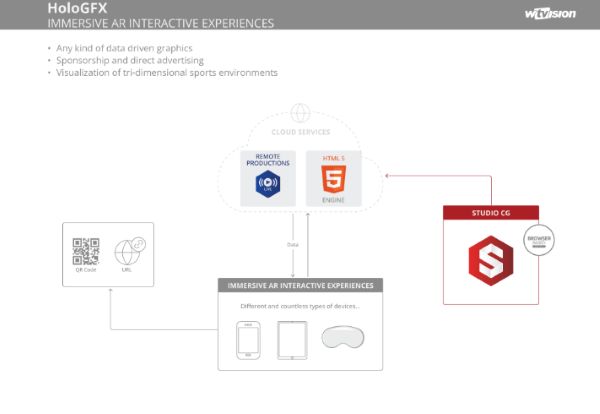
The recently introduced HoloGfx, unveiled at IBC 2025, embodies this vision: a cloud and browser based, mobile-first AR platform that empowers media producers and brands to transform passive viewers into active participants while maintaining full control of the experience through their existing production graphics workflow. It is not merely an innovation but a blueprint for how media can future-proof engagement, generate new revenue, and redefine the connection between content and consumer.