The past decade has seen an influx of digital-native media companies which have thrived completely online. These are companies that have scaled up without the legacy infrastructure that their traditional counterparts have long relied on (and now have to wean themselves off).
The proliferation of digital-native media companies can be largely attributed to shifting demographics and consumption patterns. Today, millennials often dictate the trends and technologies of the time as they form a large part of the consumer base. As a generation, they gravitate towards digital platforms to access information on the go.
This not only enables them to control what they consume but also lets them share their choicest picks with friends. It is little wonder then that millennials end up spending far less time and money on traditional linear and recorded media than online services.
As content consumption patterns skew towards purely digital channels, digitalnative media houses seem set to rule the roost. The adaptive capabilities of such enterprises lend them a competitive edge over their legacy counterparts.
The Rise and Commoditization of Live Production Technology
In the last decade alone, live video experience has made huge strides with the introduction of ultra-high definition (UHD) TV in 2012 and its subsequent progress to 8K. Apart from the proliferation of camera technology, advancements in digital video imaging have had a major role to play in the evolution of video capture resolutions. With UHD content fast becoming a mainstay among consumers, broadcasters and production houses are looking to enhance other critical aspects of the live video streaming experience such as greater dynamic ranges, broader color gamut, and faster picture capture rates.
On 19th November 2019, Ajit Pai, chairman of the United States Federal Communications Commission (FCC), announced a public auction of the C-band spectrum (about 500 MHz of bandwidth between 3.7 to 4.2 GHz) to facilitate the development of 5G. The C-Band, a swathe of satellite spectrum that has been historically used for fixed wireless services, plays a crucial role in broadcasting and live production of content such as news reporting and sports feeds.
According to the directive, the FCC has earmarked 280 MHz of bandwidth, instead of the originally expected 180 MHz, to be auctioned for mobile network operators. This leaves less than half of the spectrum, about 200 MHz, to be preserved for TV programming. Moreover, the FCC’s announcement of a USD 9.7 billion payout to satellite companies ahead of the 5G auction has introduced further confusion to an already uncertain landscape.
COVID-19 has ripped through the global economy. As people adjust to the new reality of social distancing and remote working, consumer behavior too, has transformed. And, as a majority of global population self-isolates at home , media consumption levels have gone through the roof. According to a recent report from Global Web Index, 87% of US consumers and 80% of UK consumers revealed that they are consuming more content than ever before.
Unfortunately though, these high media utilization rates come at a time when new content production— from live sports to sitcoms and movies—has come to a grinding halt. Cast and crew members are now safely ensconced in their homes, often in separate countries.
But there’s good news too. Progressive incumbents in the media industry have taken creative approaches to cater to viewer demand. For instance, traditional sports are increasingly turning to virtual competitions to keep their fans, sponsors and broadcasters engaged. Major sports and Esports leagues are making it possible for star athletes like Kevin Durant and Charles Leclerc to participate in live tournaments. This lets supporters watch their favorite athletes live, and fills up empty airtime for broadcasters. Even celebrity talk shows are now playing out of hosts’ living rooms and bedrooms .
Research reveals that there were around 2.4 billion Internet users in 2014. By June 2019, that number doubled to 4.4 billion. That’s an 83% increase in the Internet user base in a span of just five years. For the media and telecommunications sector, this raises an all-important question: How far can current underlying networks scale to accommodate the growing traffic on the Internet?
While the good news is that no one single network will need to support this burgeoning traffic, there remains some scepticism around existing networks and their ability to keep pace with the bandwidth demands of next-generation connected devices.
Аdaptive broadcasting is gaining momentum quickly. Live TV is giving way to new services that not only adapt to the broadcasting bandwidth but also receive user feedback as well as generate and display targeted advertising. However, what spurred the broadcasting revolution was streaming, a technology that selects the best available quality. It is unnecessary to have a DVB-T2 antenna, a cable run to your household, or a satellite dish on your balcony to receive such broadcasts: all you need is your favorite gadget, such as a smartphone, a tablet, a laptop, or an in-car multimedia system. These broadcasts have a low buffering capacity for guaranteed delivery of the content and can even tolerate having the user temporarily exit the coverage area.
That last point is the reason why everybody loves adaptive broadcasting. Users have become accustomed to smooth content delivery in any situation, wherever they are, be it in the kitchen, on the go, or at the summer cottage. Adaptive broadcasting comes in several formats, such as Smooth Streaming by Microsoft, HTTP Live Streaming by Apple, and Dynamic Adaptive Streaming over HTTP by the MPEG Group. All of them impose similar requirements: the content at the end device should play smoothly, without freezing and switch quickly and seamlessly between different profiles. The key competitive advantages here are the Quality of Service (i.e. guaranteed delivery) and Quality of Experience (i.e. good picture even at low bitrates and clear audio even in remote country areas).
All formats are standardized. The standards specify how the manifest (playlist) and content chunks are prepared, how they are delivered, how the switching between different quality and bitrate alternatives (profiles) works, what the buffer capacity should be, what video and audio formats should be supported in chunks etc. Even if video complies with these standards, it is necessary to make sure it has made it through the entire delivery chain intact, without artifacts, hangs, freezes, glitches, or pixelation. How is this done? Flexible software solutions for video stream analysis (including live streams and video files) come to our aid here. In this article, I will explain what to look for when choosing such a solution. We will consider HLS format as an example.
Functionality
The first thing that is assessed when validating OTT traffic is the general condition of the service. The analyzer should support real-time delivery (QoS) and decodability (QoE) analysis and automatic report generation. The results should be presented intuitively, whether using color coding, some kind of general score, or a stream status such as OK/Problem. For ongoing 24/7 visual monitoring, a task list with statuses is a familiar and friendly format. Each status or trigger (event) should have a detailed description to convey a general idea of what is going on.
Each project is unique, and it is important that the analyzer allows a flexible configuration of parameters to monitor. In some cases, picture freeze is a common case that should be ignored; in others, audio PID missing constantly is a phenomenon inherent to delivering the content in question. However, sometimes the stream needs to be so clean that even a few lost TS packets are a reason for alarm. In this case, the ability to set up monitoring for certain errors manually, specify error severity levels, and configure alert settings will come in handy. This is necessary to filter information that the operator gets in his or her work with streams. It is also useful when generating reports to exclude errors that can be disregarded.
Alerts
It would be inefficient to hire people just so they stare at their monitors the whole day. An engineer gets distracted by other tasks and often cannot respond quickly to a problem with a stream. Most modern analyzers, including those of the Mosaic View type, can send alerts. The alerts can be configured flexibly depending on the Fault Management system in place and the work schedule of the technical support department.
Such alert systems are often based on SNMP traps, GET requests, or webhooks (e.g. PagerDuty or DataMiner). Traditional methods, such as email alerts, also exist. In addition, smartphone push notifications and instant messages are currently gaining traction. It is convenient when several alert types are supported because you can then choose the one that suits you best.
Intuitive UI
It is important that the software be intuitive and user-friendly even for novices. User tips in the UI are good to have because they help learn the tool quicker than an extensive user manual describing various cases.
Tools for deep video analysis
For most top-level tasks a problem description, a timely alert, and an action to start the response process (opening a ticket or making a call) would suffice. However, modern solutions offer tools for a deeper analysis of video data.
Diagnostics and preventative measures help avoid severe failures and isolate hidden malfunctions in the service. The more information the analyzer can give about the stream, the more means the technical department has at its disposal to prevent errors from occurring. For example, detailed stream information makes it possible to diagnose playback problems on devices, especially if the device specification is missing along with requirements to input streams.
There are many possible causes of playback issues:
Unsupported video or audio format supplied to the packetizer (HLS packager) input
Invalid content generated by the encoder itself (e.g. interlaced stream sent instead of progressive)
Playlist stopped updating but keeps creating chunks
Some tags have been added to an existing media playlist, causing incompatibility with the end devices.
It is important to have such changes monitored by the analyzer in real time. If, in addition to stream parameters, the operator also gets their changes over time, it can save him or her time troubleshooting the error.
Ad insertion
In most cases, OTT services insert ads. This needs to be constantly monitored. Analysis of this type involves detecting special marks but also monitoring the operation of the devices that insert ads. The limits on volume level should be observed, and there should be no black frames or picture freezes.
Analyzer types
Analyzers can be software- or hardware-based. Each of these types has its own advantages, but recently cloud services have gained popularity. They are attractive because they do not consume space and can be easily scaled. Hardware solutions retain their stable market position and work in a set-and-forget fashion, although are often hard to upgrade and maintain.
Startup time, supported operating systems, conditional access, self-diagnostics, task grouping and resource consumption monitoring—these are the key factors for choosing a software-based video data validation and analysis system in OTT.
Additional tools
Sometimes, any single solution, however feature-rich, is not enough. A device may reject an input stream even though the monitoring tool has detected no problems, or the analyzer may falsely detect events. In these cases, it is helpful to have one or more third-party live analyzers on hand or record the stream to analyze the resulting files (playlists and chunks) afterwards. The ability to record the stream plays an essential role in such a situation.
Sometimes it is necessary to check for picture matching (frame alignment) between profiles as well as analyze the GOP structure in a chunk. For example, in the case of HLS traffic, it is vital that each fragment of a single profile begins with a reference frame from which stream decoding can start. In addition, the picture should be identical between profiles—this will allow switching between them seamlessly if the available network bandwidth changes.
Conclusion
Technology does not stand still. TV services strive to improve their quality, stability, and compatibility with all end devices, content distribution media, and the methods of interacting with them (CDN and middleware). The constant influx of new market players puts pressure on the competition to be proactive and makes it impossible to afford waiting for an issue to occur. Even the simplest, rare issues can affect reputation in big ways because social media will quickly spread the word about vendor’s or operator’s mishaps.
I encourage everybody to keep up with the times and stay ahead of any possible problems—using tools that help prevent or isolate them timely.
About Elecard
Founded in 1988, Elecard is a leading provider of software products for encoding, decoding, processing, receiving and transmission of video and audio data in different formats. The main groups of products produced by Elecard include: professional software products and software development kits (SDKs); products for in-depth high-quality analysis and monitoring of the media content; solutions for IPTV projects, digital TV broadcasting and video streaming; transcoding and video-on-demand servers. Elecard also offers easy-to-use and full-featured end-user programs essential for fast and high-quality multimedia editing, processing, conversion and playback.
Currently the Elecard team is working both with widespread in-demand formats (MPEG-2, MPEG-4, H.264/AVC etc.), and with new formats that are rapidly gaining popularity such as HEVC/H.265, VP8, VP9, AV1, VVC, EVC. Our products are highly appreciated and widely used by IT industry leaders such as Intel, Cisco, Netflix, Blackmagic Design, etc.
One of our striking advantages is that being an integrator company, Elecard is able to supply everything the customer needs: reference design, software, components and technical support in one place.
The application area of the company’s technologies is very wide and includes software solutions for PC and mobile platforms; security and video surveillance systems; terrestrial, cable and satellite broadcasting; advanced real-time and offline transcoding and professional video quality monitoring.
Review and analysis of known real-world attacks on subscriber watermarking solutions
A subscriber-level watermarking solution coupled with a large-scale content monitoring is a highly effective anti-piracy measure that allows content owners and distributors to fully protect their content and revenue from theft beyond digital rights management (DRM) systems.
In order to provide customers with the class-leading watermarking content protection service and satisfy the security requirements of its mass subscriber watermarking, Friend MTS actively research threats to watermark technology and its implementation and analyse real-world attacks instigated by technically sophisticated pirates.
Relying on the technical data obtained through operating the world's most extensive automated monitoring of a wide spectrum of illicit content services, the white paper sets out current research by Friend MTS into attempts actually being made by pirate distributors to circumvent subscriber watermarking solutions in order to hide their identity.
Structural and implementation characteristics of watermarking technologies, such as Bitstream Modification, A/B Variant, and Client-Composited solutions, are analysed to understand the level of their robustness and pinpoint vulnerabilities exploited by content thieves.
Mark Goodburn (Director of Product Marketing, Plume) & Fahri Diner (CEO & Co-Founder, Plume)
We spoke with Plume’s Director of Product Marketing, Mark Goodburn, about this innovative young company and its mission to transform broadband suppliers’ offerings through a revolutionary new bundle of Smart Home Services delivered through a Consumer Experience Management (CEM) Platform. We have also included quotes taken from an interview between Plume CEO and Co-Founder, Fahri Diner with Wi-Fi NOW’s Claus Hetting in June this year.
“More and more people are relying on more and more devices connected to the internet,” says Mark Goodburn, “and that has skyrocketed since the COVID-19 pandemic began. Even as lockdowns start to ease around the world, Plume data shows that home device usage remains much higher than pre-COVID levels. In some geographic locations we’ve seen an increase in home network usage during the day of over 120%. And with corporate leaders such as Amazon, Google, and Spotify announcing permanent or extended work-from-home arrangements, the baseline is set for a new hyper-connected future.”
Competitive advantage
But the broadband that delivers this connectivity to the home is fast becoming a commodity – the only differentiation is price. “The traditional bundles that broadband providers offer the consumer are slowly dying,” said Fahri Diner. “It used to be triple-play – voice, video, and data. But the modern consumer is not looking for a landline or 200 linear TV channels that they don’t watch. They can get what they do want to watch via an internet application. Today they just need broadband internet – that’s the key thing they are looking for. But for service providers, as their triple play customers turn into single play broadband customers, the differentiation –bigger, faster pipes – is only price now.” And that means a slowly but constantly reducing ARPU (Average Revenue Per User) – not an attractive proposition for any business.
This is where Plume comes in. “ISPs need a new set of services to grow their ARPU,” Fahri Diner continued. “Plume is betting on this new bundle in a big way – and the new bundle is the smart home. Broadband providers need to stop selling broadband, which is merely the connection of the smart home to the outside world. What they need to offer is a new ‘Experience Bundle’ – which can be 10, 20 or 30+ services and growing. This can be broadly split into four categories:
1. Adaptive WiFi and advanced controls –it’s not just mesh/extenders, but dynamic, pre-emptive, adaptive wi-fi. You need a lot of control – both access and parental.
2. Security, safety, and privacy. Security is cyber protection for IoT and connected devices, safety addresses things like cameras and recognition, and privacy speaks for itself.
3. Automation and personalization – my home needs to be programmed to my behavior and requirements.
4. Energy management and independence – a key consideration for the young digital natives.
“Plume has solutions across all of these; the new frontier is providing experiences – the ISP becomes an ‘Experience Service Provider’,” Fahri Diner explained. And some very familiar names agree – current Plume customers include Liberty Global, Virgin Media, Comcast, and Charter Communications in the US. Sky Italia has also just announced a managed WiFi service underpinned by Plume.
“Plume offers a revolutionary bundle of Smart Home Services that is built on the foundation of providing flawless home WiFi –including AI-enhanced cybersecurity, advanced user controls, motion awareness, with more to follow,” adds Mark Goodburn. “All services are controlled by the user via the Plume App. The platform ensures that other services can be readily added in the future.
“The key thing is that it is an intelligent, managed SaaS offering, not a collection of boxes,” adds Mark Goodburn. “Plume is not a supplier of hardware; Plume does provide exceptional designs for WiFi access points (pods) that can be licensed by OEM/ODMs, however, our CEM Platform works together with open-source software called OpenSync that can be freely integrated into any CPE device. OpenSync facilitates sophisticated cloud management, and leverages AI to handle – among many things –intelligent control of the smart home.”
“To be able to scale, you must decouple the services from the hardware. This requires an open source approach,” Fahri Diner added. “OpenSync is the fastest-growing open source initiative for the smart home. It’s a kind of ‘SIM card’ that talks to everyone’s cloud – where all these services are created, provisioned, maintained and supported. We created OpenSync two years ago and it’s on fire! OpenSync is the device-level framework and software – the other part is the cloud, the control plane. The objective of the OpenSync project is to remove a major obstacle to the rapid deployment and scalability of services which is disparate software present in different hardware brands.”
How are ISPs responding to the Plume proposition?
“Very positively,” says Fahri Diner. “They want to be able to offer the new services to their whole customer base rather than just a small percentage that has the right ‘box’, and Plume makes this possible. It also unshackles ISPs from the box vendors, and because OpenSync is open source, they don’t just swap one dependency for another – they’re not beholden to Plume. This is accelerating the pace of deployment – there are approaching 1 billion devices supported by the Plume cloud now.”
The Plume offer
“Plume provides a number of services as part of the new bundle, turning an ISP into an ‘Experiences Service Provider,’” Mark Goodburn explains. “For example, Plume Adaptive WiFi intelligently adapts by using AI technology to analyze the home environment and device usage patterns to deliver the best possible Quality of Experience (QoE) for each device, reducing service calls. Better wireless connectivity is enabled via our intelligent, Adaptive WiFi service which requires licensed WiFi access points to be placed in the home, or by integrating any device-makers’ CPE (customer premises equipment) hardware with OpenSync. Plume automatically prioritizes certain higher-bandwidth applications (i.e. Zoom calls, 4K video streaming, gaming traffic) that can be susceptible to drop-outs due to bandwidth restrictions, latency etc.
“Plume also proactively resolves issues – for example, dynamically switching channels if a neighbor’s WiFi interferes. And it offers movement detection via Plume Motion, which is great for monitoring elderly relatives or ensuring the kids come home after school.
“It also gives granular visibility of all connections and opportunities to enhance WiFi signal reception via sophisticated built-in monitoring,” Mark Goodburn adds. “For the ISP, it enables much faster and more accurate customer service, reducing load on support departments while giving greater subscriber satisfaction and reducing churn. And of course, the OpenSync middleware is open source, so ISPs can build their own services on top of the core Plume offering.”
What’s next?
“We are the Experience Service Provider behind ISPs,” said Diner. “Beyond what the consumer sees, you also need to provide capability to the service provider so they can support, manage, maintain, upgrade and fix these services. This is enabled by a massive amount of data; as well as driving personalization etc., it also feeds the support and IT system. So everyone is looking across and understanding the dependencies. So we provide an amazing tier 1, tier 2 support capability proactively.
“I want to eliminate the concept of ‘call in rates’ which ISPs have been relying on. With our tools behind them they should be able to have a ‘call out center’ –proactive, pre-emptive – the network knows if something is going wrong. The winners and losers are separated by the ability to learn from and leverage data for a competitive advantage.”
With a track record of innovation at CTO level in leading broadcast and media companies including Liberty, Fox, Discovery and most recently Google that stretches back over 30 years, John Honeycutt recently made a major change of direction, becoming a non-executive director of Blackbird. The company is currently making waves with its cloud video editing and publishing platform. We spoke to John to find out why and how Blackbird got his attention, and what he sees coming next for this innovative ’20 year-old start-up’.
“Blackbird has good IP and a clearly defined proposition on what it’s trying to be within the marketplace, and is playing in a sector that I want to spend time in – sport – and needs the kind of experience I can offer; that’s the attractor for me. Specifically, the IP within the company is compelling. The codec itself is hyper-efficient and very innovative, so how that is now optimized and used around the media industry is very interesting. Especially at a moment of forced innovation, with disruption driving people to make that final step. I’m talking wider production here when things restart after the pandemic – documentaries, drama – having the ability to pull all of those assets and have them available remotely to someone to begin editing and have advanced craft features within that is a whole other place.”
“I think that the rapid turn world is only going to increase speed demands on content publishing. Blackbird has all the snap, snap, cut, cut tools people need to publish quickly, and there’s also a lot of power in the platform for creative craft as well. Some great brands are recognizing the capabilities and signing up – sports leagues etc., the NHL in the US for example.
“I think post-production has been one of the last clear paths to the cloud. There’s a lot of very fine craft work and things that use tons of compute that have had to be either on-prem or hybrid. But I think that, given the disruption we’re seeing because of the coronavirus pandemic, given the direction of the industry, moving those functions to cloud makes sense. We need to get there because if you look at the workflows, and also the collaboration opportunity, by having that part of the supply chain be cloudified, you know that that is a logical point; this is the disruption.”
Will everything go back to normal in six months? “I think two months ago people thought that, but I think now the genie’s out of the bottle. Looking at BT’s coverage of the FA Cup Final and the ongoing NHL playoffs (a Blackbird customer, by the way), it’s amazing to see what people have innovated and done. Being able to have a tool like Blackbird in place to be able to help you spread people and move people around and have people be able to collaborate and work from wherever they want to do is exactly what we need.”
Are you looking at other markets? “Sticking to your knitting and being very strategic about where you go has to be a path, especially when you’re competing against large scale providers within the space – but obviously, you have to grow. So being smart about where you grow, whether it’s up or down, so to speak within your lane or horizontal, is the strategic question that I hope I will help Ian and the team think through.
“My personal view, speaking from experience as a CTO is, first and foremost, I want people to be good at what they do, and do it consistently and do it reliably. And then we’ll think together about how to take it to the next level, not getting eyes wide and sensing, ‘oh, big market opportunity, I should invest all of my development into an adjacent function’. By doing that my core product lags behind or has reliability issues or whatever. So I think it’s the balance that not only Blackbird but any small company has to face when they get hot and start to grow.
“Blackbird’s core offer is publishing, but what else can we do in that space? For example, are there things that we can do from an advertising perspective to put triggers, hooks, markers into our publishing process that allows monetization to be more efficient? While we’re touching the asset, are there things that we can do that will help the content owner monetize their content more quickly, more efficiently? Because what that does is it gets the conversation about the technology into commercial people inside of the company. When you bring this group of people into the conversation, then it gets really interesting because now you’re talking about the company making more top line revenue, so you’ve got more fans of the product inside of the company.”
So will all the changes we have seen that are driven by the coronavirus pandemic stick in the future? “There’s a lot of people with infrastructure out there who need to use that infrastructure. And there’s a lot of people who are looking to disrupt; I’m always on the side of disruption. I grew up in this business, and all this next level of innovation is learning for all of us. I think we’ve taken a massive step forward in dematerialization that might have taken another five years has happened in the space of a few months; forced innovation. Blackbird is in a great place to help people with that dematerialization.”
The Support segment enables and powers the BaM Content Chain® including monitoring, testing, communicating, and running compute and facilities. It encompasses a wide range of products and services, including supply and/or rental of video and audio monitoring, displays, test and measurement, KVM and PCoIP, compute power and cyber security, facility power and furniture as well as services to consult, design, build and run.
For this special feature we have spoken with four IABM members with products/services covering KVM, ProAV, cabling and networking (Black Box), audio monitoring (Genelec), monitoring and testing (Telestream) and systems/technology integration (Diversified) about the state of the market today and the challenges and opportunities ahead.
Drivers of change
We asked our correspondents to share their views on the drivers of change in Support. “Remote working was a driver of change in support even before COVID, and it has been accelerated by the pandemic along with a closely aligned trend: virtualization,” says Black Box senior director of R&D and KVM systems, John Hickey. “Two other key drivers include security and the demand for 24/7 operations. As they look at support, businesses need to think through all these things, as well as related sub-drivers.”
Lars-Olof Janflod, Senior Advisory Officer at Genelec, identifies several factors at play: “IT, IP & software are more and more coming into the picture in our own and other manufacturers’ products,” he says.
As a technology solutions provider, Diversified needs to keep its eyes open across a wide horizon, and sees a number of key drivers in the market today. “Migration to software-defined services necessitates a new aspect of support traditionally reserved for the IT world – no longer, this must encompass varying degrees of services and support including: cloud technologies, remote or ‘at home’ network infrastructures, COVID-19 is driving people away from each other and away from the centralized operational model,” says Diversified’s Emerging Technology & Solutions (ET&S) team.
“SLA environments are requiring the systems integrator to change their approach to supporting the end user and retaining customers – driven by expectations that the end user has insufficient resources, experience or desire to retain extended services internally,” Diversified’s ET&S team continues.
“System complexities and the migration from entirely ‘standards-based’ products to ‘open-source’ and continually adjustable solution sets changes the model from ‘buy once and amortize for 10-years’ to ‘buy-once and be prepared for regular updates’ or ‘buy-under-contract’ and/or ‘continually renew with annual support contracts’ that lead to an outright replacement (due to lack of support or obsolescence) in 3-to-5 year increments.
Telestream’s Director of Product Marketing, Dan Murray, identifies two key trends – the SDI to IP transition and the rise and rise of OTT streaming. “The SDI to IP Production transition is accelerating to increase operational efficiency, flexibility, and scale resulting from IP networking,” says Murray. “However, operations teams lose visibility of video networks now flowing across an IP network, creating the need for new ST 2110 IP Monitoring and Testing products. New IP networks require PTP timing for video synchronization which also requires new video aware PTP test and monitor products. So Telestream has introduced Inspect 2110 monitoring and PRISM waveform monitor testing solutions for PTP and ST 2110 to Support the SDI to IP broadcast video transition.
“OTT Streaming of services for customer demand of any video, any time, to any device is changing how television services are delivered,” Murray continues. “The result is often hybrid delivery networks with on-premise video sources ultimately being delivered across cloud networks and CDNs, and often have multiple hand-offs. In addition, streaming delivery has new advertisement insertion workflows, including dynamic ad insertion for personalized targeted advertising. Streaming operators require ABR monitoring solutions that support cloud or on-prem environments, especially testing that can compare and correlate with the linear video acquisition and consumer player monitoring to quickly diagnose the increasingly complex networks.” To answer these needs, “Telestream introduced IQ Surveyor ABR and Live ABR Monitor Service providing a full range of on-prem and cloud monitoring products and services. Combined with the full range of IQ Solutions provide single pane-of-glass visibility for OTT Streaming providers for complete end-to-end visibility to find and fix faults fast.”
Test & Measurement
With test and measurement products moving away from dedicated hardware appliances to software-centric products, what challenges are our correspondents encountering in this process?
“Dedicated hardware with software driven operational models which can be modified, improved, and updated is a positive,” says Diversified’s ET&S team. “This extends the life of the original capital investment but modifies the financial support model through continual and mandatory support agreements – usually fee or subscription based. Not a great deal different from systems such as editing, graphics and such in place for the past two decades.
“Products based strictly in software, deployed on user-owned servers or computers, means that users will likely become ‘self-trained’ or will utilize manufacturer provided courseware (web-based) to support the equipment. This places increased demand on IT-support personnel; but also extends the potential serviceability of the device depending upon application or complexity.
“The downside is a requirement for continual updates and maintenance of the system at the software level; and the risk that the manufacturer (now a ‘software’ company) either discontinues support for the device, requires a hardware improvement, or fails and goes out of business,” Diversified’s ET&S team warns.
“The main challenge with respect to test and measurement products has been around interoperability,” says Dan Hickey of Black Box. “With dedicated hardware appliances, checking interoperability was straightforward. Now, though, software-centric products can run on many different platforms, each presenting subtle interoperability issues. While software-centric products increase flexibility, they also introduce the challenge of selecting a supporting hardware system with the power to deliver required performance. The burden of making the right choice now falls on the end user rather than the technology vendor.”
“As broadcast facilities and production networks transition to IP, one benefit and trend is the opportunity to use premium off-the-shelf servers and switches for the video network,” says Telestream’s Dan Murray. “This benefit however can lead to increased challenges in visibility, further requiring new IP Video test and monitoring products. Standards are new and have evolved, network speeds and test needs can change, software-based monitoring and test solutions are required to ‘future proof’ testing solutions. Telestream test and monitoring products are software-based providing the future proof flexibility ST 2110 IP Video customers need.
“Delivery networks for new OTT workflows are increasingly software-based whether on-premise or cloud. Monitoring and test solutions must also be software based for delivery network monitoring to evolve with the network through software configuration or feature updates. A challenge for OTT delivery operators is having similar tools and operational practices across on-prem and cloud networks for efficiency and automation. Telestream IQ Solutions for monitoring are software based, offering a common suite of products on-prem and cloud workflows with a common single pane-of-glass management and analytics, increasing operational efficiency regardless of the type of hybrid network deployed,” Telestream’s Murray adds.
IP adoption
Our next question was around IP adoption – where has it got to and how is it affecting busines right now? For Genelec’s Lars-Olof Janflod, its effect is “Huge as it requires new competencies at all levels of the organisation.”
Dan Murray at Telestream also feels we are still only at the start: “The SDI to IP transition is in the early adopter phase but accelerating to larger industry-wide deployments. The result is test and monitoring solutions must be proven and designed for large scale deployments.” He asserts however that “Telestream’s PRISM is the most widely deployed ST 2110 IP Waveform Monitor test and measurement in the B&M industry, and is experiencing strong growth.”
Black Box’s John Hickey agrees there is a way to yet: “The industry is still in the early stages of the IP transition, and many organizations continue to work with SDI, matrix-based KVM systems, and other technologies that now are viewed as legacy technologies. Over the past 12 months, however, we have seen a larger push into IP-based technology with the roll-out of IP-centered facilities using IP-based KVM systems with connectivity to virtual machines. That trend is having a dramatic effect on our business, which two or three years ago was predominantly matrix-focused and now is leaning heavily toward IP.”
As a technology solutions provider, Diversified is at the sharp end of the transition – in both its technology and financial implications. Its ET&S team reports that “Most large-scale media organizations have already committed to upgrades or complete renewal (replacement) of their infrastructures at some level. Large projects such as sports venues, network facilities such as studios, production and news, are already a significant part of our revenue. IP cannot be only ‘partially’ done – it is a full commitment to a change at all levels. Broadcasters, unless driven by small scale projects or upgrades, are not keen on using SDI for major upgrades or new locations, because they already see the success and level of IP implementation – despite the complications experienced or perceived from other sources.
“Business impacts have been positive with the possible exceptions that increased training is necessary; a somewhat lack of support from all of the vendors; the discontinuity or adoption of the full stack of standards or interfaces; and the inadequacies of providing all the needed components in a system from end-to-end which will vary in scope from facility to facility or project to project,” the Diversified ET&S team adds.
“Manufacturers are now partnering with the IT-side of the vendor community. This takes away the more traditional discounting and/or profit margins experienced when more traditional projects (e.g., ‘entirely SDI’ based solutions) were awarded. Systems Integrators must leverage alternative technology or resource avenues to fulfil financial perspectives – including sales and support of other components in the systems.
“End users/customers are, in many cases, already aligned with the COTS IT manufacturers – due to enterprise level discounts and long-term contracts. This takes away the ability for the systems integrator to buy and resell the equipment, changing the model from a hardware provider to a services provider,” the Diversified ET&S team explains.
The growing role of AI in monitoring
‘Leverages AI…’ is an increasingly commonly used descriptor for monitoring products/services, inferring natural superiority – as the ET&S team at Diversified says: “The inclusion of ‘AI’ is more of a buzzword than a feature set for traditional services. This changes once services move from a traditional ‘central equipment room’ environment to one based in the cloud. [They are] driven almost entirely by the service provider and their product lines. These features are being integrated into the products (e.g., into Dataminer, inSITE, or SMARTscope products). One the service, to the end user, such AI technologies are essentially transparent or ‘included’ – so there is nothing necessarily obvious if the products are designed effectively. We are currently working with vendors and their AI-enhanced products; we will be using them in the future to improve monitoring of IP networks and auto escalation of issues as well as working with vendors on compliance monitoring using AI.”
“Telestream continues to add intelligence to IQ Monitoring solutions to help operators determine issues, to prevent or find and fix faults fast,” says Dan Murray. “This includes automated correlation of multiple monitoring points to identify trends and degradations, alerting operators with pre-determined problem and location. Identifying trends of advertising insertions to alert operators of changes that could be revenue impacting. And Video MOS pixel-based computer analysis to alert an operator of bad video quality.”
Black Box is yet to tap AI but is working on it. “We have been researching how AI can be used in our systems, but we’ve not yet brought to market products that leverage AI,” says John Hickey. “We do have partners who put their products around our KVM system to add functionality, such as using AI to identify an alarm event and trigger activity on the KVM system based on that condition. While the applications remain limited today, we definitely see that AI will become increasingly important moving forward.”
BIY software?
According to IABM’s recent reports, end-user broadcast and media companies are doing more and more software development in-house, often at the control level of their operations. Is there still a demand for specialist software developers? According to John Hickey at Black Box, “We see a bit of both in-house and external software development going on, depending on the type of broadcast and sort of media company involved. Some companies roll out their own, particularly as they try to figure out how to do next-generation technology around virtualization and the cloud. But because they’re not pure development houses, it’s likely that ultimately they will need to collaborate with external partners. As a result, it’s a very mixed bag, often including in-house architects as well as more traditional software development companies specializing in broadcast.”
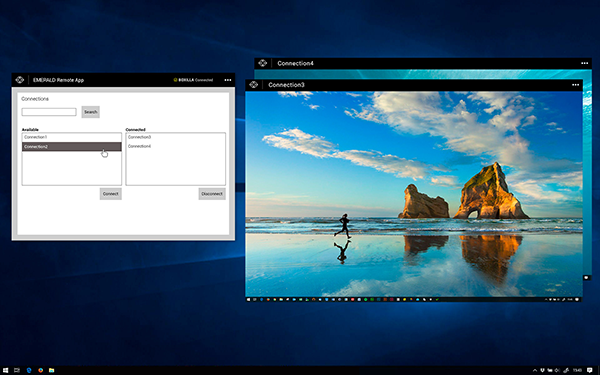
BlackBox – EmeraldRemoteApp
Telestream is clearly busy developing software for its customers and not suffering loss to in-house teams: “Telestream provides software-based test and monitoring solutions to the broadcast industry, and we believe that the media industry is moving fast and leveraging leading edge, best of breed solutions such as Telestream software and cloud products,” says Dan Murray.
“Professional AV installations frequently require or expect ‘software’ augmentation for control systems or monitoring,” says Diversified’s ET&S team. “This consists of customization of devices, e.g., Crestron or AMX systems – often found to be a requirement for certification or resale of those systems. Software to harmonize IP equipment – configurations primarily – is not especially common but may be required. Often this is identified by the systems integration team and then supported mainly by the vendor.
“DevOps is mainly confined to the end user, when applicable. Integration of those components developed may become part of a project (installation or pre-planning). Many of the projects that we lead have an inherent ‘need’ for a software solution to stitch many different products and services together. This can include functions of compatibility, a more cohesive user experience, or a function of the end user’s go to market strategy. We have established key partnerships in this space to respond to this need and consider this discipline a necessary function that will shape the SI offering in the next 12-24 months.”
Moving to the cloud
We asked our correspondents to reflect on their broadcast customers’ adoption of the cloud – is it now an unstoppable trend? “Broadcasters are still in the early days of adoption the cloud,” says John Hickey at Black Box. “COVID has accelerated exploration of the cloud, but the industry still faces many challenges around putting things into the cloud. There are latency and security elements to consider, and even copyright issues as content moves between buildings and onto third-party systems. Nevertheless, broadcasters are leveraging the benefits of the cloud today to achieve greater scalability and to ensure business continuity. In the coming five to 10 years, the cloud is the clear direction for the industry.”
For Telestream’s Dan Murray, the trend is also clear: “Telestream offers test and monitoring products on the cloud, as well as Telestream Cloud based monitoring services. Telestream believes the cloud can provide many benefits to broadcasters, not only for direct to consumer offerings, and that working with a trusted partner like Telestream Cloud to gain the benefits quickly in a proven environment to lower risks.”
Genelec has its own unique approach to using the cloud to the advantage of its customers: “At Genelec we have taken the cloud into use as an item in our acoustic measurement program,” says Lars-Olof Janflod. “The user can enter the cloud for the program, do the measurement of the room and our engineers can give advice based on the measurements stored in the cloud. By this we can offer the service remotely and we can also easily go 24/7 by involving our own people in the US, China, India, Japan as we then cover all time zones. In the time we have used the cloud the adoption rate has been good.”
“We recognize this is a growing requirement and realize that migration from on-prem services to hybrid cloud/on-prem is a future for many,” says the ET&S team at Diversified. “Cloud storage may become part of a secondary backup or processing system, however, because of the ongoing subscription or billing requirements of cloud services – this is primarily controlled and managed by the end user.”
Consulting and integration
IABM research shows that demand for consulting and integration is growing, although this is reportedly more IT-centric than it used to be. How are our correspondents managing this and the skills transition that the industry is undergoing? “Regarding consulting, this depends on the requirements or expectations of a particular project or RFP,” says Diversified’s ET&S team. “Consulting, for our SMEs or lead engineers, is not unusual. This varies from planning, budgeting or alternative configuration analysis to electrical engineering (grounding, interference) to architectural assistance in space planning and more.
“In the past 6-8 years, the level, type and consistency in providing consulting services has gradually been increasing. In some cases, the selection of a particular individual within the company is driven by past experience perceived or actually contracted for at the client (user) end. Services range from business (ROI) to long term (strategic) to specific requirements such product advisement or large-scale implementation or change in operational, delivery, or transmission and networking needs (e.g., Public Broadcasting entities).
“We’ve responded to this boldly by creating the Emerging Technology & Solutions speciality inside of our M&E practice. This consulting group has effectively ‘rolled up’ the top SMEs in our company spanning 2110, Media Workflow, Master Control, Production, and Workflow & Process engineering and provided our customers with a turnkey solution from front-end consulting (ET&S) through implementation (Traditional Diversified Design/Integrate/Support),” adds Jason Kornweiss, vice president and general manager of Diversified’s ET&S specialty.
For Telestream, consulting is a natural part of the way the company operates. “Telestream invested early in IP and Cloud products and solutions over multiple years, now leveraging that experience to assist broadcast and media industry customers in their IP and Cloud transition journey,” Dan Murray explains.
For Black Box, it’s still early days, but IT- and IP-based skills are more in demand. Says John Hickey: “As broadcasters migrate away from the traditional SDI KVM matrix to more IP-centric solutions, they want these new systems to integrate securely with standard IT systems, such as active directory login, email alerts, and SNMP traps, that help to manage other parts of their business. The skills transition to address this demand is still in the early days. While IT- and IP-centric knowledge and skills may represent a big learning curve for more traditional companies, they’re becoming more and more mainstream.”
Keeping the ‘door’ firmly shut
Cybersecurity is an increasingly important issue for broadcasters. How are our correspondents help them keep the ‘door’ firmly shut? “Cybersecurity is extremely important, particularly as broadcasters move toward IP and remote working,” says John Hickey at Black Box. “In the past, security was about locking the doors and not letting anyone in. Things have changed with facilities being linked together and with people working from home. Maintaining security in this environment is an ongoing battle, and to support customers using our KVM and AV solutions, we’re constantly performing security audits, upgrading the security in our products, and ensuring we’ve got state-of-the-art encryption.”
With its central role in building and keeping its customers’ facilities running, cybersecurity is central to Diversified’s work. “Part of our services specifically address this for individual customers, for security and/or government/defence (secure, intelligence) purposes,” says the ET&S team. “It is a specialized service, sometimes interleaved with specific RFP requests or may come out of an existing or recent contract – depending upon the needs for the services or from an awareness of our capabilities which were not previously included in a project.
“For broadcasters, when there are updates or greenfield builds, the networking components – if part of our scope – would certainly deal with security (e.g., firewalls, Internet access, access control lists, linking into software for real time uses, etc.). These needs become identifiable capabilities which may be offered in a project scope if not already provided by the end user/customer in some other form. We are offering security policy reviews as well as educating some of our clients on emerging trends that may impact their business, such as the impact of a remote workforce on security.”
What’s coming next in Support technology and workflows?
“IP Video networks are now being deployed in larger scale. Telestream announced the Inspect 2110 monitor solution to give video operations teams the visibility they need to operate their networks efficiently. Telestream continues to invest and introduce IP Video test and monitoring solutions, including introduction of 8K test solutions during 2020,” says Dan Murray.
“Telestream Cloud continues to offer new services such as the new Live ABR Monitor Service for on-demand automated spin up of monitoring around the globe. Telestream continues to expand Telestream Cloud and monitoring offerings. Telestream invests in technology to enable media companies to work remotely or increase operational efficiency. Recently announced GLIM which enables remote workers to play huge mezzanine files remotely, increasing efficiency of video staff to work from home,” Murray concludes.
“We’re seeing a lot of interest in solutions that simplify remote working, whether from home or a satellite office, and ensure security while supporting a high-performance experience,” says Black Box’s John Hickey. “We have focused a great deal of our KVM development around those requirements, and we’re also looking at how more automated workflows can help users to be more productive. We have refocused work with our partners and customers to determine how best to automate tasks so that life is easier for operators, and so they can focus on the show rather than orchestrating equipment and managing workflow. Another focus for us is bringing a real-time element to technical support. We’re enhancing our technology to make sure we can work with our customers quickly and security. If they have an issue or want to change configurations or need support, we can deal with those challenges, even across facilities and time zones.”
The ET&S team at Diversified has plenty of plans too: “We already offer support contracts and services in each of our project offerings whether new or updates. We have a global services division fully staffed with multiple NOCs, support ticketing and experts on call for various degrees of SLAs. Some of our divisions provide constant support and monitoring already – for example, digital signage for banks, large screen displays (Times Square, NYC), retailers, airports, etc. We support nearly 500,000 end points 24×7, and have extended those capabilities to all offerings in media and entertainment, ProAV, etc.
“Considerations for offering IP monitoring and remote support are being given using products which we already represent and/or resell. The concept is to offer “administrative class” support using specifically developed products that integrate with control, orchestration and COTS/IP/IT management components. We see these kind of offerings becoming a long term revenue generator, especially for those entities who cannot afford (or cannot find) the level of technical experience or talent necessary to support cloud, IP, security or other similarly related technologies,” the ET&S team concludes.
For Genelec, even as a hardware provider, the future is IT and software: “In the traditional hardware-business we were able to have our local business partners handle service issues. In the coming years with the increased complexity caused by IT and software related products the responsibility falls on our own shoulders. We realize that even for us, a hardware manufacturer for more than 40 years, the future is IT and software based and thus that is what we are planning for.”
Final word on the future goes to John Hickey at Black Box: “If we look at the business landscape and the market now and into next year, we see COVID accelerating trends that already exist in the marketplace. Companies need to deal with challenges such as remote working and invest in supporting them sooner than they may have wanted to at scale. Virtualization is another clear trend we expect will continue, and we’re working to address both these challenges while taking the burden of workflow management and orchestration off the end user. It’s almost as if we’re trying to make our KVM systems disappear into the background as our customers go about their day-to-day work.”
Diversified ET&S Team Contributors: Jason Kornweiss, Vice President & General Manager
Karl Paulsen, CTO
Bob Timpone, Senior Solutions Architect
Tom Michaels, Senior Program Manager