M2A Connect helps Spark Sport gain operational insights and content delivery efficiency

Spark Sport is a premium live and on-demand sports streaming service in New Zealand.  Launched in 2019, the platform offers a wide range of live and on demand content such as New Zealand Cricket, English Premier League, England Cricket, NFL, MBA and more. The streaming provider also streams channels such as NBA TV, MUTV, LFCTV, EDGE TV & TAB Trackside, through which sports content is available to viewers around the clock.

The Challenge

As an OTT platform, owned and operated by New Zealand’s largest digital services provider Spark NZ, Spark Sport needed infrastructure to manage, record and preview its licensed sports content. The team at Spark Sport sought greater visibility and operational control of its live sports transport throughout the supply chain.

Already using AWS Cloud infrastructure, Spark Sport was looking for a live video IP solution that wrapped around AWS Elemental Media Services and offered them scheduling automation, the ability to monitor streams in a meaningful way and control their cloud transport costs.

The Solution

Head-quartered in London, the team at M2A Media has been developing cloud-based video solutions for global rights owners and broadcasters since 2012 and is well versed in helping emerging OTT platforms achieve their ambitions of reach and growth.

M2A CONNECT, the company’s latest live IP-video transport product, was the light-touch solution Spark Sport needed to power the delivery of sports content from its global rights partners at a competitive price point.  Driven through the intuitive M2A Console, M2A CONNECT also affords Spark Sport security, reliability and ease of use.

The M2A CONNECT solution ingests redundant copies of livestreams into AWS Elemental MediaConnect in two Availability Zones providing an orchestration and oversight of the inter-regional routing between AWS regions.

All sources and proxy feeds are made available through M2A CONNECT via AWS MediaLive and MediaPackage, with the Console exposing monitoring metrics and health status of all streams. A full channel schedule can be added via the M2A CONNECT API, or the M2A Console provides an intuitive user-friendly interface allowing operators to easily schedule events. M2A CONNECT orchestrates the activation and halting of AWS infrastructure according to the events schedule, offering safety around provisioning time and over-runs as well as automated scaling as necessary. The final ‘Hand-off’ of the transport streams uses an AWS MediaConnect output in the agreed regions and AWS account.

Through use of M2A CONNECT, Spark Sport now benefits from dynamic automation of AWS Media Services, operational efficiency for high transport stream concurrency and operational insight via the M2A Console.

Conclusion

Through its advanced orchestration, M2A CONNECT brings a new level of ease to the provisioning of cloud infrastructure for live video transport, making it the perfect solution for sports rights holders and broadcasters. Scaling capacity up for knock-out rounds, scaling resilience up for tentpole events, and scaling all down for mid-week or season end have never been easier, and those last-minute deals no longer necessitate the round-the-clock working to deliver.

“When Spark Sport launched, its ambition was to revitalize sports delivery in New Zealand.  M2A Media is the perfect partner with the perfect solution to do just that. As a smart orchestration layer on top of AWS Media Services, M2A CONNECT is helping us future proof our broadcast operations.” Andrew Martin, Operations Lead at Spark Sport NZ

Keeping your distance: remote production and benefits for the sports market

Ronen Artman

VP of Marketing, LiveU

There have been many, many words written recently about remote production, indeed the wider world of remote working generally, spurred on by significantly increased use during the pandemic. But remote production didn’t suddenly spring up overnight, either as a concept or reality.

Let’s step back first. We’ve seen huge growth in the use of IP bonding across sports, especially in the last five years: from single-camera streaming to complex, multi-camera productions, often on the move. From the Rugby World Cup, where LiveU technology was used not only to gather content but also as a disaster recovery solution by ITV Sport, to the FIA World Rally Championship, Austrian football and facilitating coverage of the Spanish lower leagues, the list goes on.

Accompanying that growth has been the rise of remote production. Why is that? What are the benefits?

Even before it was really called remote production, we saw our technology being used in this way because of its fundamental IP basis. We have worked with production companies and sports broadcasters on multiple projects and have come to understand a wide range of remote production scenarios and therefore requirements moving forward.

Today remote production/At-home production/REMI is changing the way we produce live sports. The days of sending a full production crew and truck for a live show are fading. Even across tier-1 sports, the cost and cumbersome nature of satellite/fibre connectivity is being questioned. Remote production delivers a very high-quality viewer experience while organisations are able to send only the minimum amount of equipment and crew required for a sports event (and beyond) and produce the content from a central studio control room in lieu of an on-site production truck. The on-site crew is likely to consist of camera operators, an engineer, and an audio operator, while back at the studio the director, technical director, producer, talent, graphics and replay operators, and primary audio operator create the finished production. Combined with the inherent flexibility of the wireless camera approach that IP-bonding allows, this means a new era in sports broadcasting is upon us.

Remote production brings multiple benefits. Fewer staff on-site means significantly reduced costs. But it also means that sports broadcasters/streamers/production companies can concentrate far more easily on achieving the dynamic coverage – as well as additional fan engagement material – that they need to in order to compete.

This approach also greatly reduces set-up time at a given venue given the wireless nature of IP-bonding technology. It also allows for a greater re-use of both technology and people. Sports broadcasters can assemble their “dream team”, both on the technical and presentation side of things, and because they’re not having to travel to venues, they can cover more events much more efficiently. Commentators for more niche events can be hard to find, so having them able to commentate from their homes, for example, is a significant advantage. And, as mentioned, the same core, centralised technology and studio setup can be reused across a far, far greater number of events. Some broadcasters can cover hundreds of events per year.

By streamlining productions, significant cost and time savings can be accomplished using IP-based remote production, provided the correct technology is implemented and guidance sought from those with the required expertise. Organisations report that the remote production model has reduced production costs between 40 and 70 percent.

Scott Rehling, President of production company L2 Productions, attributes his booming business to the adoption of an At-Home Production workflow featuring LiveU portable transmission units, allowing the company to produce more events with lower overhead costs. He says, “Ten years ago, all of our sports were covered with a traditional truck and satellite. Over the last four years 90% of our work has changed to REMI/At Home productions.”

It's all very well and good reducing costs, but you need the other side of the coin too: increased fan engagement. Television sports coverage today is all about creating quality content that engages the fans in a sustainable way. If you can engage fans, you can attract sponsors and advertisers. Sports broadcasting is a highly competitive field. IP-bonding remote production fosters further innovation via the sheer dynamism it allows, indeed, it encourages, bringing new angles to viewers in multiple ways.

Last year, EVERTOP, a pioneering sports production company in China, looked for a solution to deliver multi-camera remote production of the Chengdu Marathon, with high-quality synchronised feeds. EVERTOP chose the LU800 PRO4, LiveU’s new production-level field unit which supports four fully frame-synced feeds from a single portable unit. With native 5G transmission and HEVC hardware encoding, the unit bonds up to eight internal 5G/4G dual SIM modems for true reliability.

Remote production comes in all shapes and sizes. With production budgets usually quite low for tier 2 and smaller sport events, traditional broadcast transmission equipment, such as satellite and microwave, are simply not suitable. Covering the marathon from multiple angles, the LU800 PRO4 streamed fully frame-synced HD feeds of four cameras from the starting line. As Haitao Ma, Director of Production for the Chengdu Marathon, EVERTOP Ltd, said at the time, it was the synchronisation that was crucial to the success of the production. The signals were then transmitted back with low delay to EVERTOP’s production OB van, where the complete coverage of the event was produced. With support from China Unicom and China Telecom, 5G signal was available in the field; the LU800 combined both 4G and 5G connectivity to ensure optimal streaming conditions.

Japanese broadcaster WOWOW, which operates both satellite channels as well as streaming services, deployed LiveU technology to provide innovative, player-following coverage of the US Women’s Open Golf held in December, using multi-camera remote production.

WOWOW decided to significantly expand and evolve its coverage this year to increase viewer engagement, taking advantage of remote production capabilities and to help with adherence to pandemic restrictions. WOWOW deployed LiveU’s IP contribution solution with multiple units via its local US production crew with only two people travelling from Japan – a producer and audio engineer. All staff were regularly checked for COVID-19 and all social distancing requirements were adhered to.

WOWOW used four units – two for each player – to follow Japanese players Nasa Hataoka and Hinako Shibuno (who came fourth) around the course. This live coverage provided dedicated player feeds as they made their way round the Champions Golf Club, Houston, Texas. Those feeds were streamed on WOWOW Members on Demand on each player’s dedicated channel. They also had an on-site reporter and another LiveU unit at the compound to send the footage. The four feeds were sent direct from the course to WOWOW’s Tokyo Broadcast Centre, where commentary and graphics were added. Content from this coverage, along with footage from the world feed, was then also used on WOWOW Prime and WOWOW Live, the broadcaster’s satellite-based channels.

Yuko Toda, Producer, Sports Department, WOWOW, said, “By having dedicated channels to show all holes played by specific players, we hope viewers enjoyed watching golf in a new style. LiveU was very stable during the event and we used a very minimal delay that enabled us to use on-camera live talk between the commentator in Tokyo and the on-site reporter.”

Toda added, “10 years ago, the way we were doing this was shooting on-site, bringing the recorded hard disk to an SNG truck to transmit the footage to Japan. After receiving the footage, we then edited the highlights and finally broadcast it. Compared to those days, sending the live feeds from the venue to studio in Japan with a unit is amazingly easy and fantastic and it really expands what’s possible and does so cost-effectively. LiveU is making this achievable for us and we’re looking forward to trying more new things and rising to future challenges.”

We very strongly believe that in terms of remote production, we are only at the tip of the iceberg. An exciting future beckons.

Supponor moves to remote delivery

Steve Plunkett
Chief Product Officer, Supponor

Supponor enables rights owners to maximize the value of live broadcast Sports & Entertainment events through world-leading end-to-end Virtual Advertising solutions, allowing partner and brand communications to be targeted and customized for each specific audience segment. Steve Plunkett, Chief Product Officer at Supponor, talks about the challenges brought by the Covid pandemic, and how the company helped its clients move to remote delivery at breakneck speed.

2020 and the uncertainty of Covid-19 forced Supponor to accelerate the implementation of its longer term plans for remote delivery of its services – and while challenging to deliver under such a compressed time line, it has helped us to become a stronger company today. The pressure to continue to support our clients,  allowed us to innovate and develop our service offering to fit with the rapidly evolving demands of the industry. Sports broadcasting was luckier than some other industries, with live sporting events returning by the summer, helping to keep us productive and busier than many others less fortunate.

Creating and delivering Covid-secure workflows which would withstand the rigours of live event broadcasting was a challenging process. The Bundesliga was the first Tier 1 league to restart its halted season, and we were fortunate  that our virtual advertising services were considered an essential part of the league’s restart plan – but with that good fortune, came an incredibly challenging learning curve as we had to learn how to maintain our demanding level of service quality with only half our normal on-site crew due to restrictions in the allocation of on-site staffing slots.

Starting out ahead of the curve on our planned pathway towards remote or off-site production helped tremendously, but suddenly we found ourselves playing catch up as the industry has leapt forward five years in its adoption of remote production operations since the start of Covid.  The broadcast industry’s rapid shift requires businesses to iterate and innovate faster to release upgraded and new solutions at a much more aggressive pace. What used to take months to plan and introduce we now find ourselves handling multiple iterations of new technology deployment plans in a matter of weeks. Soon that will be days.

Ironically, for Supponor, pausing live sports worldwide helped with that acceleration. Like most companies in the live sports event industry, we have a typical weekly cycle. We have plans, we develop software, we add enhancements and new features, and then they are tested and deployed over the weekend, which inevitably leads to a debrief on Monday and an examination of how it all performed in the field. It’s almost a four days on, three days off cycle. But with everything halted, we found ourselves being able to work through and have a much more significant and smoother development cycle.

Was it ideal? Of course not, lockdown was a tough time for everyone. But we were fortunate to not have to lose any staff so that we could leverage the time away from production to accelerate our development processes and to build in extra capacity and new capabilities that are now proving invaluable as we emerge fully into the active part of 2021.

Remote production has been a huge part of that. We had to adopt software, processes and even hardware from the way it's been used historically so that everything we have done so well onsite for many years could be deployed fully remotely. There were powerful features already defined in our roadmap relating to remote production, that few of our customers were ready to embrace pre-Covid, and those were rapidly brought to the forefront as interest and demand grew. We had to develop components around software, and add in additional remote control and remote sharing tooling into our software stack as we found ourselves suddenly working remotely at events all around the world made all the more challenging with border closures and travel restrictions.

A good example of this was a live test we conducted on a match played in Colombia, South America last year. Nobody from Supponor was at the stadium, nobody was even in Colombia; everything was operated live from London where we were creating the virtually modified feeds. This would likely still have been possible without the Covid experience, but we would probably still have had people in the stadium as a back-up. It’s forced us to lean heavily on the technology and ensure its failsafe robustness in live operation.

A lot of it went further than we thought it would. It had always been theoretically possible to work from home and be driving virtual signage in North and South America, but nobody took it seriously pre-Covid. Now it is not only taken seriously, it has become the new normal in our industry.

Will that remain the case in the post-Covid era? We’re not sure. Some of the gains made by the widespread adoption of remote production will very much be part of the future landscape; the environmental and cost benefits are too compelling to ignore. But we suspect that will consolidate into a middle ground, where centralised production from dedicated facilities and production hubs becomes the normal workflow rather than people working from their kitchen tables. It’s good to have the ability to be able to do that hugely distributed home-based workflow, and who knows precisely what the future holds when it comes to the need to adopt bio-secure working practices. But we see the synergies of assembling staff together into centralised production hubs as being irresistible to companies and people alike as human interaction will still be valued. People will no longer unnecessarily travel from venue to venue, but teams in production hubs will produce several concurrent games in a single shift.

But the key here really is flexibility. We have built a very solid offering; the software is robust, our technology is reliable and production-proven — no-one else has 10 years of experience in the field with this. That allows us to be agile and respond quickly to market demands.

That has seen us in good stead during the pandemic, and it will see us in good stead in the future when we start to move onwards to deploying other new technologies. The sports broadcasting industry was brought to a dead halt very rapidly by Covid, but it has adapted with impressive speed and is already racing ahead once more.

Development in fields such as cloud-native deployments and Augmented Reality is, if anything, even faster than before and rapidly catching up with the progress made in remote production. As fans come back to stadiums, arenas, pitches, and racetracks around the world, 2021 and onward is going to be a very exciting period to be working in sports broadcasting, whether from a production hub, an onsite truck, or even on your kitchen table.

The Big Pivot: From Fans in Stands to Communities in Concert

How Sports Venues are Adapting and Thriving Despite the Effects of COVID-19

Energy, rivalry and victory—the trifecta of elements for an exciting match, no matter the sport. Over the recent years, these aspects have been key components in the sports venue playbook of innovation as they were faced with having to transform the way they did business. Their goal? To create an immersive, energetic and memorable experience that would not only entice fans to attend events in person but also leave them looking forward to coming back again.

Their rival? The home theater. With so many advances in broadcast and audio-visual technology ranging from enormous television screens that display HD / UHD content to the transition to IP-based infrastructures that make consuming that content even better, to the introduction of social media and over-the-top (OTT) livestreaming apps, more fans are choosing to stay home—enjoying the game from the comfort of their own couch.

Now it’s a question of how to achieve the victory. Just as any business looking to expand their reach and grow their operations, sports venues from near and far became laser focused on enhancing their product—or in this case, an experience—and diversifying their offerings.

Take for instance, Chase Center in San Francisco. This world-class entertainment venue is home to the NBA’s Golden State Warriors and boasts more than 64 LED video displays including the star of the arena—a massive center-hung scoreboard with almost 10,000 square feet of surface LED space—the largest center-hung display in the league. While home televisions have certainly increased in size, they’re still no competition for the billions of pixels that immerse and excite attending Warrior fans. The entire video display package places a strong emphasis on giving fans all the information they could want from who is in the game to video replays and common stats—information that is fed from an all-IP video production control room engineered and integrated by Diversified. Finished just before the 2020 season, this upgrade was sure to bring broadcast-worthy event production in-house to the 18,000 fans in the venue, achieving the Warriors’ goal of exciting and engaging crowds with experiences they just could not get at home.

However, enter 2020 and the global pandemic—an opponent nobody wanted or expected—and the playing field quickly and dramatically changed. Even if fans wanted to attend, stay-at-home orders made that next to impossible. According to a recent interview with co-owner Joe Lacob, “The Golden State Warriors are losing 70% of their expected revenue without live fans.”[1]  What’s more, NBA commissioner Adam Silver has stated that about 40% of the league’s revenue comes from having fans at games2, and this is just one of the many sports leagues around the world to consider. With numerous, substantial venue investments slated to come online in 2020, the way in which owners and management would pivot to keep delivering those fan experiences would prove to make all the difference.

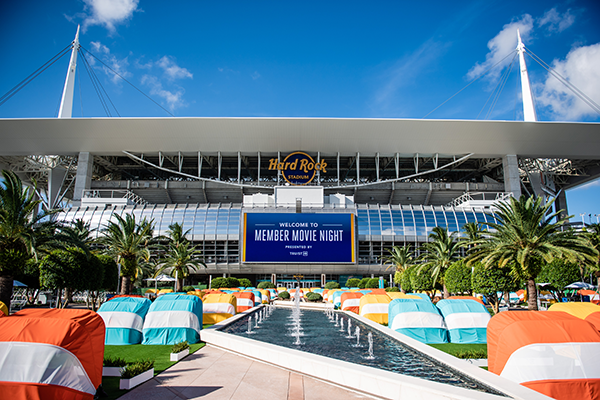
Knowing that a single sports season only lasts a few months, many venues were already seeking new ways to attract fans year-round even before the pandemic hit. Some venues go with concerts, others build in transformational pitches to accommodate two completely different sports. At Hard Rock Stadium, the venue’s primary mission is to provide a gathering place for the NFL’s Miami Dolphins to play and fans to cheer them on. Still, even in a “normal” world, the football season only lasts for about six months, leaving the stadium unused for the remainder of the year. For this reason, Hard Rock Stadium began to seek new events that would attract additional audiences, starting with the Miami Open tennis tournament that debuted there in 2019. Just months after the Dolphins wrapped up their regular season, the same space and campus around it was replaced with a tennis facility to rival just about any tennis venue seen on a major tour.[2] These kinds of transformations don’t just happen, though. They require thoughtful design when building or renovating, which Hard Rock Stadium underwent in 2016 to prepare for such occasions as well as being the host of Super Bowl LIV.

Of course, a big part of what should be considered in those designs is the technology—how will the audio be impacted? Can the control room seamlessly transition to support completely different content? According to Diversified’s director of AV and sound, Justo Gutierrez, “The first part of designing a sound system for a multi-purpose outdoor space is to understand the space itself so we know where loudspeaker coverage is needed.” Fast forward a little less than a year after the Miami Open and roughly a month after their big Super Bowl debut, and the stadium found itself in a much different situation but with the same goal in mind—keep a sense of community at the venue while creating memorable experiences in a safe environment.

As the first public facility to earn the Global Biorisk Advisory Council’s STAR accreditation, the standard used for facilities to implement cleaning, disinfecting and infectious disease prevention work practices, the Dolphins have been nothing but innovative in finding ways to stay open during the pandemic. Hence, their announcement in May 2020 unveiling both an outdoor drive-up theater inside the stadium and an open-air theater on their fountain plaza that would be used to show classic movies, marquee games in team history, commencement ceremonies, concerts and more.[3] “The inspiration for the outdoor theater really came from our Vice Chairman and CEO, Tom Garfinkel,” says Kim Rometo, Vice President and CIO of the Dolphins. “As the pandemic set in, he wanted to create a space that was socially distanced and yet still had a communal feel and so the outdoor theaters of Hard Rock Stadium were born.”

The venue started working with Diversified to utilize what they had already implemented years prior to provide maximum flexibility for the space including propagating audio all the way to the back and still filling the space with sound, as appropriate. The result is a space that can accommodate anything from live speakers or a band to a movie night, all contributing to an impactful experience and sense of community that otherwise could have been lost.

So, what’s the key to this victory? Similar to the teams on the fields, it’s agility and flexibility—words that have come to mean so much in our new normal. As more venues navigate the reality of downturned attendance and audiences awaiting herd immunity from the vaccine[4], they will need to be agile and flexible. Agile in how they reach their fans. Flexible in how they approach venue designs. Just as how we used to do so many things in our “pre-pandemic world,” the blueprint for what a sports stadium used to be has been tossed in the shredder, making way for the future of fan engagement—expanding how, when and where you engage with them from just on game day to potentially every time they’re looking to be entertained.

[1] Yahoo: https://www.yahoo.com/now/warriors-losing-70-revenue-covid-194414026.html

[2] Miami Dolphins: https://www.miamidolphins.com/news/stephen-ross-tennis-vision-becomes-a-reality-at-hard-rock-stadium

[3] ESPN: https://www.espn.com/nfl/story/_/id/29225313/miami-dolphins-open-drive-theater-hard-rock-stadium

[4] Sportico: https://www.sportico.com/business/commerce/2021/fan-experience-covid-poll-1234621300/

BLAST teams up with EVS for complete Esports production environment

Latest EVS VIA and Media Infrastructure solutions underpin BLAST’s new mobile esports production flypack

BLAST the global esports media network delivering world class entertainment experiences, has selected EVS’ market-leading VIA and Media Infrastructure solutions as the backbone of its new esports production flypack. The mobile solution is designed so that BLAST can produce its own live gaming events in-house. With the Covid-19 lockdown impacting mass gatherings, the flexibility of the EVS live production workflow is enabling the esports giant to put on online-only events instead.

Powering coverage of all BLAST Premier tournaments’ live-action is EVS’ XT-VIA and XS-VIA production servers, designed to meet the most demanding live broadcast requirements. The XT-VIA servers will deliver the power required for BLAST to record and produce live replays and highlights from the players and observers, while the XS-VIA servers provide ingest and delayed playout of the TX feeds for betting requirements. The turnkey XT-VIA solution includes 36 Full HD 1080p channels recording all the player feeds and in-game action. EVS’ next-generation IP media sharing network is at the heart of the system, enabling faster, more efficient live media sharing and storytelling by all client users.

Overseeing this infrastructure is EVS Media Infrastructure’s highly advanced broadcast control and monitoring system Cerebrum. Deployed by BLAST’s crew to configure and manage all SDI workflows within its production environment, the EVS system manages all devices in the flypack, including the router, multiviewer, vision mixer and audio desk. Cerebrum also handles UMD and Tally for the entire system, including the XT-VIAs built-in multiviewers. And it provides customizable panels that can be designed to BLAST TV’s specific needs with production configurations that allow to easily save and reload various types of events.

EVS’ all new IP-based replay and highlights system LSM-VIA will also extract maximum potential from the next generation XT-VIA servers to create super slow-motion in-game replays and support studio analysis. By providing direct access to all the content on the network, LSM-VIA will streamline BLAST’s workflows so that its crew can focus solely on delivering live storytelling with the highest production standards.

Delivering fast-paced esports content to live audiences is no easy feat, which is why the BLAST team opted to use EVS’ live production asset management (PAM) solution, featuring dynamic applications for live media content browsing, control, edit and playout. The team has also chosen to use EVS’ web browsing tool, which extends its capabilities to access, browse and select content regardless of location, as well as publish multiple in-game clips to their social media engaged fans. Part of the workflow’s speed is also due to certified integration with Adobe Premier Pro, allowing BLAST editors to instantly access clip elements made available by EVS’ Live PAM suite.

The backend resources of the EVS Live PAM Production Asset Management are hosted on EVS’ virtualization platform, providing flexibility and agility in operating a scalable infrastructure and offering cost-savings on power and much needed rack space. The EVS solution also offers extended file exchange, backup and transcoding, which is more than convenient when publishing clips and highlights to Twitch and social media, and simplifies the transfer of content inside demanding esports environments.

“Our priority is delivering world leading esports entertainment to our audience, in both pandemic and non-pandemic times, so partnering with a cutting-edge technology provider like EVS makes perfect sense,” said Andrew Haworth, Director of Operations & Production at BLAST. “EVS’ approach to this project has been incredible, understanding our unique challenges and then working through detailed technical workflows to allow us to produce however we want and beyond.”

“BLAST was faced with a unique combination of challenges. These required it to adapt to new ways of producing large-scale live esports events while still providing the high level of quality and engagement its fans expect,” said Nicolas Bourdon, Chief Marketing Officer at EVS. “Our high-end live production solutions along with our new range of control and monitoring tools raise BLAST’s operations to the next level with greater speed, control and flexibility.”

Switch on the audience

How Never.no’s cloud-based platform Bee-On powered the conversation for ITV’s The Martin Lewis Money Show Live.

A lot has happened over the last 12 months, particularly with how broadcasters have had to adapt to changing viewer habits, as content providers fight for viewer ratings, while the audience consumes content on up to three screens at a time. One mainstay on our TV in the UK is ITV’s Martin Lewis Money Show Live, the go-to money advice-show that’s helped the nation understand complex financial changes during the pandemic. Producers have harnessed the power of the audience on social media and created a format that puts viewers at the centre of the show, while they sit at home watching intently on their TVs and follow the conversation on their phones.

When the pandemic hit and the audience and production teams had to stay indoors, ITV decided to broadcast a special Covid-19 episode to talk about financial management during the pandemic. In a rapid change to scheduled programming, producers had just 48 hours to create a format that worked without a studio audience, who were usually the centrepiece to the show’s narrative.

Part of ITV studios, production company MultiStory Media looked to bridge the gap between the viewers and host, Martin Lewis, to engage conversation and respond to viewers’ current financial issues. Following the previous success of using Never.no’s audience engagement platform, Bee-On for ITV’s Peston, the cloud-based content management platform was integrated into the virtual production workflow and setup to power the conversation of the one-off live programme. Jump forward to present day and the one-time Corona Virus special turned into multiple and a 20-episode series was commissioned in September 20

Using #MartinLewis to create the conversation on Twitter, viewers tweet questions and opinions in the hope to get covered over the 30-minute broadcast. Producers gather the best of the viewers’ tweets and line it up on the Bee-On timeline. Working with pre-made native broadcast graphics, the platform pushes the content, in real-time, to a large screen in the studio, where Martin Lewis and co-host Angellica Bell follow the conversation.

Anthony Chuck, the MultiStory Media production manager on the specials said “The team at Never.no were so supportive in the fast turnaround nature of our production. Offering remote training sessions for our production teams and support throughout the whole process. The system worked without a glitch and the software assisted us in being able to successfully execute a central part of the programme.” Based in London, Cardiff and Manchester, MultiStory Media have delivered multi-award-winning current affairs, entertainment and documentaries, including Come Dine with Me, Paul O’Grady: For the Love of Dogs, 63UP and Death Row: Countdown to Execution.

Managed through a web browser, Bee-On’s full access to the Twitter API enables the production manager to simply moderate all conversation directed at the show. Picking out the best content and most relevant questions, the team can moderate content to ensure rude or insulting content doesn’t slip through on air – an important requirement for a pre-watershed live show. In the latest series, producers were keen to gather the opinions of the audience through weekly polls across the show’s social platforms; Bee-On was set up to aggregate results and broadcast graphics were added to package the results on the large screen.

“The specials were very well received, so we were excited that a tenth series was commissioned. It’s been a really tough time for all of us; Martin Lewis has strived to help everyone understand complicated financial policies, so we wanted to make sure that viewers were at the centre of show, as it’s all about them. We reach over one million followers on twitter, so featuring weekly polls gauges a highly represented opinion of the country and enables us to produce creditable content. It’s so simple curating audience generated content and publishing into a live broadcast with Bee-On alongside our graphics engine by Kenziko,” said the show’s current production manager, Sarah Bishop Fenn.

It’s no mean feat to create a trending topic on Twitter, but the show does this weekly! Following the Corona Virus special, #MartinLewis began trending on Twitter and became the third highest most talked about topic in the UK during the show. With conversation heating up, #MartinLewis continued in the top-five rank for the next five hours as the host jumped on Twitter and continued answering questions. Big issues such as ‘work,’ ‘holiday’ and ‘mortgage holiday’ were significant in the conversation, which also included ‘NHSWorkers’, ‘credit’ and ‘refund’.

During a time of lock down, MultiStory Media with ITV, created and broadcast a show where the audience is key to the narrative. By utilising social media powered by Bee-On, the audience are able to engage even more than they would have in the studio.

Verizon Media: Protecting your OTT streaming service from cyberattacks

The global video streaming industry is a multi-billion-dollar market that’s enabled streaming services of every size to succeed. Yet, with great success comes new risks and responsibilities. The rapid growth of streaming services means that they are now not only home to high-value content but, in some cases, data from millions of customers. Cybercriminals now see streaming services as a treasure trove and are eager to mine premium content and users’ data including, customer payment details, email addresses, physical addresses, and names. Inevitably, the more successful a streaming service is, the more personal data it has, which makes it an increasingly attractive proposition to cybercriminals because they have a greater surface area to attack. Growing pains in these organizations can lead to an increase in cyberattacks that take advantage of the vulnerabilities specific to OTT platforms and technologies.

Nobody understands the extent of cyber attacks better than Hollywood. During the recent launch of a popular streaming service, hundreds of thousands of users complained that they had lost control of their accounts. It appeared that a credential stuffing attack on authentication servers had put many customer accounts into the hands of hackers who attempted to resell access to the streaming service. This example illustrates that no service, large or small, is invulnerable to hackers’ increasingly sophisticated attacks. To shine a light on this pertinent issue, Verizon Media commissioned a survey in 2020, surveying security professionals at streaming and OTT service companies. Participants included broadcasters, publishers, studios, content owners, D2C platforms, aggregators, and sports leagues. The findings informed Verizon Media’s report entitled Protecting your OTT streaming service from cyberattacks, which examines the perspectives of technology executives responsible for securing over-the-top (OTT) streaming services. The report provides readers with a deeper understanding of the risks, the techniques cybercriminals use to exploit vulnerabilities, and the latest security solutions––and the emerging technologies confronting a new set of cyberspace challenges.

Every single streaming service has the potential to attract unwanted cyberattacks from cybercriminals. The most common cyber attacks include:

  • Application attacks: cybercriminals exploit vulnerabilities in the application architecture and software code that may or may not be publicly known.
  • Distributed denial-of-service (DDoS) attacks: these types of attacks use artificial traffic to disrupt a site or service, making it inaccessible or slow to respond to legitimate users.
  • Credential stuffing: hackers exploit the fact that people tend to use the same username and password combination across multiple accounts. In such an attack, the hackers can buy huge lists of stolen credentials from the dark web and use automation to try each one to gain access to the target service.

Although these attack types differ, they are often used in a coordinated fashion. Our survey found that most streaming services have probably already suffered from one of these security breaches:

  • 80% of our survey participants said they are not prepared for DDoS and Application Attacks
  • 50% said security breaches had degraded their service’s user experience,
  • 30% of respondents said a security breach that had caused a service outage
  • 14% said of respondents said their content had been misappropriated

It is not surprising that few respondents felt fully prepared for a security breach. Cybercriminals are rapidly evolving their approaches and tactics in their pursuit of premium content and customers’ data. Consequently, cyberattacks are increasing in severity and frequency and the survey reflects the market’s vulnerability. Even those streaming services with a robust defensive solution in place must continue improving and evolving their defensive stance because cyber attackers will continue to look for vulnerabilities relentlessly. Companies can keep pace with the increased sophistication of cyberattacks by adopting more cloud-based solutions. Our survey found that 30% of participants are planning to move cloud-based security solutions in the future to help minimise security breaches. Moving more solutions into the cloud and CDNs provides streaming services with greater scalability and reliability and lower operational costs than on-prem solutions.

Advancements in technology mean that cybersecurity has become a high-tech game where criminals innovate their attacks faster than most IT organizations can adapt their defences. The days of implementing solutions using a whack-a-mole approach and focusing on one cyber defence while ignoring others are over. Hackers use multiple attack approaches, and there is little point in closing one security hole if another is left open.  Streaming services need to work with security experts to identify gaps between their security priorities and their preparedness, evaluate new security approaches, and then leverage a coordinated set of cloud-based solutions that work together to bar all entry points.

Download this report to benchmark your streaming service’s security preparedness compared to your peers’ and use the data to examine risks and actions you can take to protect your content, user data, and reputation. Cybercriminals are always looking for new ways to undermine your business, and the best line of defence is to take a comprehensive and coordinated approach to cybersecurity solutions. The report can be downloaded at https://www.verizondigitalmedia.com/report/ott-security-report-2021

Book your free live streaming anti-piracy consultation

Live streaming of sports, eSports, and other events has become ubiquitous. While great for fans around the world it exposes the most valuable content to online theft. Do you know what to look for when evaluating anti-piracy services for live streaming? How does DRM, forensic watermarking and app shielding work? Book your free consultation with a security specialist to help determine the vulnerabilities your live services may be exposed to and, above all, what to do about it.

Book yours now!