
In this IABM TV interview, we speak to Chang Li from Accedo, winners of the BaM Awards® ‘Consume’ category.
In Conversation with Vislink
In this IABM TV interview, we speak to David Edwards and John Ellerton from Vislink, winners of the BaM Awards® ‘Connect’ category.
Friend MTS – 10 Questions to ask a video watermarking vendor
So you need to choose a video watermarking solution to best protect your revenue. How do you decide which solution, and which vendor, are the right ones for you? When choosing a content protection company that offers video watermarking, as a broadcaster or service operator you need to determine which solution is most suitable for your content protection needs. Of course, there are a large number of factors that affect this decision, but here are some questions that you should ask all of your prospective vendors to determine whether their watermarking solution:
• Is viewer-friendly and pirate-unfriendly;
• Offers a universal and cost-efficient solution;
• And actually works!
Let’s look at what this actually means and what these must-ask questions are – we have selected 10 of them to help you guide your conversations with watermarking vendors to make sense of what is actually being offered and how it aligns with your content protection needs. Keep reading for a quick content fix or download the full ebook here.
Overcoming Performance-inhibiting Factors to Serve Gamers in Emerging Markets & Beyond
Experience is everything for gamers, yet there are factors outside of the gaming company’s control that will affect performance. In emerging markets especially, factors like relative underdevelopment of network infrastructure, fractured ISP landscape, and limited public cloud presence make it more difficult for gaming companies to ensure the kind of performance gamers expect.
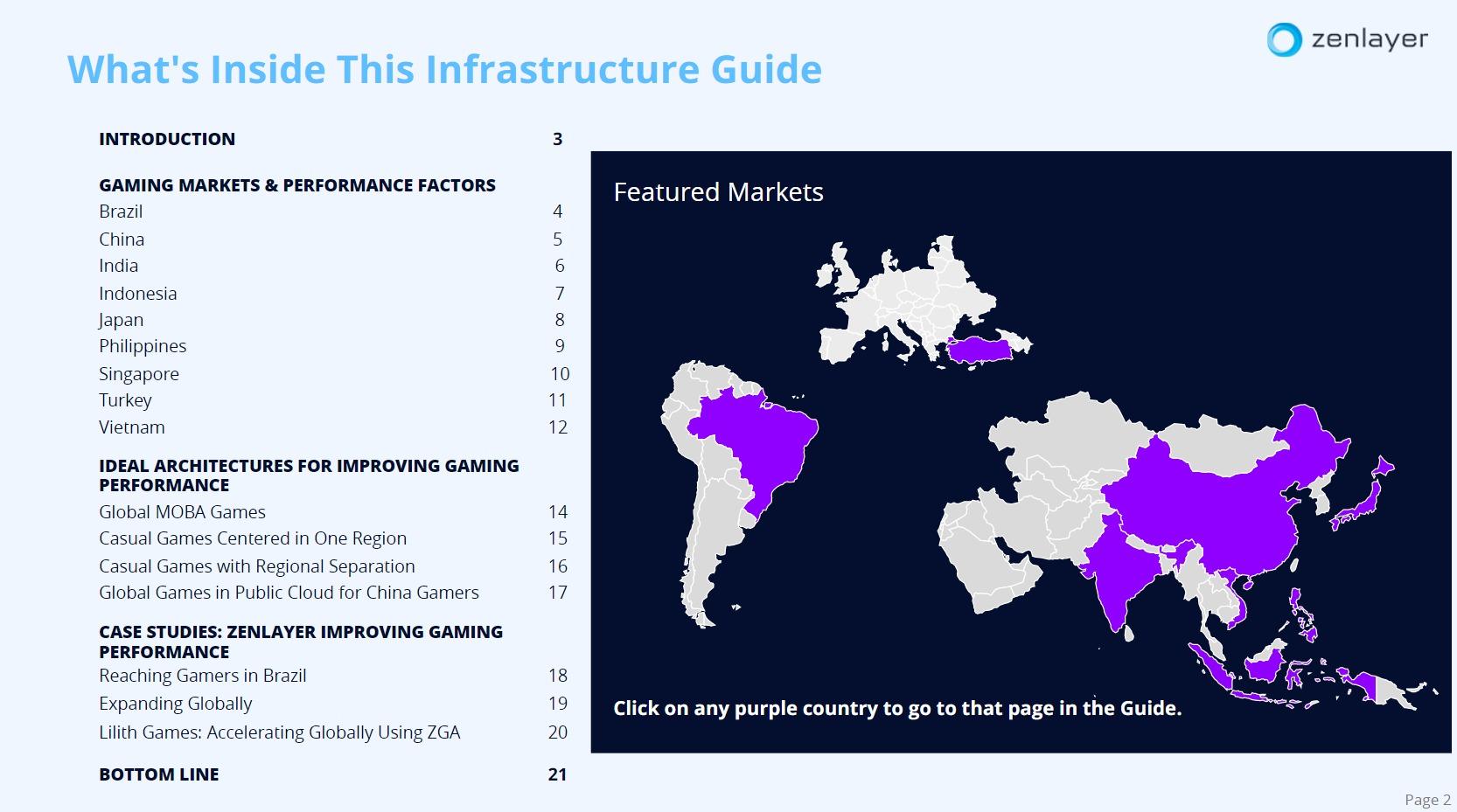
This Infrastructure Guide is authored by experts at Zenlayer who have been helping gaming companies deploy services in hard-to-reach markets for years. By reading the ebook, you will learn how some key emerging markets rate on performance factors and how Zenlayer's edge cloud services can improve gaming performance significantly. You will see specific examples of solutions to key gaming use cases architected for Zenlayer customers.
To view the interactive guide, click below:
Regional Spotlight: Europe
This Regional Spotlight on Europe summarizes key stakeholders and technology trends in Europe. It also introduces major business initiatives by European media companies reflecting changes in their long-term strategies. View the interactive report below.
Empowering Audience Measurement for UK Broadcasters_BARB-MetaBroadcast
BARB, the UK‘s television audience measurement provider, required a solution that would process and manage metadata to help them better identify and classify content into a standard genre taxonomy for measurement of viewing across TV, computer, tablet and smartphone screens.
View the PDF:
Empowering Audience Measurement for UK Broadcasters_BARB-MetaBroadcast
Adoption Trends: Artificial Intelligence and Machine Learning
IABM Adoption Trends reports annually track the adoption of specific emerging technologies within the broadcast and media sector. The purpose of these reports is to enable member companies to better understand what is driving the adoption of emerging technologies within customer organizations. This will provide member companies more insight to better address the challenges lying ahead, from new product development to marketing strategy. These reports contain a discussion on the state of adoption of a specific emerging technology in broadcast and media, as well as an analysis of significant customer deployments.
Highlights:
- AI/ML adoption is growing, reaching 32% in 2022. AI/ML adoption is enabled by the growing cloud adoption and accelerated by COVID-19.
- Manage and Produce remain the main deployment areas for AI/ML technology in the M&E industry.
- Most AI/ML use cases in content management systems are to automate routine tasks such as metadata tagging, image recognition, audio/video recognition, and speech-to-text.
- Data availability is growing, and the cost of data training is declining with wider technology deployment, resulting in more predictable ROI.
- Media businesses prefer internal deployment of AI/ML technology, which requires recruiting talent with specific skills, making talent scarcity one of the main challenges for AI/ML adoption.
View the interactive version below or click here to access the PDF.
IP KVM in media and broadcast

Jamie Adkin
VP Sales EMEA, Adder Technology
This is the age of multi-tasking and multi-production. Behind the scenes of every news, sport and live broadcast channel is a team of people who make the content come to life, and here in 2022, almost every aspect is driven by computer technology. These live production environments rely on multi-server, multi-PC and multi-monitor infrastructure, where people take control through our default peripherals; the keyboard and mouse.
Keyboard, video, and mouse switches (KVM) are a critical technology to enable users to access all the computers they need, instantly. The creation, production and management of content requires seamless collaboration between individuals, and across teams and departments. KVM seeks to support the content chain by facilitating these needs.
The role of KVM in broadcast
If we ask what the role of KVM is within the broadcast and media industries, there’s a straightforward answer: it instantly connects people with the computer access and control they need to perform their job, whilst meeting organisational needs of flexibility, space optimization and bolstered security. Compared to alternative approaches, it saves time, increases productivity, and reduces costs.
The seamless nature of KVM is a major attraction for both user and engineer. Fast, reliable switching breeds much-needed confidence in the middle of live programming. But the ‘Connected Experience’ is equally valuable. The defining sign of successful implementation is that once a computer is selected, the KVM is hardly noticed.
KVM has become such a staple of the broadcast and media operating model, that it has not just changed the way production teams operate, but has enabled the industry to keep pace with the changing demands of the consumer, while remaining flexible to fit around those doing the hard graft.

Built around the individual – and the team
An individual within a production team needs to work across a variety of studios in a broadcast facility. Equally, they need to collaborate with others using computers that must physically sit in a different location, like an apparatus room - a space dedicated to maintaining computer security, performance, and longevity.
As such, the ability for a KVM system to be designed as a footprint, not a floorplan, means agility and remote integration is put at the centre. In this model, the computers figuratively follow the user to where they need to work – not the other way around.
Workstation design has endless possibilities. Whether opting for multiple displays, or an adaptable multi-view setup on a single, high-resolution display, the workstation should retain one ergonomic feature - all computers should be controllable with a single keyboard and mouse.

Flexing to the modern workforce
The media and broadcast industries have – and always will have – a high proportion of freelancers and contractors across operations. The need for such flexibility has been exacerbated in recent years, and complicated further by the default nature of hybrid models as a way of working – employees aren’t only performing their jobs in their employer’s physical building; they’re doing so remotely too. This requires access management to protect high value content, and the right infrastructure to adapt to evolving requirements.
With the breadth of Adder’s KVM portfolio, it is possible to apply a uniform approach to the framework, together with customizable system access across a facility. This gives users familiarity and confidence, with increased reliability, the flexibility to grow and adapt the system to suit needs, and assured compatibility both now and in the future.
No compromise on quality
Media companies live and die on the material they deliver. Inadequate quality content is not an option. The technology backbone of any production house is critical to the commercial success of the business.
As such, VFX and post-production teams need pixel-perfect video. It is here where a high-performance IP KVM system comes into its own; companies can optimize their working environment for their artists while drastically increasing the efficiency and productivity of their facilities.
When we consider how media consumption has changed in the last decade, with hundreds of channels and VOD platforms competing for attention, then it is evident why rapid turnaround, where required, can be the difference between success and failure. The nature of KVM immediately flips this model. It allows companies to maximise usage of their edit suites and expensive computer resources. It reduces downtime. It makes operations concurrent, rather than subsequent.

The products for success
No two broadcast or media facilities are the same, and neither are their technology stacks. One of KVM’s greatest values for engineering departments is its ability to connect users to both the legacy and the leading edge. Recent innovations in IP KVM, such as the introduction of virtual machine access, or the ability to connect with broadcast control systems via APIs, provide engineers with even tighter integrations.
For users, new products such as ADDERLink INFINITY® (ALIF) 4000 series, mean video delivery of up to 5K resolution at 60 Hz across two screens is not an issue. Advances in technology have also enabled the use of extended color gamut via HDR10 – mandatory in all post-production environments.
When asked about the ALIF4000 series, John Stevens, director of engineering at leading Los-Angeles post-production house, The Foundation, said, “As a business, we have seen significant demand to supply HDR content to our customers. Many of our editors are now working outside of the studio, for example in mobile set-ups or home production, so a flexible workflow that supports the creation of both UHD and HDR10 content is more important than ever. Ever since we installed the ADDERLink INFINITY range, it has continued to be an IT stalwart. It has given us the flexibility to grow our business, and Adder’s continuous innovation has allowed us to adapt our set up to meet our everchanging technology needs. The fact that we can now benefit from HDR10 support and 10-bit color will help us continue to meet the needs of our customers.”

The Adder Ingredient
Overall, we have established that KVM is a versatile solution that can be used across the content chain. The evolution of IP KVM from the datacentre to broadcast control rooms and post-production facilities is driven by a desire to be flexible and efficient. As IP KVM has become the core of connectivity, customers are seeking platforms that are robust, resilient, and future-proofed. With 12 years of development and thousands of installations, Adder’s ADDERLink INFINITY® range continues to be just the answer.