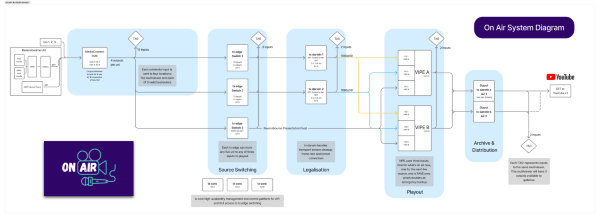
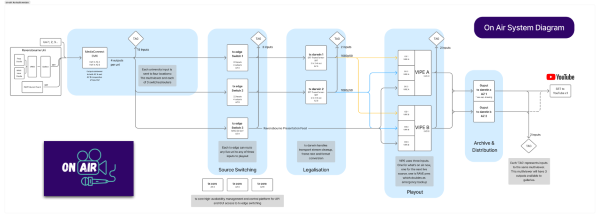
 The production leveraged existing broadcast facilities at various universities to simplify operations as much as possible. The SRT output was routed via AWS MediaConnect to the On-Air AWS environment. Techex tx edge was used to receive the signals and route them into playout. If frame rate conversion was required, the signal was passed through tx darwin, which utilised InSync's FrameFormer to convert to the 1080p50 house format. Playout was provided by Levira using the BCNEXXT VIPE playout system which loaded assets after compliance viewing in Tanooki. For onward distribution to YouTube, tx darwin was again used, simultaneously writing the output to a dedicated TAMS store set up specifically for the event to facilitate segment creation and highlight generation. Everything was overseen by TAG VS's monitoring and multiviewer software platform. A temporary control room including equipment from VizRT was built in a teaching room at Ravensbourne to host playout and MCR operations.
 On Air 2025: The Future of Media Talent – It’s Here!
Carrie Wootten
I am acutely aware as I write this piece that I am never going to be able to ever thank everyone enough or indeed include all their names in this article, as we had just under 1000 people involved. But please know as you read this that I have never underestimated your contribution or impact to this project.
Thank you. You made On Air 2025 happen.
On Air 2025 seemed to fly by in a matter of seconds, even though we had been preparing for the event for six months. Having now fully recovered from the crazy few days, I am incredibly proud of what the team and the international student network produced. What began as a small idea became something truly extraordinary: a 24-hour live global broadcast, created by over five hundred students from seventeen universities across six continents. It still feels surreal that we pulled it off – although I never doubted the extreme talent and capabilities of the industry professionals and students I had the immense pleasure to work with.
This project was always about building an eco-system to give students real-world experience while giving industry access and direct contact to the next wave of talent. On Air 2025 was designed to showcase the next generation of creative and technical talent while proving what’s possible when education, innovation and collaboration meet. What became evident over the months of preparation is that although this was the ambition, this wasn’t a training exercise; as Stephen Stewart reminded me, we were creating a fully-fledged TV channel, with editorial, scheduling, compliance, technical and operational issues to address.
And of course, issues did come up.
Niki Whittle was the glue that held us all together from the start – her deep understanding of technology, production and logistics were mission critical for this event. The brilliant Sarah Chase, Laurissa Yeung Shea and Paul Walsh were continuously adapting and changing the schedule as more universities and locations came on board. I think we started with around 10 and each time a new one was confirmed, I promised it would be the last – but of course it wasn’t! But when on 14th October, just 36 hours before we went live, Sydney let us know that they couldn’t broadcast live, they, and the amazing Levira playout team (Martii Kinkar, Sven Rekkaro, Victoria Butt), had to adapt again, but at speed. There were of course technical issues too on the test day – the brilliant technical team consisting of Russell Trafford-Jones, Tim Guilder, Simon Blunt, Kendrick Foo, John Biltcliffe and Scott Kerr were working flat out to test with every location, starting at 9am with Brisbane right through to Washington at 9pm. Whether it was frame rates, ports being opened, lip-sync or latency – it was all going on! And this was before the broadcast had even started.
In addition to this, we were also using innovative tech that is at the forefront of production. From Vizrt’s Flowics for our graphics, to Clear-Com’s Gen-IC, which provided our global intercom systems so we could communicate from playout to every international location – it was all vital. This was never truer than when implementing AWS’ TAMs too,using Techex tx darwin, where all the live studio feeds were ingested into an AWS S3-based TAMS store as one continuous, time-addressable source. Students working remotely were able to access the store through the Drastic plug-in, clipping highlights and social packages directly from the live timeline. Having innovative technology was a key element that I wanted to embed in the project wherever we could – providing students the access and opportunity to understand how the industry is evolving is critical to their integration into the sector once they graduate.
On this note, the Ravensbourne students were outstanding; they had a triple threat to manage. They were managing the 24-hour production, fulfilling all gallery and studio roles, as well as supporting playout. In addition to this they had their one hour of content to produce and deliver, as well as an Alumni event to film and stream too. A couple of them also grasped the opportunity to create the presenters’ script – and with the many changes right up to the last minute, they were ultimate professionals. It is probably a huge underestimation that they had little time to prepare! And some of them had only been involved in live broadcast a few times up until that point. But their dedication, talent and ability to adapt to continuously moving goalposts was phenomenal. A huge thank you to Tim Verrinder, Bill Hobbins, their brilliant team, alongside Howard Austin and his colleagues who all made it run so smoothly.
Perhaps one of the areas that I didn’t fully appreciate until the night the breadth of cultures we were showcasing on the channel. Moving as the sun rises across the globe literally gave us a moment in time to see the creativity and the stories from the people within every country. This also included the small segments with Rise Academy and CNN where we were able to bring in Primary and Secondary School children, giving them access and exposure to live television too – an element I am proud that we managed to develop in the schedule.
Following the sun gave us a visual guide to the world, all seen through young people’s eyes. It was powerful, impactful and joyous to see. The project started about global connections but what has emerged in addition to this, is connection through storytelling – which of course is always at the heart of our industry and why we do what we do.
A critical team I should also mention is our amazing presenters – they were the ones driving the energy of the channel, as well as representing its values and what On Air what trying to achieve. They were flawless at it. Perhaps one memory that will be for ever is when we needed to fill some time quickly and Suzie Cox started a morning stretch class with Mya – showing her off her Vogue Gladiator moves – priceless! And then when we signed off the broadcast at 1am on 17th October – Mya and Urban brought it together beautifully highlighting what the channel had accomplished and the memories from across the 24 hours.
The final few moments of the broadcast I will treasure forever – Charlotte Layton running around with the post-production students to get a recap to air, Sarah getting the streamers ready and everyone realising that we’d done it.
The power of collaboration, a shared goal and community.
Oddly I never really felt tired during the broadcast – I think it must have been the adrenaline (or maybe those jet-lag feelings from NAB helped?!). It definitely took me a good few days to be able to sleep again. Perhaps it’s because I can’t stop thinking about next time?
There are so many ways we can expand and grow On Air – the debrief has happened and plans are already underway for On Air 2026. If you would like to be involved, please let me know.
This is building the future generation of talent – something that you don’t want to miss out on!
On Air: bring on the talent!
Stuart Ray, IABM
If you are the sort of person who thinks to yourself: “I know what I should do! I should set up a 24 hour live global broadcast featuring contributions from University TV and Film courses from around the world, get loads of industry people and companies to volunteer their time and run it on YouTube” you are probably dangerously unhinged. Or you are Carrie Wootton.
‘On Air’ went live on YouTube on Thursday 16 October 2025. It only lasted 24 hours but it was one of the most extraordinary days in TV History.
The project brought together 17 universities and schools from six continents – each submitting up to an hour’s worth of content to be seamlessly woven together in a 24-hour broadcast managed out of Ravensbourne University in London.
The brainchild of Carrie Wootton, CEO and Founder of the Global Media and Entertainment Talent Manifesto, the concept was designed to showcase the incredibly talented young people representing the next generation of the Media Technology industry.
Starting at 1.00am UK time with a game show contributed by Griffith University in Brisbane, and culminating in the early hours of the following morning with California State University, the project was supported by a huge range of individuals and media companies who donated time, expertise and equipment.
Wootten explained the reasoning behind the concept: “We know that this industry is a global industry and if you’re a student we want to give you the best opportunity to build the peer-to-peer network you will be working with and collaborating with as you enter the sector. To have that opportunity at an early stage in your career seems like a really powerful thing to enable and empower students to have. We also know that industry wants to spot the best and up-and-coming talent – we’ve got skill shortages in particular areas – so industry can say ‘oh X in Mumbai you are incredible’ or ‘Y in Brisbane we saw your fantastic work and we would like to talk to you’ … then actually that becomes super powerful. What we’re trying to do is to create this global ecosystem that integrates fully students, tutors and industry so that we work as one and those gaps don’t exist anymore.”
Niki Whittle, Principal Product Manager with VizRT, was one of those who donated their time and worked as Delivery Lead. “My focus was on removing blockers, keeping everything aligned, and making sure all teams stayed in sync so we could successfully get to air. I saw this as a great opportunity to help students connect with the industry in a more meaningful way. I talk to a lot of graduates who are still struggling to find their footing, and there’s a real risk that they’ll move into other industries. If we can help them build connections earlier, not just with fellow students around the world but also with industry professionals, I hope it can ease that uncertainty and help them feel more confident in their career paths. It was also such an ambitious project, and I wanted to be part of that challenge!”
With 913 students, university staff and volunteers around the world contributing to the Production, the end credits lasted over four and a half minutes. Many IABM member companies donated time, equipment and staff to the project.
Another who volunteered their time in support was Scott Kerr, Lead Solution Architect for Sky. Scott was one of the Tech Leads on the project, though he “Did a little bit of everything where I could lend a hand – everything from having input on the design, setting up the control rooms and even preparing the graphics for playout and the end credits.”
Russell Trafford-Jones, Industry Engagement Manager with TechEx, was another tech lead on the project. TechEx supplied essential equipment as Russell explains: “tx edge, a software gateway from Techex, played a critical role in monitoring all incoming feeds and switching them into the playout system via tx darwin. tx darwin is Techex’s modular platform for live video manipulation which played two essential roles ahead of playout: Rebuilding incoming transport streams to correct timing errors ahead of decoding and format conversion. This allowed playout to run in our house format of 1080p50 and to deal with a whole range of encoders from a variety of universities.
“After playout, tx darwin wrote to a Time Addressable Media Store (TAMS) which played a pivotal role in allowing universities around the world to instantly access footage akin to a classic ‘growing file’ post workflow.”
Levira Media Services also provided physical and human resources to the project. Stephen Stewart, COO, explains, “Levira Media Services was at the sharp end, ensuring that all the multiple live feeds from across the globe (as well as the live studio inputs from Ravensbourne’s studios and event space) were delivered as a robust playout stream. This involved taking the signal hand-offs from AWS and Techex; working with the schedulers and studio crews; and reacting to live compliance instructions in the case of any live non-compliant content appearing from the universities.”
The project’s central hub was based at Ravensbourne University in London. Their students not only produced the whole 24-hour broadcast, they also contributed an hour of content themselves. Levira set up a playout control room and as Stewart reflected: “It was Levira Media Services’ first major broadcast project in the UK – starting with a 24-hour live broadcast with 20 outside sources from around the globe with multiple timezones, controlled via a university corporate and Wi-Fi network – and it certainly proved that the Levira platform and team is capable of pretty much anything.”
For all those involved the project proved an unforgettable experience. Third year Ravensbourne Digital Television Production student Suzie Morrow, who was a Script Supervisor and Co-Producer said, “This was a wonderful experience, and I feel as though I have gained a great deal! The On Air experience was a whirlwind journey, very fun but also very stressful at times. It was such an important test of my classmates and my skills, and it has taught us so much.”
Niki Whittle reflected, “I’ve learned so much myself, especially about the cloud platforms we used, and got to work with an incredible group of highly skilled professionals. We faced plenty of challenges along the way: cloud production realities verses the dream, logistical hurdles, last-minute university changes. But seeing it all finally come together, and seeing how proud the students were after delivering it, was truly rewarding. We had 24 hours of students and professionals around the world really championing each other, collaborating, and bringing that innovative spirit to life, and that’s exactly the kind of industry I want to see!”
Scott Kerr: “It was a fantastic experience – and certainly a big challenge with it happening over 24 hours. I think I counted that I was up for a full 43 hours in the end, which is something I will not be trying again in a hurry! The general feeling at Ravensbourne on the day was fantastic and seeing how students across the globe were working together, congratulating each other was a joy to see.”
“The event was such a positive experience and reinforced for me what we all know – that everyone is always learning,” said Russell Trafford-Jones. “The non-student volunteers were all pushing themselves out of their day-to-day comfort zone, either reprising roles they had earlier in their career or trying something new. And, of course, even with the decades (centuries!?) of combined experience on the wider team, dealing swiftly with all the problems that twenty four hours of live TV throws at you is always fun, never flawless and leaves you eager to do it all over again.”
For Stephen Stewart, “The thing that struck me most was the degree of respect shown by and between the students, as well as the industry professionals. In the whole 24 hours, I didn’t hear a single raised voice; a single cross word; or a single moan or groan. If these students are the future of our industry- I think it’s in safe hands.”
And what of the person whose original idea started the whole thing off? Wootten has already confirmed that ‘On Air’ will return in 2026 (you can read her own reflections opposite) and IABM will once again be offering our support. And we’d love to see our members getting even more involved next year.
The production leveraged existing broadcast facilities at various universities to simplify operations as much as possible. The SRT output was routed via AWS MediaConnect to the On-Air AWS environment. Techex tx edge was used to receive the signals and route them into playout. If frame rate conversion was required, the signal was passed through tx darwin, which utilised InSync’s FrameFormer to convert to the 1080p50 house format. Playout was provided by Levira using the BCNEXXT VIPE playout system which loaded assets after compliance viewing in Tanooki. For onward distribution to YouTube, tx darwin was again used, simultaneously writing the output to a dedicated TAMS store set up specifically for the event to facilitate segment creation and highlight generation. Everything was overseen by TAG VS’s monitoring and multiviewer software platform. A temporary control room including equipment from VizRT was built in a teaching room at Ravensbourne to host playout and MCR operations.