Cinegy – Breaking Down the Broadcast/AV Divide

Jan Weigner, CTO, Cinegy
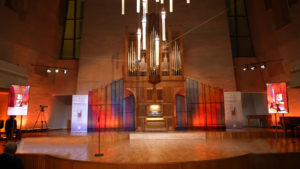
When we decided to install what’s likely the largest 8K LED wall at IBC2025, it wasn’t just about creating eye candy for our stand in Hall 7. Sure, we’ll be shamelessly promoting our products with it, delivering rapid-fire messaging to the thousands walking past on the escalators. But it was also about proving a fundamental point that the industry has been slow to grasp: the lines between broadcast and professional AV aren’t just blurring, they’ve practically disappeared.
Resolution is Just a Number
Here’s the thing about 8K that everyone keeps missing – it’s not about broadcast television. The majority of HD channels globally still broadcast in 1080i today. This creates an absurd situation where we’re producing interlaced content for flat screen displays that never supported interlace in the first place. Apart from some prototypes in museums, HD tube televisions simply never existed.
These standards persist not because they make technical sense, but because change costs money. Meanwhile, cinema after 4K will be moving to 8K projection. Event venues like the Sphere in Las Vegas operates at a resolution that make broadcast standards and 8K look quaint. Corporate venues, houses of worship, and live events are demanding display capabilities that dwarf what traditional broadcasters consider cutting-edge. The cameras exist – Black Magic’s 17K camera costs less than what broadcasters used to spend on a single lens.

The disconnect isn’t technical, it’s economic. Broadcasters won’t upgrade until they see clear revenue benefits. But content creators shooting today would be foolish not to capture at the highest resolution possible. You can’t go back twenty years later and reshoot that wildlife documentary when the species is extinct and AI upscaling does not perform miracles.
Where Innovation Actually Happens
Let’s be honest about who’s driving production standards today. It’s not the broadcasters, it’s Netflix. Camera manufacturers care about getting on Netflix’s approved equipment list, not what traditional broadcasters specify. Netflix defines post-production workflows, subtitling standards, and AI integration because they have the budgets that matter.
Most traditional Hollywood studios are still operating like it’s the 1930s, weighed down by nepotism and legacy thinking. Even basic technical decisions like shooting at 24 frames per second persist not because they’re optimal, but because change is hard and expensive. It is cheaper to call it the “film look”.
This creates opportunity. Professional AV installations want broadcast-quality capabilities without broadcast-industry constraints or timelines. They need 4K and 8K output (or more), flexible format handling, and reliable automation, but they also need the agility to deploy quickly and scale efficiently – in hours not years.
The Convergence Reality

What we’re seeing isn’t really convergence, it’s recognition that content delivery requirements have always been similar regardless of the destination screen. Whether you’re delivering to a smartphone, a broadcast transmission, or a concert hall LED wall installation, you’re dealing with the same fundamental challenges: format conversion, quality optimization, and reliable playout.
The difference is that AV installations don’t care about arbitrary broadcast standards. If you need 60Hz output in Europe, nobody’s going to penalize you. If your content library mixes PAL, NTSC, different frame rates, and various resolutions, you just need it to work, not comply with decades-old technical standards that made sense when bandwidth was expensive, and displays were primitive.
This is where software-defined approaches prove their worth. Instead of separate hardware boxes for every conversion and processing task, you get flexible software that adapts to whatever your output requirements demand. Scale from single channels to dozens without architectural changes. Handle mixed playlists with automatic format adaptation. Upgrade capabilities through software updates rather than equipment replacement.
AI: Beyond the Hype
Everyone’s talking about AI, but most miss the practical applications that actually matter today. Forget about generating entire videos from prompts: that’s interesting but legally and creatively challenging. Focus on fixed-function AI solving specific problems: real-time speech-to-text subtitling that outperforms human transcribers who rotate every 15 minutes in high-pressure environments.

Our real-time upscaling and format conversion capabilities exemplify practical AI implementation. Take mixed-format content: SD music videos from the 1980s alongside HD material, and output consistent, high-quality results automatically. No more watching legacy content that looks like “Lego man in a storm” because of poor upscaling.
These aren’t revolutionary capabilities, they’re evolutionary improvements that solve expensive, time-consuming problems. But they represent the kind of AI implementation that delivers measurable benefits rather than impressive demonstrations.
The Economics of Change
Industry consolidation is accelerating. Public broadcasters face funding pressures. Streaming services are cutting content budgets while raising subscription prices. Sports rights costs continue escalating. In this environment, operational efficiency isn’t optional: it’s survival.
Software-defined infrastructure addresses these pressures by eliminating the hardware upgrade treadmill. The same platform that handles today’s requirements scales to future needs without architectural replacement. Whether that’s supporting higher resolutions, additional channels, or new delivery formats, software approaches adapt rather than obsolete.
This matters equally for traditional broadcasters seeking operational efficiency and AV integrators pursuing new market opportunities. The technology requirements increasingly overlap, and the most successful organizations will be those that recognize content delivery as a unified challenge rather than separate broadcast and AV markets.
Looking Forward
Our 8K demonstration at IBC isn’t about convincing broadcasters to upgrade their transmission standards: that’s a business decision they’ll make when economics justify it. It’s about showing that the technology infrastructure exists today to support whatever resolution and format requirements emerge tomorrow.
More importantly, it’s proof that the same software-defined tools powering broadcast operations can drive immersive installations, corporate communications, live events, and digital signage. The screens may be different sizes, but the fundamental requirements: reliability, flexibility, and scalability, remain constant.
The future belongs to organizations that understand content delivery as a technology-agnostic challenge. Whether you’re feeding a traditional broadcast transmission or a concert venue LED wall, success comes from having infrastructure that adapts to requirements rather than constraining them.
That’s what software-defined television actually means: the freedom to focus on content and audience rather than technical limitations. It’s taken the industry longer than expected to reach this point, but we’re finally here.